Published : 27 Jul 2023, 01:47 AM
Updated : 27 Jul 2023, 01:48 AM


Nine months ago, tile setter Shobuj Ali dreamed of getting rich overnight. He spent Tk 160,000 on an app called 'Ultima' and, in a month, received Tk 8,000 in dividends at a rate of 5 percent.
Since then, he has not received any further payments.
The 23-year-old youth from the Purbapara area of Rajshahi City's Danshmari wasn't the only one snared. He got his family involved too.
Of the money Shobuj 'invested' in the app, Tk 40,000 was from his savings. He received the rest by taking out a loan from an NGO in his mother's name.
Like Shobuj, many others are tricked by apps that scam them in the guise of betting, gambling, gaming, investment, and casinos. Though such get-rich-quick scams have been operating for years, little effective action has been taken to stop them.
The government agencies involved are also reluctant to take responsibility, instead trading blame with each other.
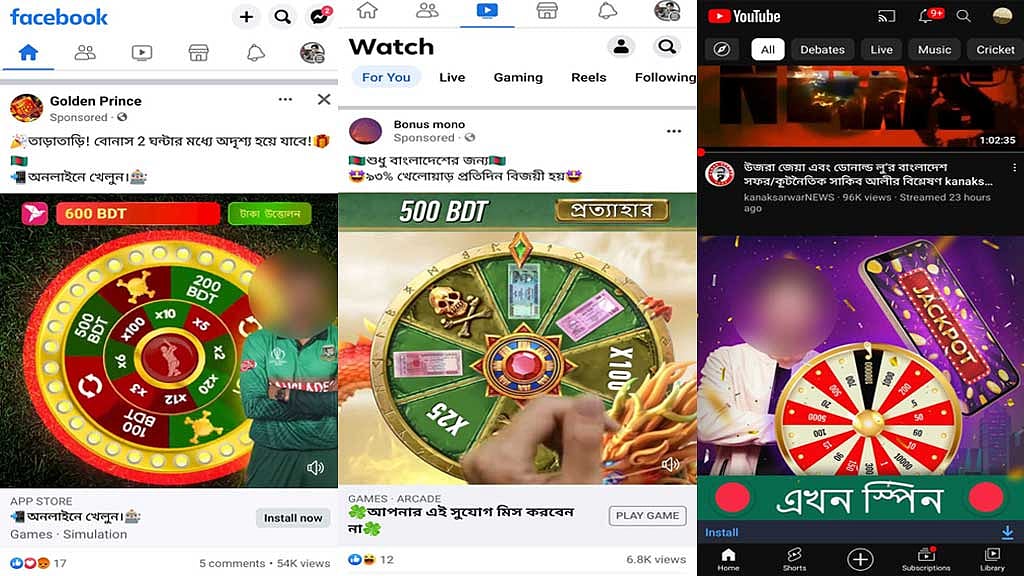
Several months of monitoring show that advertisements for such apps circulate on Facebook, YouTube, and other popular websites.
Customers fall for these scams by visiting web pages and downloading apps from the Play Store. Digital wallets are created without authorisation for money transactions.
Through manipulation, transactions occur using these wallets and legitimate domestic financial channels.
Several active scam companies have been identified through social media and speaking to their victims.
Some of these include Expert Option, Modern Income Assistance, Lasting Disguise, Big Lucky Bell, Gold from Olympia, Spin & Win, Victorious Bell, Plinko Adventure, Cash Box, Bigbook Win, Rich Olympus, Zucker Twins, Big Win Lucky, Rapid Cash, Onexbet, DreamEleven, Bet365, Wheel of Luck, Glory Casino, Bazi999, MTFE, and MovieApp.
These institutions and their representatives conduct transactions through mobile financial services (MFS) like Bkash, Rocket, Cash, OK, or Tap.
When asked about these scams, BTRC Chairman Shyam Sundar Sikder told bdnews24.com that it is Bangladesh Bank's responsibility to prevent any financial crime or irregularity.
He said if someone commits money laundering or any other financial crime on foreign apps or websites or in any other way, Bangladesh Bank will look into it.
However, Bangladesh Bank redirects questions to law enforcement. Law enforcement, in turn, spoke about legal and technical limitations preventing proper action.
THOUSANDS SCAMMED IN RAJSHAHI
Investment apps are so popular in the northern divisional city of Rajshahi that many have opened 'offices'. Currently, an app called 'MTFE' is the most popular in the city.
Rubel Hossain, one of the investors on the app, said, "If someone invests money in the app through me, a commission is credited to my account. The more investment you attract, the larger the commission you get."
"If I can get 100 people to invest this way, then I can have my own office, and my position will be CEO."
Rubel said that half a hundred investors of Durgapur Upazila have invested money in MTFE app through him.
Sabuj, who introduced himself as the CEO of the MTFE app in Rajshahi and also opened an office in the city, said, "You can call it the office of the MTFE app, and you can also call it my chamber. There are nine CEOs of this app across the country like me."
"No one is forced to invest money in that app. It is good for us if an unemployed youth gets a job through [this app]."
But tile setter Shobuj's experience is different. On Jun 20, he went to Mahbubur Rahman's 'Plating Coin' establishment in the suburb of Rajshahi city in sector No. 3 and found it closed. On June 26, Shobuj filed a case against 13 suspects, noting the names of eight members of the fraud gang. Later, the police arrested six people.
Like Shobuj, Ekhlasur Rahman (25), Liton Islam (28), Titu Islam (38) and Siton (25) 'invested' around Tk 2 million in the 'Ultima' app.
Similarly, hundreds of people have been cheated by investing hundreds of thousands of taka in another app called 'E-Movie'. A young man named Manik opened an office in the city's Shiroil in the name of the app and ran his fraudulent activities through there. He scammed over a hundred people from Godagari's Premtoli area. A case was filed against Manik at the city's Chandrima Police Station, and he was later arrested.
Rajshahi Metropolitan Police spokesman Rafiqul Alam said, "These apps are not approved in the country. Bangladesh's money is being smuggled abroad through the app. It can be shut down at any time."
"If anyone complains about being cheated, swift action will be taken. Two cases have already been filed over two apps that were shut down. Police have also arrested 10-12 people."
The police officer said the Rajshahi Metropolitan Police cyber crimes unit is investigating these matters.
SCAMS OF ALL SHAPES AND SIZES
Facebook and other social media are awash in tempting advertisements and links to sites that promise easy ways to make money. Many websites also advertise downloads of these apps.
A deposit is taken from the customer using the agent number of a mobile financial service. In these cases, money has to be sent to an agent number of an MFS using the cash-out option. After a few days of displaying an agent number within the app, it is replaced with a new number.
The money sent through various banking channels is deposited in unauthorised wallets of apps or websites.
A customer can deposit Tk 20, Tk 50 or more in a particular slot before the casino wheel starts spinning. If the wheel of fortune stops on a winning slot, the customer can state how much money they want back for their winning bet.
At the start, the app gives payouts hundreds of times larger than the deposit. The Tk 50 bet is converted to several thousand and returned to the digital wallet. But then the customer can lose all their money on an unlucky spin.
Although the app says the wheel's spin is random, due to its virtual nature, it is unclear if that is truly the case.
There is another game called Live Casino where a person steps into the casino' and spins the wheel. As a result, players get a similar thrill to entering a casino in person.
The basic idea of these apps and sites is the same, but they arrange different games under different names.
Using these apps, customers can bet on the results of various games running in different parts of the world.
Even if someone earns a few hundred thousand taka through this process, according to the current rules of mobile financial services, a maximum of Tk 20,000 can be received using an MFS number. However, customers can withdraw money using multiple numbers.
But these apps aren't limited to gambling on games. Some from unknown companies allegedly collect 'investments' from customers who are gambling on the ups and downs of the stock market.
A casino customer named Eklasur Rahman told bdnews24.com, "When there is a profit here, a lot of money can be made quickly. For example, if someone puts in Tk 100, they can earn up to Tk 176,000. And they can lose all that money too."
"At the end of the day, an hour playing with Tk 100 can leave you Tk 1 million up or down to Tk 50."
Victims report that fraudsters make huge amounts of money through these apps.
Many people addicted to these games can be seen in parks, shops or even in the spectator gallery at fields across the country. However, even if these apps cheat massively, the customers have few options. After all, these games are illegal and unsanctioned. Fraudsters see that as an opportunity ripe for exploitation.
Two major incidents of online gambling scams recently came to the notice of law enforcers, but only after tens of millions of taka were lost.
In January 2020, Shamsul Islam, cash in-charge at the Rajshahi branch of the privately owned Premier Bank, withdrew Tk 35 million from the bank's vault. He then lost it all gambling online. The theft was discovered after an extended period when the accounts at the bank did not match.
In June 2021, two officials of the Bangshal branch of Dhaka Bank were arrested for gambling on an app, with nearly Tk 40 million withdrawn from the bank.
The law enforcement agencies have not disclosed the names of these apps to the media.
Recently, a customer wrote under an advertisement on Glory Casino's Facebook page, "I did not know that this casino cheated in this way. No one but Allah knows how many people of this country are suffering as I am."
"Those of you who have yet to deposit money, don't spend a dime. I have not received Tk 300,000 from 11/5/2023 till now. Nor Tk 40,000 on 11/4/ before that. You can contact my mobile number 01784****** for more details."
NO ONE IS TAKING RESPONSIBILITY
Bangladesh Bank is closing any accounts that are found to be transferring money through various MFS and banks through unauthorised currency, whether through its monitoring or through tips the central bank has received, says spokesman and Executive Director Mezbaul Haque.
"Bangladesh Bank's job is to make the payment system safe, risk-free and easy to use," he said. "If anyone uses it for dishonest or illegal activities, the account will be closed upon receiving a complaint."
"Bangladesh Bank monitors suspicious transactions. But it is impossible to monitor the purpose for which a person or business engages in a money transaction."
Asked about the issue of these apps, he said, "The BTRC is responsible for barring websites and apps running in Bangladesh using digital currency and advertising channels for unauthorised payments."
But BTRC Chairman Shyam Sunder Sikder said, "The virtual world is vast and such criminal groups are numerous. As such, taking such measures in a day is impossible."
He said that the websites involved in these activities are actually blocked under the BTRC's watch, but it is not always possible to shut down the apps in the Play Store.
A BTRC official said that in 2022, the regulator requested 150 Play Store casino apps to be closed. In the end, only 25 to 30 apps were shut down.
BTRC chief Sikder said that Facebook and other social media platforms had been requested to halt these advertisements, "Even though we have made some requests to Facebook, sometimes they are late in taking action. For that reason, we have written to the ministry requesting that the report on social media advertising in Bangladesh should be given to Bangladesh Bank as well as BTRC."
A BTRC official said that nearly 1,000 gambling sites have been shut down in the last year, and a team of 12 people in the organisation conducts regular website monitoring. They also shut down gambling or casino sites when they notice or receive complaints.
Bangladesh Bank spokesman Mezbaul said that law enforcement agencies are responsible for taking action against those websites and apps involved in illegal activities like digital gambling, casinos and betting using the banking system and MFS.
There is currently no concerted initiative by law enforcement agencies to stop app-based gambling or alleged investment. There is no specific law to govern the issue. Various units of the police have undertaken arrests based on victims' complaints, but they are booked under Section 420 for fraud.
Commander Khandaker Al Moin, director of RAB's legal and media wing, said, "When BTRC shuts down these apps, customers just open them through VPNs. Currently, there is no specific law regarding such apps, but one has become imperative."
"When we receive a complaint from a victim, we conduct raids and nab [the suspects]. However, as no specific law exists, fraud cases must be filed against them."
An assistant commissioner of the Dhaka Metropolitan Police Detective Branch, who conducted an operation last year on app-based betting and chatting apps, said some members of an app-based gang were arrested last year based on specific complaints. Now the apps have betting or gambling and live chat services simultaneously.
"The apps allow you to 'chat' with women of different ages on video calls in the live chat. Their target is mainly expatriate Bangladeshis. Many are wasting their money on live chat rooms day and night."
According to the police official, these apps have appointed agents and dealers in Bangladesh. Through them, a customer buys 'digital currency' for joining chat rooms using cash or other forms of currency. But aggrieved customers can only reach these agents and dealers. Even when the BTRC shuts down apps in the country based on police complaints, users still access chat rooms through their VPNs.
From his experiences arresting agents and dealers last year, the police official said that some young women take part in these chat rooms and get paid based on the digital currency collected from users. Some local actors take part as well.
(This report was written by Rajshahi Correspondent Badrul Hassan Liton, Senior Correspondents Faysal Atik, and Golam Mortuja, and Staff Correspondent Sheikh Abu Taleb)
[Writing in English by Shoumik Hassin]