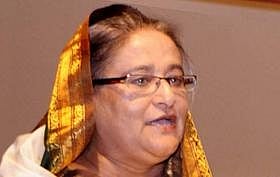
PM for fixed-term caretaker govts
The prime minister suggests three-month fixed tenure for caretaker governments instead of doing away with the constitutional provision altogether. UPDATES 2
bdnews24.com News Service
bdnews24.com
Published :
27 Apr 2011, 12:08 PM
Updated :
10 Aug 2022, 04:43 PM
Dhaka, Apr 27 (bdnews24.com)—The prime minister has suggested if the caretaker government fails to ensure elections in three months, the previous elected government will do the job.
Sheikh Hasina after the talks on Wednesday with the special parliamentary committee on constitution amendment also said that she was in favour of parliament reserving the right to impeach judges.
She asked, "If parliament can impeach the president who appoints judges, why can the judges not be impeached?"
Law minister Shafique Ahmed earlier in the day, however, said that Hasina was against such a move.
She suggested a specified timeframe for the caretaker government instead of doing away with the constitutional provision altogether.
"Elections must be held within three months. Or else, voting will be held under the previous government in the office," Hasina said at a media briefing at her Ganabhaban residence after the meeting.
She said, "There should be a rule to limit the caretaker government's duration in order to stop them from taking care of themselves."
She also suggested that both the government and the opposition give five representatives, who would select a caretaker government chief.
The prime minister said it would be better if the government and the opposition found a way to avoid the impact of caretaker government system on the judiciary.
She opined that if the Election Commission was strong and electronic voting system was launched, there would be no need of a caretaker government.
The matter of limiting the president's power to declare ordinance during the caretaker government was also discussed at the meeting, she said.
Hasina said they also proposed to raise the number of parliament seats reserved for women from 45 to 50.
The president of ruling Awami League led a 20-strong party team to the over two-hour talks held on the first-floor Cabinet Room of the parliament building. The meeting ended at 2:30pm.
The prime minister turned up before the parliamentary committee in a first-ever appearance in Bangladesh's history.
Speaking to the media, the law minister said the prime minister suggested further discussion on the issue of retired chief justices becoming chief advisor to caretaker government.
Committee chairperson and deputy leader of parliament Syeda Sajeda Chowdhury and other members of her panel attended the meeting.
Prime minister's parliamentary affairs advisor H T Imam, former general secretary Abdul Jalil, Dhaka University's former vice-chancellor (VC) A K Azad Chowdhury, her education advisor Alauddin Ahmed, economic affairs advisor Mashiur Rahman, former VC of National University professor Durgadas Bhattacharya, presidium member Yusuf Hossain Humayun, joint general secretary Mahbub-ul-Alam Hanif, central working committee member and former home minister Mohammad Nasim and former chip whip Abul Hasnat Abdullah were among the Awami League delegates.
The parliamentary special committee is being represented by co-chairman Suranjit Sengupta, members Syed Ashraful Islam, Amir Hossain Amu, Abdur Razzaque, Tofail Ahmed, Sheikh Fazlul Karim Selim, Rahmat Ali, Fazle Rabbi Mia, Rashed Khan Menon, Abdul Latif Khasru, Hasanul Haque Inu, Anisul Islam Mahmud, Mohammad Hasan Mahmud and Shirin Sharmin Chowdhury.
Ashraf, however, was absent from the meeting as he is currently abroad.
The committee elicited opinions from Supreme Court judges, constitution experts and lawyers on Sunday.
Since BNP skirted the meeting, the committee held talks with other political parties the next day.
Regarding BNP's rejection to join the talks, Hasina said to invite them again was nothing but 'waste of time'.
"If they want to come, the committee won't forbid. We want their participation," she said.
The current government formed the 15-member parliamentary special committee to review the charter on Jul 21 last year as part of initiatives for the 15th amendment to the constitution.
Independence leader Bangabandhu Sheikh Mujibur Rahman's tenure brought the first to fourth amendments, while the fifth and the sixth amendments were made during military ruler Ziaur Rahman, founder of BNP.
Later, autocrat Hussain Muhammad Ershad's regime went for the seventh to the tenth amendments and president Shahabuddin Ahmed's regime for the eleventh amendment.
Afterwards, the BNP-led government brought the twelfth to fourteenth amendments.
STATE OF RELIGION AND BISMILLAH
"A state cannot have a religion. Men administer religions. Those, who are not religious, speak more about religion. They utter Bismillah with the mouths that were used to drink alcohols," she said.
"Islam was made the religion of the state by the 1988 elections that was illegal. He (Ershad), who did it, is now with the grand alliance. Everybody knows about his religious activities," she barbed.
"However, Bismillah will be there as it was. Islam will also continue as the religion of state," the prime minister told the briefing.
"We've proposed that the right to do religious duty be ensured by mentioning the names of all religions in the constitution," she added.
Hasina said the Article 38 of the '72 constitution would be restored after some corrections to give scope to the religion-based political parties to continue.
The EC would look after the matter while registering the parties, she added.
INDIGENOUS PEOPLE
When asked about the constitutional recognition of indigenous people, Hasina claimed, "There are no indigenous people in the country, but Saotals."
"We all are indigenous people," she said.
The rights of undeveloped and tribal people were there in the constitution, she added.
bdnews24.com/mhc/mi/ach/pks/ost/bd/nir/2345h