Published :
17 Jul 2013, 04:57 PM
Updated :
09 Aug 2022, 10:55 AM
His remarks had left the families of martyrs and freedom fighters angry and devastated.
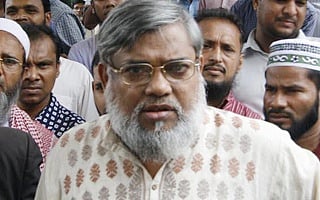
A leader of the Islami Chhatra Shongho, Mujaheed was one of the chief commanders of Al-Badr, created to kill and loot to thwart the chances of the country’s liberation.
Like other war criminals of 1971, Mujaheed had entered politics under the regimes that assumed power after Bangabandu Sheikh Mujibur Rahman's assassination.

"There were never any war criminals in Bangladesh and there aren't any now," Mujaheed had said on Oct 25, 2007, after a meeting with the Election Commission on Jamaat's behalf when an army-backed caretaker government was at the helm.
The Al-Badr commander's remark sparked a countrywide outrage. Social and cultural originations, as well as the families of those killed in 1971, stridently protested, demanding punishment for criminals.
Several groups including the Sector Commanders’ Forum pushed political parties to severe ties with Jamaat and promise in their polls manifestoes trial for war criminals.
Amid all this, the Awami League - the party that had led the liberation struggle - came up with their ‘Vision-2021: Manifesto for change’, unequivocally promising trial of those suspected of war crimes.
The war-crimes trial promise became a passionate issue, especially among first-time voters. The outcome of the pervasive sentiment was a landslide victory for the Awami League-led Grand Alliance in the 2008 parliamentary elections.
The first International Crimes Tribunal was set up on Mar 25, 2010 to try those charged with crimes against humanity during the Liberation War.
Investigation and prosecution teams were formed the same day. The second International Crimes Tribunal, created in 2012, tried and sentenced Mujaheed.
In the dialogue that began in Sep, 2007 Krishak Sramik Janata League, led by Kader Siddiqui, Gonotontri Party, Jatiya Party (Monju) and JSD (Rob) demanded the banning of criminals and anti-Liberation forces including Jamaat from the election process. They also objected to the Jamaat polls symbol - 'scales’ - saying it is an icon of the court.
Mujaheed, in a fiery reaction to this concerted demand, told reporters, “There are no war criminals in Bangladesh. One hundred and ninety-one from the Pakistani Army had been branded war criminals but an Awami League government pardoned them long ago. There is no anti-Liberation force working in the country."
“All this is imaginary. A strange and cooked up thought. There are no war criminals in Bangladesh. They were none then and there aren't any now,”
“There was never anyone against Liberation in Bangladesh and there is no one now,” he had thundered.
When asked about Jamaat’s role during the war, he turned evasive. “Why don’t you find out,” he said.
The meeting with the EC had been attended by Jamaat’s Delwar Hossain Sayedee, Muhammad Kamaruzzaman, Abdul Quder Molla, ATM Azharul Islam, Barrister Abdur Razzaq besides others. Among them, Sayedee and Kamaruzzaman have been convicted of crimes against humanity and awarded the death penalty. Azharul has been arrested on war crime charges.
Mujaheed was asked at a media briefing after the first war crime tribunal was formed on Mar 31, 2010 whether it was right to support Pakistan in 1971.
“Past is passed. Don’t look into it too much”, said the Jamaat leader. “Why were those who committed atrocities 1971 pardoned and let off?”
Mujaheed had dodged questions that asked if Jamaat would seek forgiveness for trying to abort the nation's birth.
“The decision was political. Drop that issue now,” he said.
When asked about the reason behind their objection to the trial of war criminals, the Jamaat Secretary General said, “The matter was resolved 36 years ago. A judgment on this issue is beyond question.”