Published : 26 Aug 2026, 06:49 PM
Updated : 08 Sep 2026, 09:36 AM


Bangladesh is considering an invitation to join the newly formed Makkah defence pact between Saudi Arabia, Türkiye and Pakistan, a decision that could mark a significant departure from Dhaka’s longstanding effort to avoid becoming tied to rival geopolitical camps.
Saudi Arabia has invited Bangladesh to join the agreement, Reuters reported, citing a Bangladesh foreign ministry source, while State Minister for Foreign Affairs Humaiun Kobir has said the proposal is being viewed “positively”.
“If there is a security arrangement among Islamic nations in the Middle East, it is not unusual for us to consider participating,” Reuters quoted Kobir as saying.
Bangladesh has not agreed to join, and the precise obligations an additional member would assume have not been publicly detailed.
So what is the Makkah pact, why was it created, what security problem would it solve for Bangladesh, and what could membership mean for Dhaka’s wider foreign relations?
What is the Makkah Defence Pact?
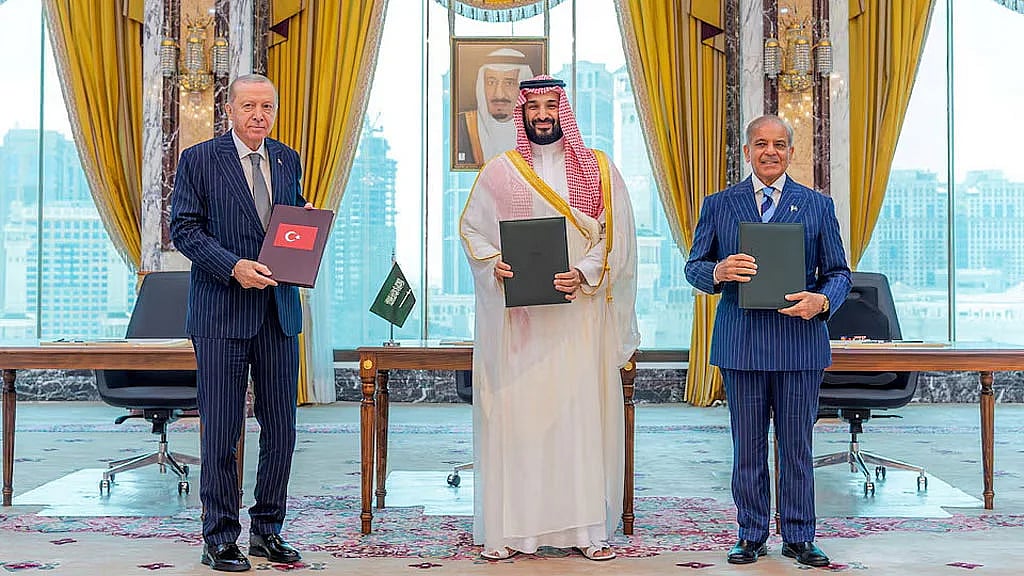
Saudi Arabia, Türkiye and Pakistan signed the Makkah Joint Defence Agreement on Aug 7 amid heightened tensions across the Middle East.
Its most consequential feature is its collective-defence principle: an armed attack against one of the three members would be regarded as an attack against them all.
The provision has prompted comparisons with Article 5 of the NATO treaty, which considers an attack against one alliance member an attack against all.
Türkiye’s Foreign Minister Hakan Fidan has himself said the principle is technically comparable with NATO’s Article 5, Reuters reported.
But the Makkah agreement is considerably less developed than NATO. Questions remain over what assistance members would actually be required to provide during a crisis and how the collective-defence provision would work in practice.
Al Jazeera has noted that the wording may leave some room for interpretation, with analysts pointing to a distinction between declaring that an attack “should be” treated as an attack on all and establishing an automatic obligation to respond militarily.
That distinction could become crucial for Bangladesh.
Why Did Saudi Arabia, Türkiye and Pakistan Sign It?
The pact emerged during a period of intense regional instability, including attacks affecting Saudi Arabia and the wider confrontation involving Iran.
Reuters reported shortly before its signing that Riyadh was preparing for possible attacks from Iranian-aligned forces and was seeking to strengthen its regional defence partnerships.
The agreement also brings together three countries with different strategic strengths and interests.
Türkiye has NATO’s second-largest military and an increasingly important defence industry, Pakistan is a major military power, while Saudi Arabia brings substantial financial resources and regional influence.
Al Jazeera also noted the three countries’ combined military weight, including large active forces and extensive air, land and naval capabilities.
But officials from the three countries have stressed that the pact is defensive and is not directed against any particular state.
Pakistan’s Foreign Minister Ishaq Dar described it as “purely defensive”, while Turkish officials have said Iran or any other country was not identified as a common enemy.
Why Is Bangladesh Being Invited?
The founding members have made clear that they do not necessarily intend the arrangement to remain a three-country pact.
Fidan has said Türkiye wants the grouping to expand to other friendly countries.
“We should not remain limited to three countries,” Al Jazeera quoted him as saying, citing Türkiye’s Anadolu news agency.
Bangladesh, with a population that is overwhelmingly Muslim and longstanding relationships with Saudi Arabia, Türkiye and Pakistan, has now emerged as one possible entrant.
Reuters reported that Saudi Arabia had invited Dhaka to join, though the timing of the invitation was not disclosed.
Kobir also said the pact’s members were inviting Bangladesh’s leadership, particularly Prime Minister Tarique Rahman, to participate.
Would Joining Mark a Break with Bangladesh’s Non-Aligned Approach?
Potentially.
Bangladesh has traditionally sought to avoid formal military blocs while maintaining relationships with competing powers, an approach that has given Dhaka considerable room to manoeuvre in foreign policy.
Writing for bdnews24.com, journalist Sabir Mustafa described possible membership of the Makkah pact as a potentially significant departure from that tradition, arguing that entering a collective-defence arrangement would be very different from maintaining close bilateral defence relationships.
Reuters made a similar point, saying alliance membership could test Bangladesh’s long-standing policy of avoiding rival geopolitical camps while seeking investment, exports and economic ties with competing powers.
That distinction matters because formal membership of a defence pact creates obligations that ordinary bilateral cooperation does not.
What Security Problem Would the Pact Solve for Bangladesh?
This is one of the most important questions facing Dhaka.
Mustafa argued that the debate should not focus simply on whether joining could strengthen Bangladesh’s position relative to India, but on what specific national-security threat the pact would actually help address.
That question is complicated by the fact that the security priorities of the three founding members differ considerably from Bangladesh’s own.
Saudi Arabia is heavily exposed to instability in the Gulf and Yemen, Türkiye has security concerns linked to Syria and Kurdish separatism, and Pakistan operates in a different strategic environment in South Asia.
For Bangladesh, any decision would therefore need to establish whether the pact addresses an identifiable security need of its own, rather than simply offering closer relations with three friendly countries.
Given the uncertainty over what Bangladesh would be obliged to do in a future conflict, the case for joining cannot rest simply on closer ties with friendly states or on assumptions about strategic advantage.
What Could Bangladesh Gain?
One potential argument for membership is greater defence and security cooperation with three increasingly influential regional powers.
The pact is expected to encourage closer coordination in areas such as training, defence industries and security cooperation.
Al Jazeera has reported that analysts see one of the arrangement’s attractions as the complementary capabilities of the three founding countries, including Türkiye’s advanced defence industry and Pakistan’s military experience.
For Bangladesh, membership could therefore provide another channel for military cooperation while strengthening already important political and economic relationships.
Saudi Arabia is particularly important to Bangladesh because of the large number of Bangladeshi migrant workers employed there and the remittances they send home.
Deeper strategic ties with Riyadh could also potentially complement broader economic and investment cooperation.
But neither the invitation nor publicly available details of the agreement establish what specific economic or security benefits Bangladesh would receive by becoming a member.
That makes the potential benefits easier to identify in broad terms than to quantify.
What Would Bangladesh Be Committing Itself to?
This is the more difficult question.
Unlike joining an economic or diplomatic organisation, entering a collective-defence agreement can create obligations during a military crisis.
If Saudi Arabia, Türkiye or Pakistan came under armed attack, the pact says the incident would be regarded as an attack against all members.
What that would require from Bangladesh is not yet publicly clear.
Would Dhaka be expected to participate militarily? Could assistance instead take diplomatic, logistical or intelligence forms? Would every member retain the right to determine its own response?
The publicly disclosed provisions do not yet provide firm answers.
Even analysts examining the agreement itself have cautioned that it is unclear how strongly the collective-defence provision would bind members during an actual confrontation.
For Bangladesh, those details would arguably be among the most important issues to establish before any decision on membership.
Could Bangladesh Become Involved in Conflicts Outside Its Interests?
Potentially — depending on how the mutual-defence clause is eventually interpreted.
The security priorities of the three founding countries are considerably different from Bangladesh’s.
Saudi Arabia is heavily exposed to instability in the Gulf and Yemen, Türkiye has security interests stretching across several neighbouring regions, and Pakistan operates in a substantially different strategic environment in South Asia.
Mustafa also cautioned against viewing the pact primarily through an India-Pakistan lens, arguing that Bangladesh must consider how membership would affect it in crises involving Saudi Arabia, Türkiye or other possible future members.
That raises a fundamental question for Dhaka: whether joining could make it more difficult to remain outside a conflict involving another member but posing no direct threat to Bangladesh.
At present, there is no publicly available answer.
Has Bangladesh Responded to Saudi Security Requests Before?
Yes, although under very different circumstances.
Mustafa pointed to the 1990-91 Gulf crisis, when then-president HM Ershad sent Bangladeshi troops to the Gulf after Iraq invaded Kuwait and Saudi Arabia sought support from Muslim-majority countries.
Bangladeshi forces did not take part in frontline combat but later contributed to post-war security and mine-clearing operations in Kuwait.
The episode illustrates Bangladesh’s willingness in the past to cooperate with Saudi Arabia on security matters.
But there is an important distinction: contributing troops to a specific international crisis is not the same as joining a standing mutual-defence pact under which an attack on one member may trigger obligations for all.
What Could It Mean for Bangladesh’s Wider Foreign Relations?
Reuters identified this as one of the principal risks.
Bangladesh has traditionally sought to maintain working relationships with countries that are themselves strategic rivals.
Its economy depends heavily on garment exports to Britain, the European Union and the United States, while remittances from millions of Bangladeshis working abroad, particularly in the Middle East, remain a crucial source of foreign currency.
Dhaka also has extensive economic and defence relations with China, a crucial geographical relationship with India and important ties with Japan, Russia and Gulf states including Qatar, Kuwait, Oman and the United Arab Emirates.
Reuters said joining a military bloc could make Bangladesh’s traditional balancing strategy more complicated because other governments may increasingly ask where Dhaka stands when interests clash.
That does not mean those relationships would automatically deteriorate if Bangladesh joined.
But formal membership of a collective-defence pact would be qualitatively different from maintaining close bilateral defence relationships with several countries at the same time.
And What About India?
India presents a particularly sensitive consideration because Pakistan is one of the pact’s founding members.
Relations between Dhaka and New Delhi are already strained over several issues, including Bangladesh’s request for the extradition of deposed prime minister Sheikh Hasina and allegations concerning push-ins across the border.
Reuters reported that analysts expect New Delhi to view potential Bangladeshi membership uneasily, although they also stressed that India’s reaction should not determine Bangladesh’s decision.
India’s foreign ministry has so far said it is closely following developments surrounding the pact and the broader situation in West Asia.
For Bangladesh, however, the more consequential question would be practical rather than simply diplomatic: how would the pact’s collective-defence provision apply if Pakistan became involved in an armed confrontation with India?
The publicly available details of the agreement do not settle that question.
So What Should Bangladesh Weigh Before Deciding?
At its simplest, Bangladesh would have to compare the benefits of another security partnership with the consequences of formally entering a collective-defence arrangement.
Membership could deepen relations with Saudi Arabia, Türkiye and Pakistan, potentially expand defence cooperation and give Dhaka another strategic partnership at a time of considerable regional uncertainty.
But the agreement could also constrain the freedom Bangladesh has traditionally sought to preserve in its dealings with competing powers.
The central questions remain unresolved: what security threat would membership address for Bangladesh; what would Dhaka have to contribute if another member were attacked; how much discretion would it retain over its response; whether membership could expose it to conflicts unrelated to its own security; and what concrete benefits Bangladesh would receive in exchange for assuming those obligations.
Until those questions are answered, joining would amount to taking on potentially far-reaching security commitments without a clearly defined threat, benefit or exit plan.