Published : 23 Jul 2026, 04:47 PM
Updated : 08 Sep 2026, 09:27 AM


Three Bangladeshi researchers have developed a locally made ventilator they say could cut the cost of the life-saving device to a fraction of imported models.
They have spent seven years developing the ventilator, named Ventas, and say it has successfully completed its first-stage human trial.
The team said the device can support a patient's breathing while remaining portable and inexpensive to produce.
The researchers are Asif Ur Rahman, an intensive care unit (ICU) consultant at the National Institute of Neurosciences and Hospital, cardiology postgraduate trainee Sifayet Enam Swakkhar, and engineer Baizid Shuvo.
They said the trial closely monitored patients' oxygen saturation, blood pressure, heart rate, respiratory rate and level of consciousness.
An arterial blood gas (ABG) test was also carried out after the trial to assess oxygenation and ventilation, with the device performing as expected.
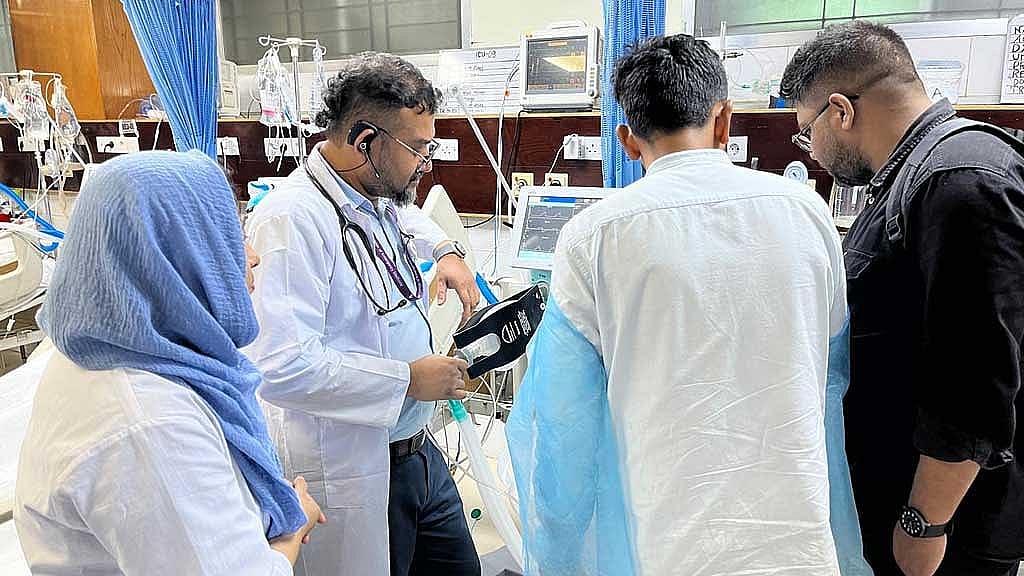
Asif said imported ventilators typically cost more than Tk 2 million, while Ventas could initially be built for about Tk 100,000.
Adding three ventilation modes would raise the cost to around Tk 250,000-Tk 300,000, while a more advanced version would cost up to Tk 500,000, he said, claiming it could provide performance comparable to imported ventilators costing over Tk 2 million.
Asif said Swakkhar and Shuvo first approached him with the idea in early 2020, aiming to build a machine capable of supporting human breathing.
The team initially developed a prototype called “Spandan”, which successfully demonstrated basic functionality at Dhaka Medical College.
Although that project did not progress further, they continued refining the concept before developing Ventas.
He said Ventas-1, the first prototype, has been designed for use in Upazila-level hospitals, supporting patients with both routine and emergency respiratory needs.
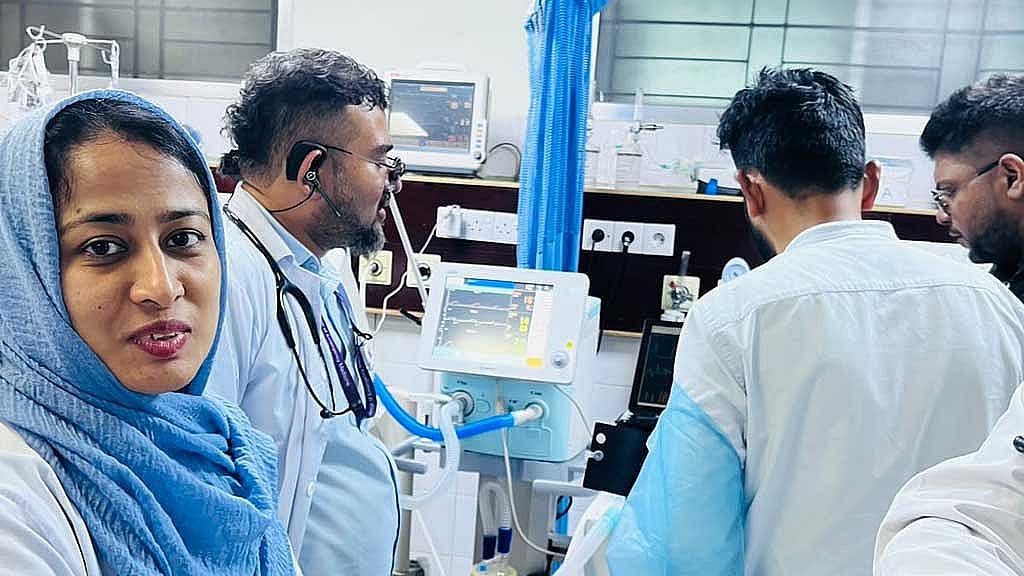
Software coding for more advanced versions suitable for district and divisional hospitals has already been completed, with further testing planned before they are introduced.
Asif said the prototype can draw in ambient air instead of relying entirely on oxygen cylinders or oxygen plants.
He added that the device has been designed for simple operation, allowing healthcare workers to begin ventilation by inserting an airway tube and pressing a single button.
The researchers said another clinical assessment on Jul 12 kept a patient on Ventas for two hours.
They said breathing performance and other clinical indicators matched those of imported ventilators.
They hope government involvement will help speed up research, regulatory approval and large-scale production.
Asif said the team wanted to retain the intellectual property in Bangladesh while partnering with the government and an overseas manufacturer to produce the ventilator commercially before eventually exporting it.