Published :
31 Mar 2013, 02:29 PM
Updated :
09 Aug 2022, 10:27 AM
“Those who earn more and use more water must pay more, and those who can’t afford should get free,” he said as the WASA authority has decided to introduce the system ‘to prevent misuse of water and earn more revenue’.
The PM’s Adviser for Public Administration Affairs was speaking at a dialogue styled ‘Progressive water tariff: Potentials and challenges for DWASA’ on Sunday in Dhaka.

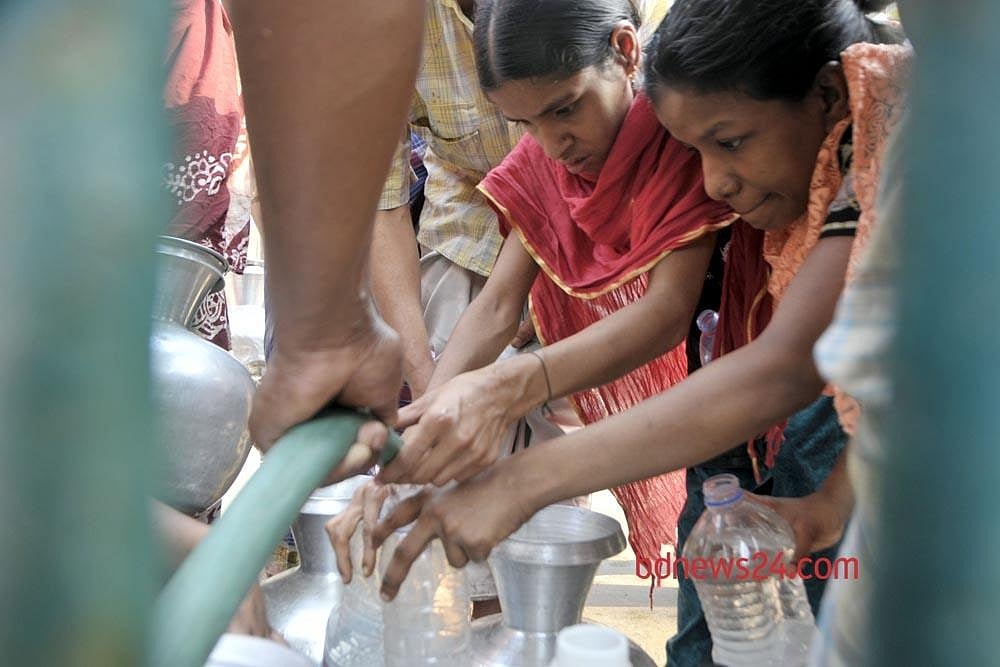
The UK charity Wateraid, World Bank and the DWASA jointly orgainsed the dialogue to find ways to introduce the system in the capital where only 0.68 percent of the WASA-supplied water is available to the low-income group.
DWASA Managing Director Taqsem A Khan, presenting his thoughts on the initiative, said the current tariff system was not ‘socially just and equitable’.
“Those who live in Gulshan, Baridhara and Dhanmondi apartments pay the same as those living in impoverished areas,” he said as he described Dhaka’s water tariff of Tk 6.99 per 1,000 litres ‘lowest in the world’.
“But if you see the consumer pattern, 92.71 percent goes to the residential buildings,” he said as he showed growing disparity in the use of water in the capital.
He said the rich drained out potable water in washing their cars and flushing toilets while the poor bought it for drinking.
Showing the water usage pattern, Khan said on an average, 130 liters of water was being used per person per day, of which 92 percent was used for toilet flushing, cleaning, washing and bathing.
He said the dialogue was the first step forward towards introduction of the system, which he felt was fraught with implementation challenges.
“Currently, households are connected to one meter, particularly in apartments, hostels, messes, and segregation at such places difficult,” he said adding that technical solutions to the issue should be devised.
There were also chances of facing resistance ‘initially’, he said.
National Human Rights Commission Chairman Mizanur Rahman bemoaned the current water supply system and said sometimes he found Bangladesh ‘a pro-rich and anti-poor’ country.
He supported the WASA’s new concept and said, “Treating the unequal equally is inequality and it is not acceptable.”
He described how people in some localities have to scramble to manage their regular water from a one source point. “There has to be a different approach (for the rich and the poor).”
“Don’t pour oil in oily hair, try to put some in dry hair as well” was his advice.
Wateraid Bangladesh’s country representative Dr Khairul Islam extolled the government for ‘consistently increasing’ the water and sanitation budgets.
“But 70 percent of those budgets goes to the city people and only 30 percent to the villages where 70 percent people live,” he said and added the city people wasted a fifth of water on flushing toilets.
World Bank’s water and sanitation specialist Mark Ellery on the sidelines of the dialogue told bdnews24.com that their studies in Mozambique found there were challenges to implement the system.
As many low-income communities did not have water connections, he felt the progressive water tariff system could be effective only after connections were provided to them.
“We need to get the low-income communities connected in order to make progressive tariff effective in true sense,” he said.
Ellery said the system was being implemented in many parts of world including India and Australia.
The Prime Minister’s adviser also stressed on creating awareness about the rational use of resources like water, electricity and gas.