Published : 05 Aug 2025, 06:46 AM
Updated : 21 Aug 2026, 01:36 PM


The morning began with echoes of gunfire.
Dhaka, Aug 5, 2024. On the July Uprising’s revised calendar, it was 36 July.
In response to the Anti-discrimination Student Movement’s “March to Dhaka” call, tens of thousands surged towards the city centre. Crowds blocked the highway near Uttara.
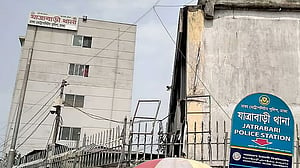
Suddenly came word that the Army had withdrawn from their positions in Uttara. In Jatrabari, gunfire and chaos continued. Police were shooting in Chankharpul. Then came the news that changed everything: “Sheikh Hasina has fled.”
Spontaneous jubilation erupted across Dhaka.
In Ganabhaban, the parliament complex and surrounding government quarters, people poured in by the thousands. Joy mingled with fury.
Hasina’s home became a selfie spot; parliament benches turned into platforms of rebellion. Across the capital, police stations and party offices were vandalised and set ablaze. Some government buildings were attacked.
Thick plumes of black smoke curled above the skyline. With no fire brigade able to reach the scenes, and police nowhere in sight, panic spread overnight as rumours of looting and lawlessness gripped the city.
Bangladesh had to wait three more days for a new authority. On Aug 8, at the student movement’s request, Nobel laureate Muhammad Yunus flew in from Paris and took charge as the head of an interim government.
Since then, the wait has continued -- for justice, for reform, and for elections.
Exactly one year later, on Aug 5, 2025, Bangladesh is observing the first “July Uprising Day” with a national holiday and commemorative events across government and civil society.
In a message to the nation, President Md Shahabuddin declared: “Today marks the historic July Uprising Day. On this day last year, students, workers and citizens launched a united resistance against an unjust state and fascist misrule, securing a decisive victory.”
He extended heartfelt greetings to all who struggled for “freedom from autocracy” and remembered the martyrs of the July Uprising with “deepest reverence”, as well as those wounded, blinded or left permanently disabled.
“The state is duty-bound to ensure justice for the families of the martyrs and the injured,” said Shahabuddin.
Describing the context of the Uprising, he said it was a “mass eruption of long-suppressed anger” against inequality, authoritarianism, corruption, forced disappearances, murders, abductions, and the denial of voting rights.
“The goal of the Uprising was to end this fascist system, restore democracy, empower the people and ensure freedom of expression,” the president said.
“We must now fully implement the ideals of July to build a prosperous, democratic, and happy Bangladesh.”
He noted that the state is undergoing a process of deep institutional reform to reflect the spirit of the Uprising, and expressed hope that this would lead to “a truly democratic transition and a just, equitable new Bangladesh.”
In his message marking the day, Chief Advisor Yunus congratulated the nation.
“Today is an unforgettable day in our history. Exactly one year ago, the July Uprising reached its climax and our beloved country was freed from long-standing fascist misrule,” he said.
He extended his gratitude to the public, calling the Uprising “the fruit of their united struggle.”
“I remember with reverence the brave youth, workers, day labourers and professionals who laid down their lives. I honour all July fighters who were injured, lost limbs or eyesight. The nation remembers their sacrifice with deep gratitude.”
Yunus described the Uprising as “a collective explosion against 16 years of authoritarian misrule”.
He said its core aim was to build a new system free from discrimination, corruption, and tyranny, and to restore democracy by returning state power to the people.
Since assuming office, the interim government has initiated a set of political and institutional reforms. Yunus noted that initiatives had been launched to honour the martyrs’ memory and rehabilitate the wounded.
Political dialogues were under way with parties and stakeholders to accelerate democratic transition through electoral and constitutional reform, he said.
“The interim government is committed to a sustainable political resolution and to returning all state power to the people through peaceful, free, and fair elections,” Yunus said.
He called the Uprising “a new beacon of hope for a just, equitable and corruption-free Bangladesh,” and added: “We must protect, at any cost, the opportunity for reform created by the sacrifice of thousands.”
Yunus warned that the fallen autocracy and its profit-driven allies were still plotting to derail the nation.
“We must all unite, regardless of party or ideology, to defeat these conspiracies,” he said. “Let us build a Bangladesh where autocracy can never return.”
ROAD TO 36 JULY
A quota system in public service had existed since Bangladesh’s independence, though its scope and composition changed over time.
Until 2018, 56 percent of civil service positions were filled under various quotas -- 30 percent for descendants of freedom fighters, 10 percent for women, 10 percent on district basis, 5 percent for ethnic minorities, and 1 percent for persons with disabilities.
Last year, the protests demanded reform of the quota system. In response, the government abolished quotas in first- and second-class public jobs, but retained the previous structure for third- and fourth-class posts through a formal circular.
Challenging the legality of this circular, seven petitioners led by freedom fighter’s son Ohidul Islam filed a writ in the High Court in 2021.
On Jun 5, 2024, after final hearings, the High Court ruled the government’s decision to scrap the quotas in upper-grade jobs as illegal.
That same day, students staged protests rejecting the verdict at Dhaka University, Jahangirnagar University, Rajshahi University and elsewhere. On Jun 9, the government filed an appeal to suspend the ruling.
A closer look at the events that followed reveals that, in the 61 days after Jun 5, student protests spread across the country for the first 40 days. But by mid-July, as security forces resorted to indiscriminate shooting, the movement drew in activists from various political parties, madrasa students and teachers, industrial workers, and even office-goers.
Their demand unified into one goal: the resignation of Sheikh Hasina as prime minister.
As violence escalated and blood was spilt, July bled into August. But protestors vowed not to let the month end until their objective was met. They continued counting—31 July, 32 July…
It finally ended on the 36th day of July, when Sheikh Hasina, who had ruled Bangladesh for 15 years, fled the country on Aug 5, 2024. A new era began -- one without Hasina.
The interim government has officially gazetted the names of 834 individuals killed in the Uprising, designating them as martyrs.
However, a separate UN human rights report paints a much grimmer picture. Investigating the period from Jul 1 to Aug 15, 2024, the UN Office of the High Commissioner for Human Rights (OHCHR) estimated that more than 1,400 people may have been killed during the upheaval.
The report documented gross human rights violations committed during the student-led protests, including multiple large-scale deadly crackdowns that, it stated, were “carried out under the orders and supervision of former prime minister Sheikh Hasina.”
Based on rigorous and independent analysis of all collected information, the OHCHR wrote, it is credible that the former government, along with its security and intelligence agencies, systematically engaged in serious violations of human rights in collaboration with the Awami League.
These violations, the UN said, included “hundreds of extrajudicial killings, mass use of excessive force against protesters, arbitrary arrests, torture, and other forms of abuse”.
“Moreover, OHCHR finds reasonable grounds to believe that these acts of repression and abuse were executed with the awareness, coordination, and directives of political leadership and senior security officials.”
HOW THE YEAR UNFOLDED
One year has passed since the bloodstained Uprising.
In a televised address to the nation on Jun 6, Yunus said: “To begin anew from the wreckage left by the fallen autocracy, three essential tasks must be fulfilled.
“First, we must make the pursuit of justice and accountability visible. Second, a national consensus and roadmap must be established to democratically restructure the state and reform its institutions. Third, we must organise a free, fair, and peaceful election to ensure a democratic transfer of power -- this demands a permanent overhaul of our broken electoral system.”
He added, “These three mandates form our pact with the people. This pact, soaked in the blood of the martyrs of 2024, can be realised only through your collective support and by overcoming every obstacle laid by the remnants of the fallen regime. I firmly believe we can fulfil this mission together.”
In line with that pledge, the International Crimes Tribunal has begun trying Hasina, ex-home minister Asaduzzaman Khan, and former police chief Chowdhury Abdullah Al-Mamun for crimes against humanity linked to the July Uprising. Of the three, Mamun has confessed and turned state witness.
Separate indictments have been filed over killings in Chankharpul and the Abu Sayed murder case in Rangpur. In Ashulia, a case involving the burning of corpses is awaiting indictment hearings.
A Dhaka court has also ordered the trial of Hasina, her sister Sheikh Rehana, and their children in a high-profile land corruption case.
Across the country, over a thousand cases have been filed in connection with killings, attempted murders, and orchestrated attacks during the Uprising. Dhaka alone has seen 668 such cases.
Many suspects, including Hasina, Awami League general secretary and former bridges minister Obaidul Quader, and Asaduzzaman, remain beyond the reach of the law. Hasina is believed to be in India, which has yet to respond to the interim government’s request for extradition.
To translate the Uprising’s momentum into structural reform, the National Consensus Commission engaged in five and a half months of dialogue with over 30 political parties. A resolution has now been reached.
According to the commission, parties have agreed on 81 points drawn from reform proposals submitted by five bodies: the Constitution Reform Commission, Electoral Reform Commission, Judiciary Reform Commission, Anti-Corruption Reform Commission, and Public Administration Reform Commission.
The parties are expected to sign a written pledge to implement these reforms -- regardless of who wins the upcoming election. This pledge will be included in the National Charter, scheduled for release on Tuesday on the anniversary of the Uprising.
In his June address, Yunus said the government was aiming to hold the national election in the first half of April 2026. But following a Jun 13 meeting in London with BNP Acting Chairman Tarique Rahman, government officials announced that elections could be moved forward to February.
The Election Commission has since begun preparing with February in mind, and the chief advisor’s spokesperson has hinted that a date could be announced within days.
But cracks have begun to appear among those who once marched shoulder to shoulder during the July movement. Many who had dreamt of transformation now feel disillusioned.
Although inflation has eased slightly in recent months, business confidence remains low. Concerns over law and order, job security, and livelihoods persist.
On Aug 2, 2024, at the peak of the revolt, left-leaning parties had declared a “March of Defiance”, where Jahangirnagar University’s retired economics professor Anu Muhammad had laid out the movement’s single-point demand. One year on, he is sceptical of the progress made.
“I don’t see much of that vision reflected today,” said Anu. “Removing Hasina alone doesn’t bring democracy. Her fall was inevitable, but there’s a vacuum in how we achieve democratic transformation.
“This government, which came in on a promise to end inequality, is showing bias. There’s mob violence, oppression of women, assaults on workers -- and their response has been weak. They suppress just voices, yet go soft on violent mobs. That’s deeply troubling.”
Journalist Muktadir Rashid Romeo, who was injured by police pellets while covering the Uprising, also remains critical.
“There’s a glaring gap between what July stood for and today’s reality. Previously, the state apparatus idolised one person; now they’ve just replaced her. The culture remains unchanged.”
“No one is speaking of people’s welfare or their quality of life. Hasina’s loyalists may be gone, but the underlying structures are intact.”
Romeo warned of a “dangerous institutional rise” of far-right forces.
“Back then, people were denied voting rights. Today, they live with uncertainty just to get a chance to vote.”
Actor Azmeri Haque Badhon, who marched with fellow artists during the Uprising, reflects with disappointment.
“Everyone joined the July Uprising with their own goals. But what united us was one cause -- the fall of a tyrannical regime.”
“We all saw authoritarianism unfold in front of us. From street vendors to labourers, from actors to students, people came out because they believed authoritarianism could fall.”
She said, “I dreamt of a Bangladesh rooted in equality, where people of all genders could live freely and safely, regardless of faith or caste. I believed the Uprising was a once-in-a-lifetime chance to bring that to life.”
“As an ordinary citizen, I had hoped we’d use that chance to reform the state. This government could have begun that journey, but they have failed.”
Explaining her frustration, she added: “Mob culture is spreading. We’re seeing misogynistic rallies, widespread harassment, mass murder charges, vandalism of shrines and sculptures, attacks on plays and films -- none of this is what we hoped for. That these things are surfacing shows the government is failing.”
“I know many in this government personally. I used to follow their activism. But the roles they’ve been given -- they are not able to fulfil. Maybe they tried, but I’ve seen no results. What I have seen leaves me disheartened.”
She now believes an elected government might offer more hope than the interim administration.
Dhaka University political science professor Kazi Mohammad Mahbobor Rahman, however, remains cautiously optimistic.
“The July movement dismantled an authoritarian system. For 15 years, opposition parties fought against it, and now, at last, there is a path to political transition.”
Some believe conditions are better now than at any point in the past. To them, security and prices feel stable.
Sifat Hossain, a student of Jagannath University, said: “The economy has rebounded, inflation is under control. Trials for the BDR and Shapla massacres have begun; those wronged in those events are seeing justice. Prices have fallen. It used to be far worse.”
Habib Mia, a rickshaw puller from Narsingdi, said: “We’re safe now from abuse. The police used to threaten us constantly. We couldn’t speak freely. The administration did whatever it wanted.”
“This pressure has eased. This is a Muslim country. I can’t just be cosy with India. Now those things are ending. We have rights. We have freedom.”
DAYLONG COMMEMORATION
To mark the first anniversary of the Uprising, a full day of state-organised events will take place on Tuesday on Dhaka’s Manik Mia Avenue.
The centrepiece of the commemoration will be the unveiling of the July Proclamation by Yunus at 5pm. State-TV Bangladesh Television will broadcast the programme live.
Key events include musical performances by different artists from 11am, a symbolic performance titled “Celebrating the Fascists’ Fall” at 2:25pm, the publication of the July Proclamation at 5pm, a special drone show at 7:30pm, and a performance by the band Artcell at 8pm.
The Ministry of Cultural Affairs, Bangladesh Shilpakala Academy, and the Parliament Secretariat are jointly organising the events.
The Dhaka Metropolitan Police has advised residents to avoid Manik Mia Avenue and the surrounding roads on Tuesday due to traffic restrictions.
Separately, the Jamaat-e-Islami has announced a nationwide mass rally on the same day. In a statement, Secretary General Professor Mia Golam Porwar urged party members in all major cities and districts to ensure peaceful marches across the country.
Islami Andolon Bangladesh will observe the day as Anti-Autocracy Day, beginning with a daylong event at the northern gate of Baitul Mukarram Mosque from 10am. After a mass gathering, party leaders and activists will march through key city roads. A cultural programme is scheduled to begin at 2:30pm and continue until the Maghrib prayer, after which religious gatherings and prayer sessions will be held.
Meanwhile, the BNP has been observing a 36-day programme commemorating the Uprising. However, it has scheduled no events for Tuesday out of respect for the official ceremonies. Instead, on Wednesday, the party plans a Victory March of Students and Citizens in Dhaka and other cities nationwide.
Shahadat Hossain, office secretary of the Students Against Discrimination, said the group has no separate programme for Tuesday but will join the state events.
The same was confirmed by Mushfiq Us Salehin, joint secretary of the National Citizen Party.