Published : 01 Jun 2026, 06:58 AM
Updated : 21 Aug 2026, 03:48 PM


Floundering Fields and Empty Granaries
Procurement plummets: State rice collection collapses to just 20 percent after early monsoon floods drown the region’s vital Boro crops
Granaries bone dry: Severe yield losses leave ruined farming households without enough surplus rice to supply government silos
Data in dispute: Farmers claim real losses are triple the official figures, sparking disputes over state relief packages
Spoilt at the gates: Waterlogged, blackened grain fails strict moisture tests, forcing depot officials to turn away local harvests
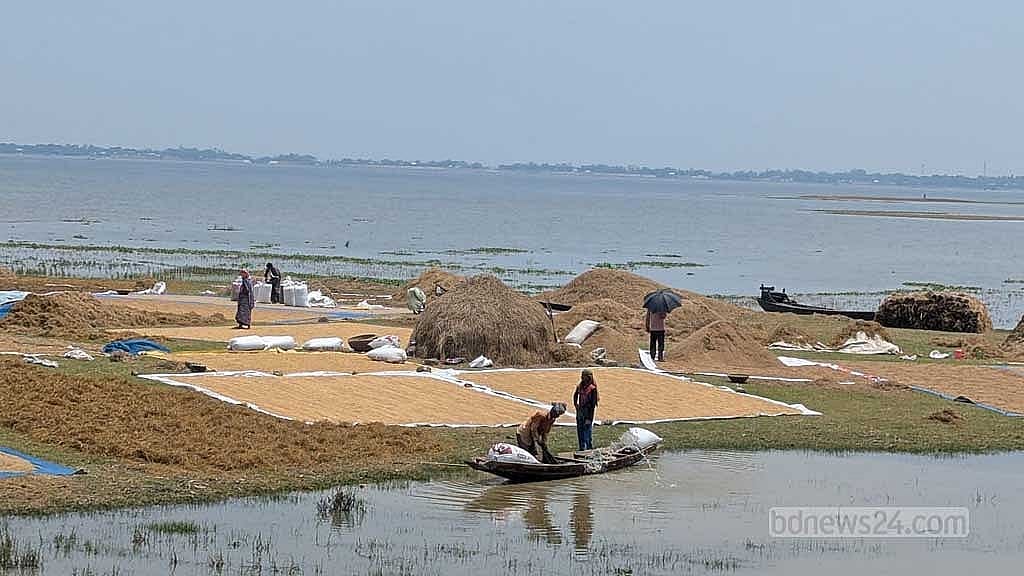
In Sunamganj’s vast Haor wetlands, where golden Boro rice used to ripen in orderly fields before the annual waters returned, this year’s harvest has been swallowed early by untimely rain and flooding.
What remains on drying floors cannot meet household needs, far less state demand.
The impact has moved beyond the fields, disrupting government procurement plans and exposing the fragility of a region that contributes a significant share of the country’s rice output.
Stalled Procurement
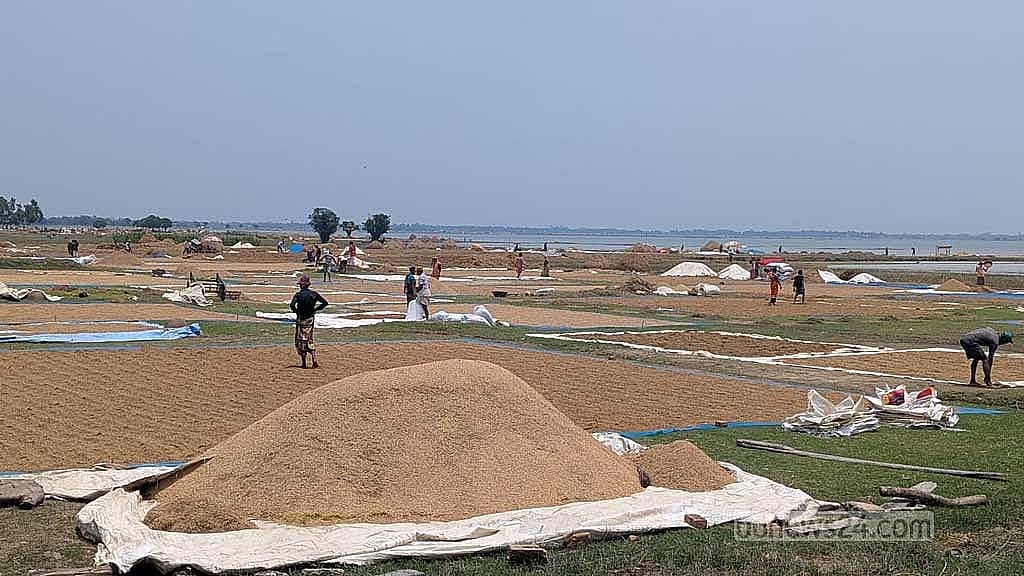
The government began rice procurement in the district on May 3, but after three weeks, only around 20 percent of the target has been met.
Farmers say they are struggling to survive on what little they managed to save. Delivering grain to state silos, they say, is no longer an option.
The Haor region accounts for roughly 20 percent of the country’s total Boro production, spread across six districts.
In Sunamganj alone, a food-surplus district, Boro cultivation is carried out in 193 Haors and beels.
This year, over 225,000 hectares were brought under cultivation.
But late April rains inundated 20,120 hectares, destroying crops and affecting more than 60,000 farming households.
Farmers Count Losses
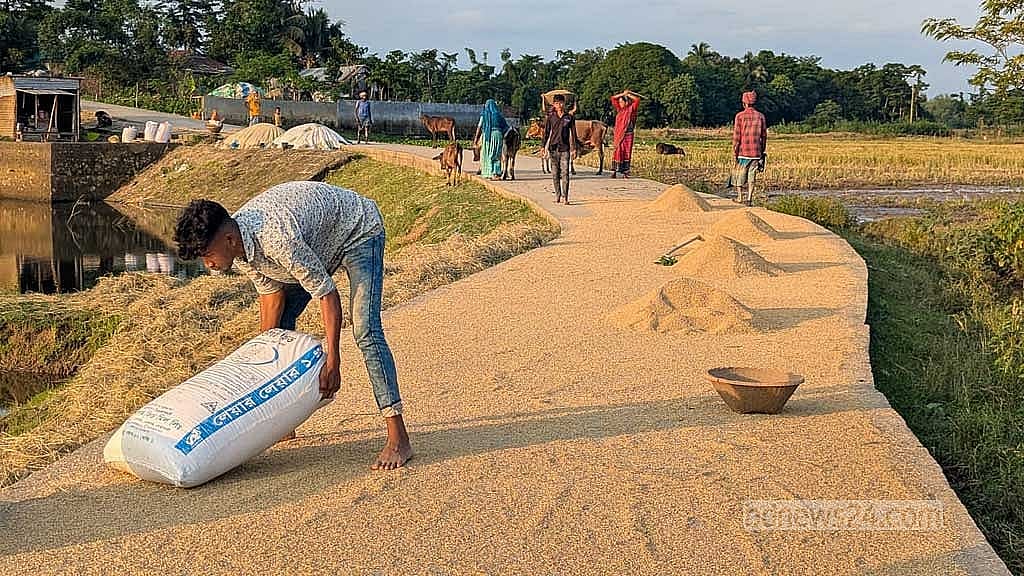
In Jamalganj, farmer Harun Or Rashid -- classified as a “major farmer” under agricultural guidelines due to owning over 750 decimals (more than 3 hectares) of land -- usually harvests 650 to 700 maunds (26,000-28,000kg) of rice each year from the Hail Haor.
After the traditional Boro harvest festival “Dawamari”, he stores enough for household consumption and sells the rest to government silos or markets.
This year, the pattern collapsed.
Early March rains damaged part of his standing crop. By Apr 25, continuous rainfall submerged much of his field.
“Last year, I supplied 300 maunds (12,000kg) to the government silo. This time, after keeping what we need at home, there is nothing left to store. Whatever little remains is also of poor quality. We have suffered huge losses. It will be very hard to recover,” he said.
He cultivated around 3 “haal” of land (1 haal equals 12 kias; one kia equals 33 decimals), or nearly 4.8 hectares, but now has less than 150 maunds (6,000kg) left -- barely one-fifth of his expected yield. Around 550 maunds (22,000kg) were lost to water.
“No Rice Left for the Granary”
In Fenarbak village of Pagna Haor, farmer Tofail Ahmed Chowdhury Shona painted a similar picture.
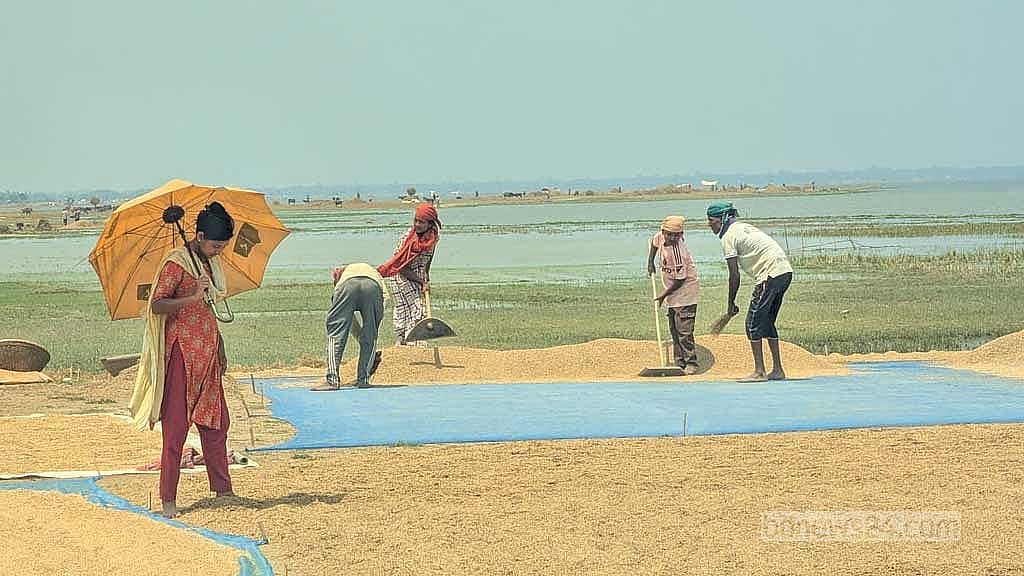
He cultivated 42 kias (nearly 5.6 hectares) but could harvest only 5 kias (0.67 hectares) manually, at a labour cost of Tk 5,000 per kia. Even that grain was partly damaged after cutting.
“We are in deep loss this year. It cannot be recovered. I supplied 300 maunds (12,000kg) to the government last year. This time, I cannot give even one maund. There is no rice at home -- what will I give? Survival itself will be difficult,” he said.
He added that farmers in Hail and Pagna Haors face similar conditions, with little or no surplus left after household needs.
Procurement Falls Far Short of Target
According to the Directorate General of Food, Sunamganj was allocated a procurement target of 21,349 tonnes of paddy this season.
Jamalganj alone was assigned 2,373 tonnes. But in the first 20 days -- from May 3 until just before Eid holidays -- only 126 tonnes were collected there, significantly lower than previous years.
Officials say many farmers are bringing paddy, but it is being rejected due to poor quality caused by prolonged waterlogging and rain damage.
Across the district, procurement has remained well below expectations.
Dispute over Loss Estimates
Agricultural officials say 223,511 hectares were cultivated this Boro season in Sunamganj, including 165,000 hectares in Haor areas and 58,236 hectares in non-Haor zones.
A May 23 report states 148,489 hectares in Haors have been harvested, with a completion rate of 89.84 percent, while non-Haor harvest stands at 92.38 percent.
Officials estimate less than 10 percent crop loss. However, 64,384 farmers have been listed as affected and are receiving government relief of Tk 3,000 per month and 15kg of rice for three months.
Farmers and local groups strongly dispute the official assessment, claiming actual losses are between 25 percent and 30 percent.
Prof Chittaranjan Talukder of Haor Banchao Andolon said, “In many areas, more than half of the fields were damaged. Those who could have supplied rice to the silos are now unable to do so. That is why procurement is slow.”
He added, “The agricultural department has misrepresented the real situation. Farmers are being deprived of government support.”
Agricultural officials, however, defend the figures as based on field-level reports.
‘No Rice Left to Deliver’
In Shalla Upazila’s Satrapur village, farmer Ershad Ali cultivated 30 kias (nearly 4 hectares) but lost 25 kias (approximately 3.34 hectares) to flooding. The remaining 5 kias (0.67 hectares) also rotted after harvest.
“This is a huge loss. It cannot be compensated. Last year I gave 300 maunds (12,000kg) to the government. This year I cannot give even one. There is no rice at home -- where will I get it from? It will be hard to survive,” he said.
Another farmer, Sujon Das from Mamudnagar village, said: “I cultivated double the land compared with last year. I supplied 80 maunds (3,200kg) to the government last year. This time I cannot give anything.”
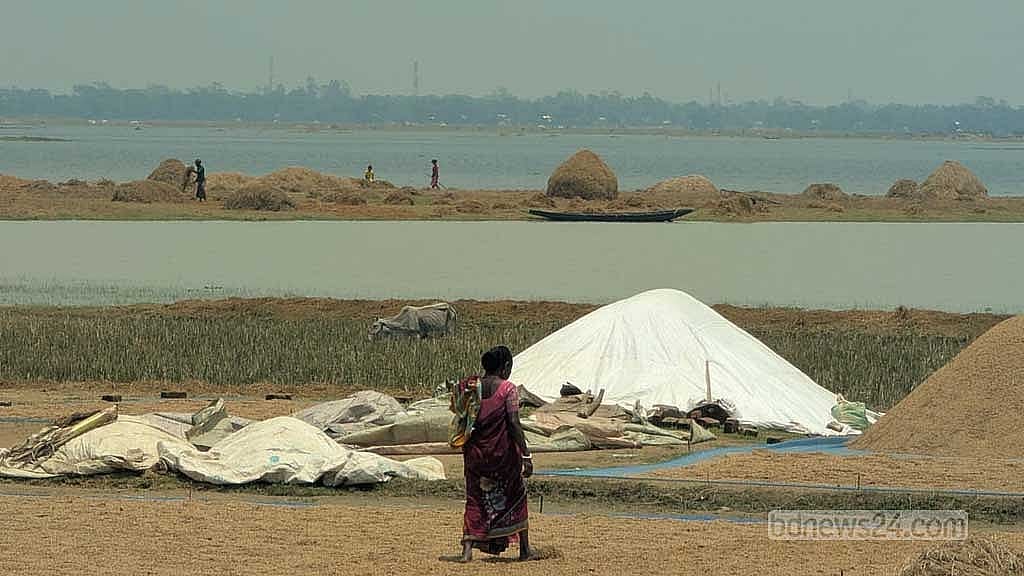
He added that harvested rice had turned black and broken down after drying attempts.
‘Far Higher’ Losses
Sunnamganj Haor and River Protection Movement President Raju Ahmed said at least 50,000 hectares of Boro crop had been damaged.
“Even harvested crops rotted due to rain. Agricultural estimates are underreporting the true scale. Farmers are being deprived of compensation,” he said.
He claimed actual losses are “three times higher” than official figures.
Data from the Food Department shows severe shortfalls across districts.
Out of the 21,349 tonnes paddy target, only 3,773 tonnes have been collected so far. Rice procurement stands at 4,648 tonnes (boiled rice) and 1,981 tonnes (non-boiled rice).
In Dira, out of a 2,985-tonne target, only 388 tonnes were collected. In Shantiganj, just 12 tonnes were collected against 2,121 tonnes.
In Tahirpur, only 30 tonnes were collected against 1,594 tonnes; in Bishwambarpur, 9 tonnes against 956 tonnes. Similar gaps exist across all Upazilas.
Moisture Test Barrier
Officials say procurement depends critically on moisture levels, which must remain between 12 percent and 14 percent for storage suitability. A device is used to measure this before acceptance.
Farmers’ paddy often exceeds this threshold due to delayed drying caused by continuous rainfall, leading to rejection.
Selection is also conducted via manual and digital lottery, limiting each farmer to a maximum of three tonnes.
Officials Defend Estimates
Sadar Upazila Food Controller Shahinur Reza said prolonged rain had directly affected procurement.
“Without proper moisture levels, we cannot store paddy. That is why procurement is below target.”
Tahirpur Local Supply Depot (LSD) Officer Avinash Chandra Das said procurement may improve after Eid as lotteries expanded to more unions.
Shalla LSD Officer Bakul Baidya said, “This year Shalla farmers have suffered the most. That has directly impacted procurement. We have collected only 142 tonnes against a target of 2,212 tonnes.”
Across Sunamganj’s Haor belt, the floodwaters that arrived early have left behind not just submerged fields, but an entire procurement system struggling to source grain that, in many places, no longer exists.