Published : 22 Jul 2026, 04:35 PM
Updated : 08 Sep 2026, 09:27 AM


The Teesta has risen sharply again after persistent rain and an upstream surge, bringing the river close to the danger level in Nilphamari.
Water at the Dalia gauge point is now just 1cm below the official flood mark.
On Wednesday at 9am, the Teesta's water level at the Dalia gauge point (Khalisha Chapani Baishpukur) in Dimla Upazila was recorded at 52.14m, just below the danger level of 52.15m.
Bangladesh Water Development Board (BWDB) Dalia Division Executive Engineer Amitabh Chowdhury said the river could cross the danger mark at any time.
He said the Flood Forecasting and Warning Centre had warned on Tuesday that more upstream water could reach the Teesta overnight.
To keep the flow normal, all 44 gates of the Teesta Barrage have been kept open.
BWDB water gauge reader Nurul Islam said the river remained 1cm below the danger level at both 6am and 9am on Wednesday.
He said the river level on Tuesday stood at 52m at 6am, 51.93m at 9am, 51.90m at noon, 51.89m at both 3pm and 6pm, before rising to 51.98m at 9pm, which was 17cm below the danger mark.
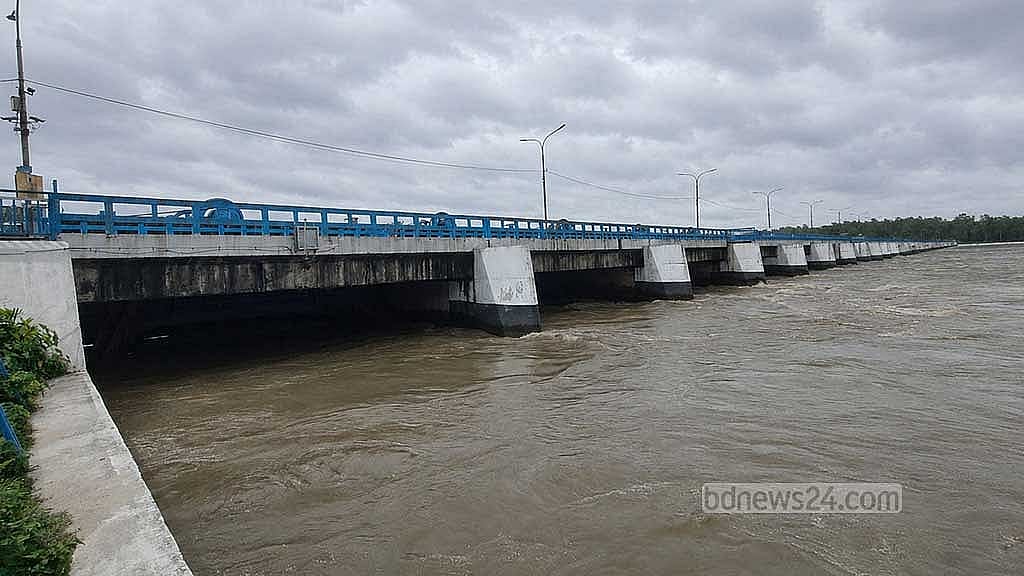
Nurul added that on Monday morning, the river had also flowed 5cm below the danger level, fluctuating between 52m and 52.10m throughout the day.
Since Jul 13, Teesta water has entered low-lying areas of Purba Chhatnay, Khoga Kharibari, Tepa Kharibari, Khalisha Chapani, Jhunagach Chapani, Goyabari in Dimla Upazila, and Golmunda, Dawabari, Shoulemari unions in Jaldhaka Upazila, leaving riverside residents struggling.
Purba Chhatnay Union council Chairman Abdul Latif Khan said around 1,200 families in Jharsingheswar and Purba Chhatnay villages remained stranded, with many moving temporarily to higher ground.
Tepa Kharibari Union council Chairman Robiul Islam Shahin said about 1,350 families in the Char areas of his union had remained marooned since Jul 13.
He said residents had hoped falling water would ease their hardship, but upstream flows had yet to recede.
Engineer Amitabh said it takes roughly one and a half to two hours for water to travel from Mekhliganj Point in India, 25km upstream, to reach the Teesta Barrage at Dalia in Bangladesh.
During heavier upstream flows, it can arrive in about one hour.
He said Teesta water usually flows at 8-10km per hour during normal conditions, but both speed and volume increase significantly when upstream surges occur.
The BWDB is continuing round-the-clock monitoring of river levels.