Published : 24 Mar 2026, 06:35 PM
Updated : 28 Aug 2026, 01:33 AM


Power, Energy and Mineral Resources Minister Iqbal Hassan Mahmood says a sharp increase in demand for fuel after Eid has left petrol pumps running through a full day’s supply in just three hours.
Speaking to reporters at the Secretariat on Tuesday, the first working day after the Eid holiday, Iqbal said the pressure on fuel stations had disrupted the normal supply cycle.
“Demand has suddenly risen so much that pumps which used to sell a full day’s fuel are now running out of that same amount in three hours,” he said.
“Naturally, fuel will be exhausted.”
When asked how much demand there was over a full day, the minister said he did not have the figures with him.
He was speaking about the fuel supply strain linked to the impact of the Iran war.
Although the situation improved somewhat after restrictions on fuel sales were lifted before Eid, it has become more precarious again since the night of Eid.
Long queues of vehicles have continued to build at petrol pumps across the capital amid supply shortages, with many drivers returning empty-handed. Pump workers have also struggled to manage the crowds, and arguments with customers have become frequent.
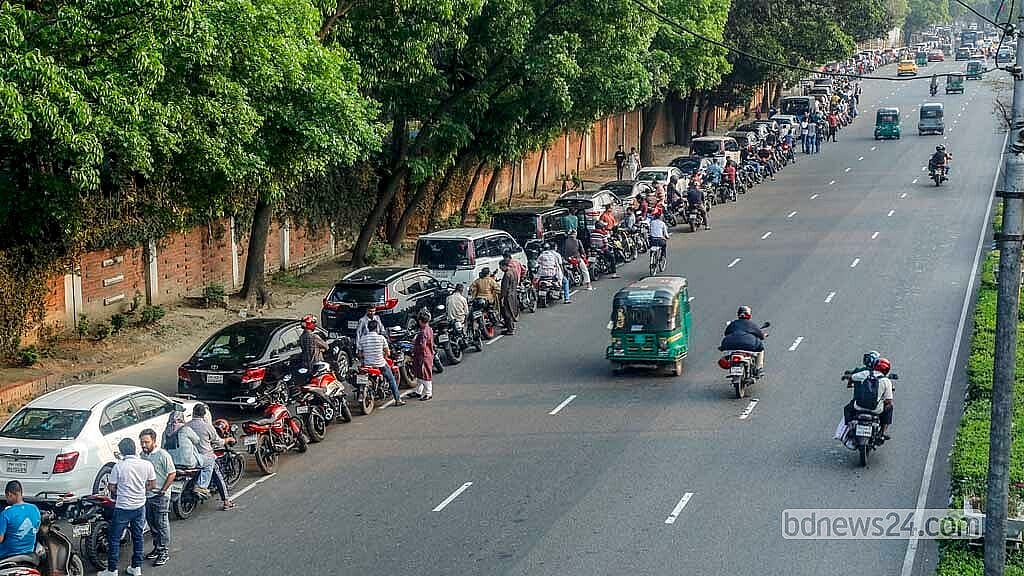
On Monday, two days after Eid, long lines of motorcycles and cars were seen at filling stations across Dhaka during the day and into the evening. The same picture was visible late the previous night.
Long queues were still seen on Tuesday morning. In Paribagh, a line outside one fuel pump stretched almost to Shahbagh.
Pump operators say the main problem is that they are not receiving fuel in line with demand.
Customers, meanwhile, fearing the shortage could worsen, are also buying extra fuel, widening the gap between demand and supply.
Explaining the earlier decision to ration fuel sales, Iqbal said stations were no longer able to carry enough stock through the day.
“The problem was that, earlier, when tank lorries were filled in the morning, the fuel would last the whole day and some would remain,” he said.
“But after selling all day with queues like this, nothing is left over. And it takes time for fuel to reach from our depots by tanker. So there may not be fuel early in the morning, though it becomes available later.”
When it was pointed out that shortages were being seen throughout the day, the minister replied: “You have to understand one thing — demand and stock.”
The government imposed limits on the sale of petrol, octane and diesel on Mar 6 to deal with the crisis, but later withdrew those curbs in view of Eid travel and irrigation demand.
Speaking to reporters at his residence on Monday, Iqbal had urged people to remain patient.
“Take only as much fuel as you need. There will be no problem with fuel,” he said.
It had also been suggested that some supply disruption stemmed from petrol pumps being unable to issue pay orders while banks were closed. But on Tuesday, the minister said he did not have information on that matter.
He said the usual supply process had come under strain because of a sudden rush of customers.
“People have suddenly descended on petrol pumps in huge numbers,” he said.
“Petrol pumps operate under a process. Fuel is supplied according to that system. That system has now broken down.”
He said the volume of fuel being supplied each day had remained unchanged, but the number of customers had increased.
“Naturally there will be queues and some people will not get fuel. That is normal. There is nothing abnormal about it,” he said.
The minister called for cooperation from vehicle owners and said the government would do whatever was necessary to address the situation.