Published : 10 Aug 2026, 06:24 AM
Updated : 08 Sep 2026, 09:31 AM


When Israel launched its latest war against Hezbollah in March, its first warnings were strikingly different from those that typically precede an air campaign. The targets were not only weapons depots or underground command centres. They were banks.
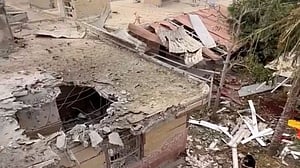
Israeli fighter jets destroyed more than 12 branches of Al-Qard al-Hassan, a shadowy financial institution long accused of functioning as Hezbollah’s bank in Lebanon, The New York Times reported.
Israel also struck exchange shops used by Iran to send money to Hezbollah and gas stations that generated revenue for the group.
The attacks marked the most aggressive effort yet by Israel, the Trump administration and Lebanon’s government to disrupt Hezbollah’s finances, particularly the flow of money from Iran.
In the months before the war, Lebanon’s government, under pressure from Washington, had reportedly moved to restrict the routes Hezbollah used to receive and transfer funds, including through Beirut’s international airport.
The United States also pressed Lebanon’s central bank to tighten controls over the country’s largely cash-based economy, which Hezbollah had long exploited.
The campaign is part of a wider US-Israeli effort to constrain Tehran’s ability to project power through allied armed groups across West Asia.
The Squeeze on Hezbollah’s Finances
The full impact of the crackdown is difficult to measure. Hezbollah’s finances are closely guarded, while both the group and Iran have repeatedly demonstrated an ability to rebuild military capabilities and find alternative channels for moving money, according to the NYT.
Still, the pressure has begun to affect the group’s ability to meet some of its obligations.
In May, Hezbollah spokesperson Youssef al-Zein told the NYT that the group had stopped compensation payments promised to supporters as it struggled to meet the needs of hundreds of thousands of people displaced by the war.
The US State Department has estimated that Iran provided Hezbollah with about $700 million a year, covering most of the group’s roughly $1 billion budget.
Lebanese, US and Israeli officials told the NYT that Tehran had increased its support over the past year, but still failed to cover Hezbollah’s war-related expenses.
Washington Targets Hezbollah’s Lifelines
For decades, Hezbollah operated something approaching a state within Lebanon, providing food, housing and salaries to supporters while maintaining media outlets, hospitals and schools.
It also generated income through businesses including petrol stations and pharmaceutical companies and amassed an arsenal larger than Lebanon’s own military, financed in large part by Iran.
The collapse of Syrian President Bashar al-Assad’s government closed the land corridor that Iran had relied on to funnel resources to Hezbollah.
Tehran was then forced to seek alternative ways to finance its Lebanese ally, according to US and Israeli officials and people familiar with Hezbollah’s finances.
One route was Beirut’s international airport, which had long been viewed as operating under significant Hezbollah influence. US and Lebanese officials said it was used to bring in Iranian money and weapons.
In early 2025, US officials warned Lebanon that Iran was sending dollars to Hezbollah on civilian flights to Beirut, sometimes carried by diplomats. Lebanon subsequently suspended flights from Iran, removed Hezbollah-linked airport staff and strengthened security coordination with Washington.
Washington then turned its attention to Lebanon’s central bank. The Trump administration also sought to influence the selection of a new central bank governor last year, a senior Lebanese official told the NYT.
Hezbollah’s media office rejected the allegations, describing claims of economic exploitation as “false and entirely baseless”.
As larger money-service businesses came under scrutiny, Hezbollah shifted funds through Iran, the UAE, Turkey and Iraq using hawala, an informal broker-to-broker transfer system that does not necessarily require cash to cross international borders.
From Cash to Gold
The financial squeeze pushed Hezbollah towards another store of value: gold.
After the US Treasury sanctioned Lebanese money exchangers last November, the group began searching for alternative sources of cash, according to the NYT.
Weeks before the latest war, in February, the Treasury said senior officials at Al-Qard al-Hassan had established a network of gold-trading companies to generate funds.
US and Israeli officials told the newspaper that Hezbollah had sought to convert gold into cash after Israeli airstrikes destroyed a significant portion of its foreign currency and gold reserves.
Al-Qard al-Hassan provides interest-free loans and war-related compensation to hundreds of thousands of Lebanese people, many of them Hezbollah supporters.
The organisation describes itself as a charitable lending association rather than a bank, while its director has maintained that Hezbollah keeps its organisational finances separate from the institution.
The Trump administration is now pressing Lebanon to shut Al-Qard al-Hassan down entirely, the NYT reported.
After the 2024 war, Hezbollah said the organisation would provide $12,000 to $14,000 per household to families whose homes had been destroyed.
Those payments were repeatedly delayed. They have now been stopped altogether, according to Hezbollah spokesperson al-Zein, the NYT reported.
For Hezbollah, the financial campaign has opened another front in a conflict where money itself has become a battlefield -- and where every disrupted route forces the group to search for another way to survive.