Published : 21 Sep 2026, 12:54 PM
Updated : 21 Sep 2026, 12:54 PM


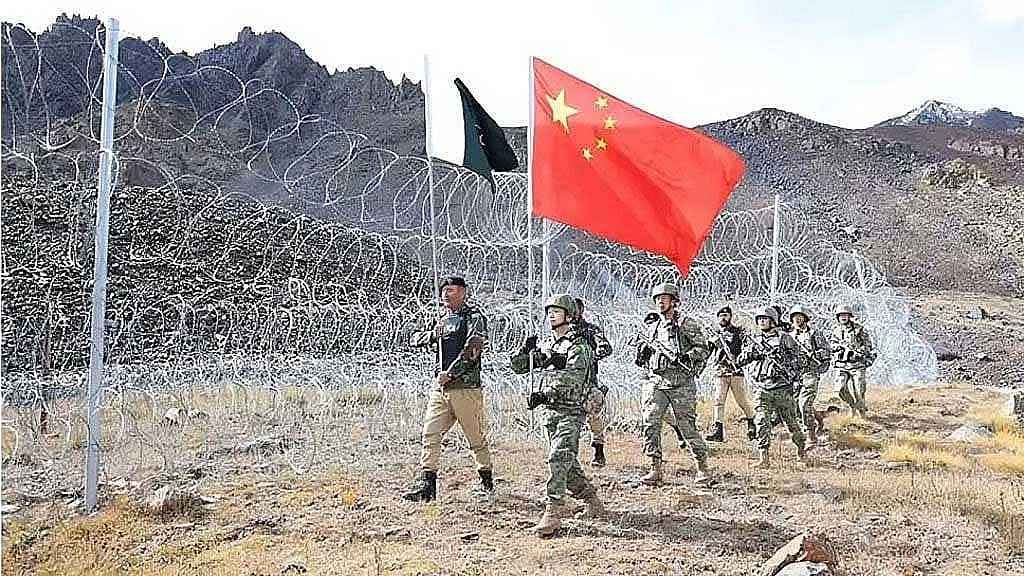
Pakistan and China have formalised a joint mechanism for managing their Himalayan frontier, drawing a sharp response from India over territory New Delhi claims as its own, the BBC reports.
The two countries signed the Pakistan-China Boundary Joint Commission last week, with Pakistan describing it as a significant milestone for cooperation on border management, trade and connectivity between the two regional rivals, the British broadcaster said.
India rejected the move as having no legal basis, saying it does not recognise any Pakistan-China boundary in territory it claims as Indian.
The announcement comes at a sensitive time as India and China seek to stabilise ties after years of military tensions along the Line of Actual Control (LAC), the disputed line separating their forces along much of their Himalayan frontier.
At the same time, Beijing and Islamabad are deepening cooperation along a neighbouring stretch of the frontier also claimed by India.
“There is no boundary between Pakistan and China,” Indian foreign ministry spokesman Randhir Jaiswal said, rejecting the joint commission as having no legal basis.
The commission covers the Pakistan-China frontier, including the Shaksgam Valley, a roughly 5,180sqkm tract that Pakistan ceded to China in 1963 but which India claims as part of its territory in Ladakh.
India says the territory was part of the former princely state of Jammu and Kashmir and was illegally occupied by Pakistan before being ceded to China.
The Indian government has never recognised the agreement and considers it illegal and invalid.
The history helps explain the sensitivity surrounding the announcement, per the BBC.
“Pakistan has no locus standi to enter into arrangements concerning Indian territory under its illegal and forcible occupation,” the Indian foreign ministry said.
Pakistan says Jammu and Kashmir remains a disputed territory and argues that India therefore has no standing to challenge its 1963 boundary agreement with China. Islamabad considers the agreement valid.
Jabin Jacob, a professor at the Department of International Relations and Governance Studies at Delhi’s Shiv Nadar University, said the latest development represents the revival of an old mechanism rather than an entirely new arrangement.
A joint boundary commission was already provided for in the 1963 Sino-Pakistan agreement, with the key issue being the timing of its operationalisation, Jacob told the BBC.
He said the timing could reflect several factors, including China’s broader effort to demarcate its boundaries and a desire to institutionalise exchanges and movement along the frontier at a time when Pakistan’s other borders have experienced conflict and instability.
Jacob said the development should concern India and argued that the move appears to disregard a provision in the 1963 treaty itself.
Article 6 of the agreement provided for its renegotiation once the Kashmir dispute was settled with whichever country ultimately controlled the territory, Jacob said.
He also said India’s concerns are compounded by the international information environment.
China’s relative dominance of the international media and information landscape, including CGTN, CRI and its social media presence, allows it to put forward its narrative and maps globally, while India is more limited in its ability to do so, the professor added.
The issue is separate from the practical management of the frontier itself. Pakistan and China already have extensive infrastructure and connectivity links across the region, including the China-Pakistan Economic Corridor (CPEC) and the Karakoram Highway.
Husain Haqqani, a former Pakistani ambassador to the United States and now a senior fellow at Anwar Gargash Diplomatic Academy and the Hudson Institute, said the new commission has both practical and political dimensions.
He said the mechanism could strengthen border and boundary cooperation, prevent illegal crossings and protect strategic infrastructure linked to CPEC.
It also serves as a signal to India that Beijing continues to view Kashmir through the Pakistani prism, Haqqani said.
“China has never accepted India’s position on Kashmir,” he said.
Gilgit-Baltistan is part of Pakistan-administered Kashmir, borders China and is claimed by India as part of its territory.
Haqqani said Islamabad’s position has evolved in response to developments in Indian-administered Kashmir.
Pakistan still maintains that the final status of Jammu and Kashmir has yet to be decided, he said.
But following India’s internal changes, including the abrogation of Article 370 in its part of Kashmir, Pakistan sees no issue with institutionalising what has been de facto with China since 1963.
For Beijing, the arrangement also reportedly fits into a broader pattern of using relationships with neighbouring states to manage and signal its position towards India.
Haqqani said reassurance to Pakistan on Kashmir has both strategic and geopolitical value for Beijing.
Strategically, he said, it further deepens ties with Pakistan, while geopolitically it reinforces India’s concerns about a two-front threat from China and Pakistan, which benefits both Islamabad and Beijing.
The timing of the announcement is also significant, according to the experts cited by the British broadcaster.
Haqqani said China plans its decisions months, if not years, in advance, meaning the decision to operationalise the joint boundary commission must have been taken some time earlier.
He said the information was released after President Xi Jinping’s recent BRICS summit trip to reassure Pakistan about the strategic partnership and remind India that multilateral engagement does not represent a change in China’s vision for South Asia.
Jacob, however, cautioned against interpreting every aspect of the development as a direct military move against India.
“There aren’t any immediate or apparent implications for the LAC as of now,” he said.
The significance of the announcement may therefore lie less in any immediate change along the disputed Himalayan frontier than in the gradual institutionalisation of arrangements that India has consistently rejected.
India’s position remains “clear and consistent”, Jaiswal said, adding that any attempt to legitimise what New Delhi considers Pakistan’s illegal occupation of Indian territory is unacceptable and has no bearing on India’s sovereignty.
Haqqani, however, said the dispute goes beyond the legalities of borders.
He described the key disagreement between India and China over the border as geo-strategic rather than cartographic, saying there is therefore a limit to what border negotiations and management mechanisms can achieve.
Pakistan, he added, remains “China’s secondary deterrent against India”, with Beijing’s engagement with Islamabad continuing to send that message to New Delhi.