
Published : 22 Apr 2024, 10:47 AM
Updated : 22 Apr 2024, 12:46 PM


The heatwave currently sweeping across Bangladesh has already claimed several lives. Three people died amid the heat in Meherpur, Sylhet, and Narsingdi on Sunday, while two more died in Pabna city and Gazipur’s Konabari. Doctors believe they suffered from ‘heat stroke’.
The mercury hit 42.6 degrees Celsius in Jashore on Saturday, a record for the year. And there seems little chance of the heat letting up. The Bangladesh Meteorological Department’s forecasts say temperatures are likely to remain the same or even rise slightly over the next few days.
As the UN was warned, the world now lives in the era of ‘global boiling’.
So, how hot is too hot for the human body to handle?
James Gallagher, presenter for BBC Radio 4’s programme ‘Inside Health’, took part in a heatwave experiment to find out. With the help of Prof Damian Bailey from the University of South Wales, the presenter was put through a ‘typical heatwave encounter’ under laboratory conditions in an environmental chamber.
The environmental chamber is an airtight space where temperature, humidity, and oxygen levels can be controlled.
They started the experiment at 21 degrees Celsius, raised the temperature to 35 degrees Celsius and then to 40.3 degrees Celsius, which was the equivalent of the UK’s hottest day.
Gallagher was connected to equipment that monitored the temperature of skin and internal organs, the heart rate, and blood pressure. In addition, a mouthpiece was used to analyse the air he exhaled and an ultrasound was in place to inspect the flow of blood to the brain through the carotid artery.
"The thermostat in the brain, or hypothalamus, is constantly tasting the temperature, then it sends out all of these signals to try to maintain that," Prof Bailey told the BBC.
The goal of Gallagher’s body was to maintain the 37 degrees Celsius core temperature while the external temperature rose.
Gallagher finds that 35 degrees Celsius is bearable, but says he would not want to work or exercise in such weather. But at 40 degrees Celsius, he says the heat began to ‘pound him’.
"It's not linear, it's exponential. Five degrees centigrade [more] doesn't sound much, but it really is physiologically so much more of a challenge," Prof Bailey says.
Afterwards, Gallagher was shocked to find that he last more than a third of a litre of water due to sweating during the experiment.
As a person heats up, the blood vessels near the surface of the skin open up to make it easier for the blood to lose heat to the air. At 40 degrees Celsius, the heart rate rises significantly as it has to pump an extra litre of blood per minute around the body than at 21 degrees Celsius.
This extra strain is why there are more heart attacks and strokes when the temperature rises.
Even a simple memory test proves more difficult for the BBC presenter after the ordeal. His score on the puzzle fell from 23 out of 30 to 17 out of 30 in less than an hour of heat strain.
But another factor that wasn’t part of the experiment was the water vapour in the air – the humidity.
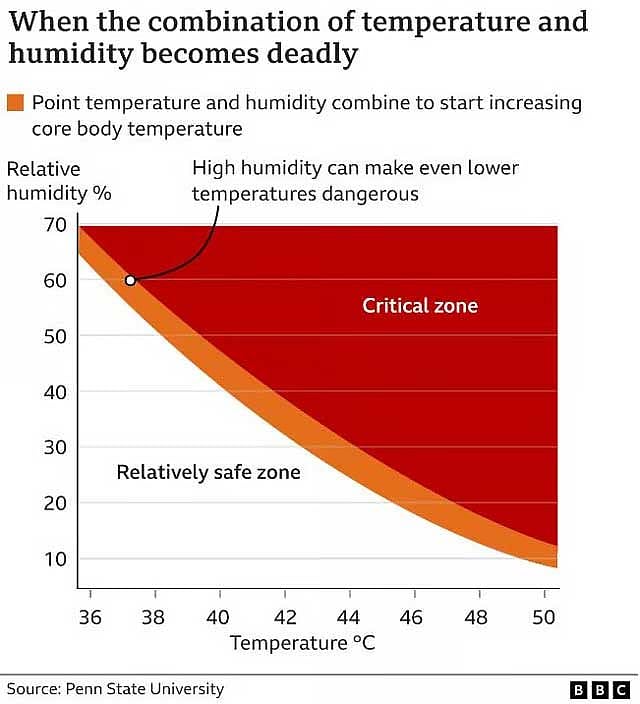
Humans sweat as a way to cool off. Our sweat carries heat from our bodies to the surface of the skin. Once that sweat evaporates into the air, it carries the heat with it, in effect cooling the body. But sweating isn’t enough. If it is too humid, then there are already high levels of water in the air that makes it difficult for sweat to evaporate.
When the humidity is high, people can become dangerously hot, even at lower temperatures.
Rachel Cottle, a researcher, told the BBC that one major concern is that heatwaves are growing more frequent, longer, more severe, but also more humid.
The problem isn’t one just confined to a future affected by climate change. India and Pakistan experienced severe heatwaves at critical temperatures and high humidity in 2023, she said.
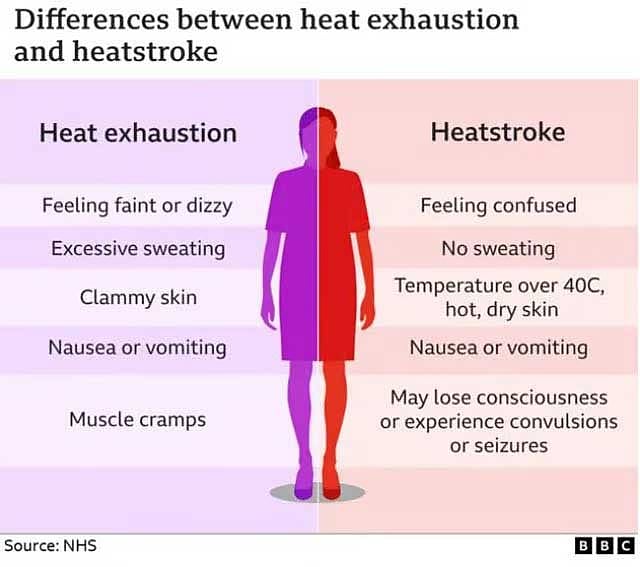
The human body is made to operate at a core temperature of approximately 37 degrees Celsius. As that core temperature rises to 40 degrees Celsius, we become light-headed and prone to fainting.
Higher core temperatures can damage body tissue – like heart muscle and the brain. It can even grow deadly.
"Once the core temperature rises to around about 41-42 degrees centigrade we start to see really, really significant problems and if not treated the individual will actually die as a result, succumbing to hyperthermia," Prof Bailey told the BBC. This is a ‘heat stroke’.
The ability to handle the heat varies from person to person, but age and poor health can make us more vulnerable. Old age, heart disease, lung disease, dementia and some medications strain the body, making it less adaptive to the heat.
The tips to stay cool under the circumstances are widely known – keep to the shade, wear loose clothes, keep living and working spaces cool, avoid strenuous exercise especially in the heat, and stay hydrated.