Published : 26 Jul 2026, 03:52 AM
Updated : 08 Sep 2026, 09:27 AM


Daffodil Group is highlighting Bangladesh’s expanding strengths in advanced technology, artificial intelligence (AI), robotics, smart manufacturing, and the emerging semiconductor industry at the Semiconductor Symposium and BEAR Summit 2026.
The event was held on Saturday at Bhashani Novo Theatre in Dhaka’s Agargaon.
A statement by the group has said it is showing how closer collaboration across education, research, industry, and innovation can help speed up Bangladesh’s shift toward a knowledge and technology-based economy.
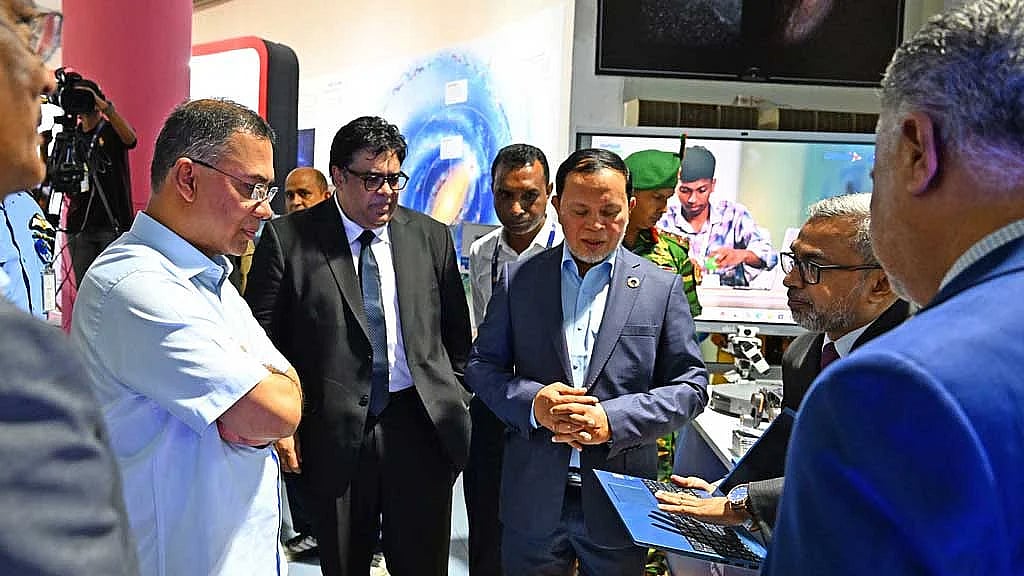
Prime Minister Tarique Rahman visited the Daffodil Computers pavilion during the summit, accompanied by Fakir Mahbub Anam, minister for the Ministry of Posts, Telecommunications and Information Technology and the Ministry of Science and Technology; Rehan Asif Asad, ICT advisor to the government; and senior government secretaries, the statement added.
During the visit, he toured Daffodil’s technology exhibits, with particular attention on the laptop and ICT hardware manufacturing operations of DCL Hi-Tech, the group said.
He also reviewed the company’s production capabilities and praised the initiative, stressing the importance of promoting locally made technology products in global markets under the Made in Bangladesh brand, encouraging stronger recognition of Bangladesh’s domestic manufacturing capacity.
The prime minister held a discussion with Prof Md Sabur Khan, chairman of Daffodil Group, where he presented several innovative projects and technology-based solutions developed by students of Daffodil International University (DIU).
The statement cited Prof Khan as saying many of them could support government development efforts more efficiently and at lower cost.
Tarique expressed appreciation for the initiatives, while the minister and ICT advisor also endorsed their value, it added.
Prof Khan invited the prime minister to visit Daffodil Hi-Tech Park, noting its important role in strengthening Bangladesh’s technology ecosystem and producing industry-ready skilled professionals.
During the discussion, Prof Khan also proposed reactivating the ICT Task Force, first established in 2001 under the late premier Khaleda Zia, to help accelerate the development of the country’s ICT sector.
Highlights of the Daffodil Pavilion
The group said DCL Hi-Tech is showcasing its advanced electronics manufacturing capabilities, including Surface Mount Technology (SMT), Printed Circuit Board (PCB) assembly, product integration, and quality assurance, reflecting Bangladesh’s growing capacity in electronics production.
Daffodil Robotics is presenting innovative solutions in robotics, automation, embedded systems, and AI-powered technologies, along with industry-focused projects developed by students and researchers.
According to the statement, Daffodil International University (DIU) is displaying work in artificial intelligence (AI), the Internet of Things (IoT), cybersecurity, extended reality (XR), capstone projects, startup development, and industry-linked research, underscoring its commitment to preparing future-ready technology professionals.
As part of its digital transformation efforts, Daffodil Software is exhibiting AI-driven solutions such as AI Professor, Central AI, the Integrated University Management System (IUMS), and 1 Card, showing how artificial intelligence is improving education, administration, and organisational efficiency.
Through its participation in BEAR Summit 2026, Daffodil Computers is creating new opportunities to connect with policymakers, universities, research institutions, industry leaders, development partners, investors, and international technology organisations, the group said. The event is also opening doors to research collaboration, technology transfer, joint innovation, and stronger industry-academia partnerships.
Organisers believe this integrated ecosystem of education, research, industry, and technology will make a major contribution to Bangladesh’s semiconductor and high-tech sectors, while helping equip the country’s young people with the skills needed to compete in the global technology landscape.