Published : 24 Sep 2026, 12:00 AM
Updated : 24 Sep 2026, 12:00 AM


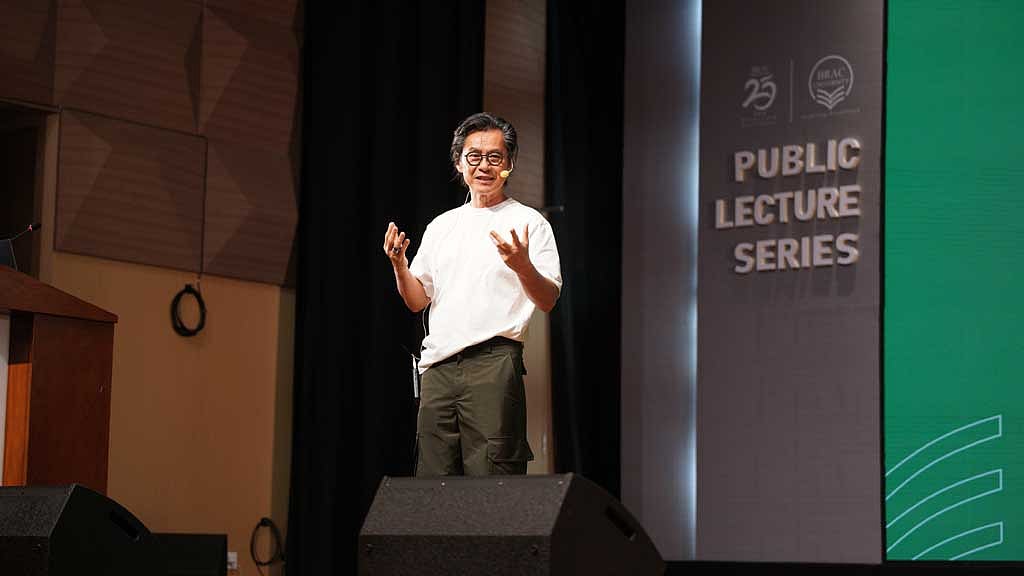
Architect Wong Mun Summ, designer of BRAC University's award-winning campus, has shared ideas for making tropical cities more livable amid climate change, according to the university press release.
Summ, founding director of Singapore-based architectural firm WOHA, delivered the lecture titled “Form Intelligence: Towards a New and Regenerative Tropical Urbanism” at BRAC University's Merul Badda campus on Wednesday.
The lecture was part of the Silver Jubilee Public Lecture Series marking BRAC University's 25th anniversary, the university said.
Drawing on WOHA's projects and its “Garden City Mega City” concept presented at the Venice Biennale in 2016, Summ explored ways to reimagine dense tropical cities by bringing together people, nature, climate-responsive design and communities, according to BRAC University.
He described “form intelligence” as the ability of architectural form to respond to and enhance the systems around a building, making architecture an active part of urban performance rather than simply a container.
BRAC University said WOHA's projects are characterised by layered structures, greenery, breezeways and civic spaces.
Parkroyal Collection Pickering in Singapore, for example, has greenery covering more than twice the site's area, while Oasia Hotel Downtown has a green façade that has reduced cooling energy consumption by 43 percent and maximum façade temperature by 21 percent, the university said.
Another WOHA project, Pan Pacific Orchard in Singapore, uses four open-air strata stacked vertically. Its greenery provides filtration, pollutant removal and temperature regulation, according to the press release.
The firm has also developed a masterplan for a self-sufficient new town in northern Jakarta designed to accommodate 210,000 people, the university said.
The project features layers for housing and workplaces, rainforest-like spaces and underground transport and services.
WOHA's broader vision is to make Singapore a livable, sustainable and resilient city by 2100, where people and nature coexist within regenerative and circular systems, BRAC University said.
Speaking about the BRAC University campus, Summ cited a social survey in which 88 percent of respondents said the campus made them proud to be part of the BRAC community.
“The country itself is extremely proud of…this extension of the nature (the campus)…giving to nature and becoming a part of nature,” Vice-Chancellor Professor Syed Ferhat Anwar said.
Pro-Vice-Chancellor Professor Arshad Mahmud Chowdhury, Treasurer Ariful Islam, Registrar David Dowland and Professor Fuad Hassan Mallick, dean of the School of Architecture and Design, attended the lecture.
Khairul Basher, director of the Office of Communications, moderated the event.