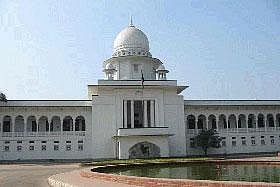
Dhaka, May 12 (bdnews24.com)—The Supreme Court has lifted a ban on fatwa but said extralegal punishments, both physical and psychological, through Islamic religious edicts are illegal.
The top court partially upheld the earlier High Court verdict but added a number of observations.
A six-strong Appellate Division bench, headed by chief justice A B M Khairul Haque, delivered the verdict on Thursday that modified the High Court order of 2001 clamping a blanket ban on.
The top appeals court said that "properly educated persons" may dispense fatwa which may be "accepted only voluntarily".
The verdict was delivered upon two petitions challenging the High Court's judgement that outlawed all forms of edicts after a series of fatwas inflicted beating and caning on rural women, leading to deaths in some cases.
In a landmark verdict on Jan 1, 2001, the High Court bench of justices Golam Rabbani and Nazmun Ara Sultana banned fatwa outright and all associated punishments.
Mufti Mohammad Toyeeb and Abul Kalam Azad filed two writ petitions against the HC verdict with the Supreme Court the same year.
The court started hearing the appeals on Mar 1, 2011, over 10 years after filing of the petitions.
In the short order, the highest constitutional court on Thursday said 'fatwa on religious matters only may be given by the properly educated persons which may be accepted only voluntarily but any coercion or undue influence in any form is forbidden1.
It added that no person can pronounce fatwa which violates or affects the rights or reputation or dignity of any person which is covered by the law of the land.
"No punishment including physical violence and /or mental torture in any form, can be imposed or inflicted on any body in pursuance of fatwa."
Attorney general Mahbubey Alam told reporters after the verdict, "Violence against women will fall now that punishments through fatwa have been banned."
He recommended the government include family laws in Madrasa curriculum.
The petitioners welcomed the court order too.
Abdur Razzaque, one of the lawyers for the petitioners, said, "The verdict is in favour of liberty of individuals and freedom of expression. But the order also calls for caution so that one's freedom of opinion does not stop others from doing so."
Nazrul Islam, another lawyer for the petitioners, said, "No-one can laugh at fatwa any more after this verdict."
The court heard observations of T H Khan, Rafique Ul Haque, Rokanuddin Mahmud, Mahmudul Islam, M Zahir, A B M Nurul Islam, A F Hassan Ariff, Tanya Amir and M I Faruki as amici curiae or friends of court.
It also listened to opinions of five eminent Alems or Islamic scholars.
The Appellate Division said that the High Court order had been appropriate to judge the incident on which it handed down the verdict.
It added the verdict is not applicable to all sorts of fatwas.
Human-rights activists say fatwa is frequently issued at the level of local mosques to settle marital disputes and cases of rape, the ruling being weighed against women.
There was a public outcry recently when a 14-year-old girl was raped and the local clergy issued a fatwa, subjecting her to public lashing. She died during the flogging.
bdnews24.com/sn/mi/ach/bd/1104h