Published : 24 Jul 2026, 12:33 AM
Updated : 08 Sep 2026, 09:27 AM


The conflict in Ukraine, now in its fifth year, appears to be nearing a decisive stage. On one side, there is growing talk of a negotiated settlement; on the other, fears are mounting that the fighting could spiral into a direct confrontation between Russia and Ukraine's European backers.
President Donald Trump, who hoped to leverage his rapport with Russian President Vladimir Putin to achieve a quick peace deal, appears to have given up on his quest. Instead, the US President has fallen in line with European leaders and promised to grant licence to Ukraine to manufacture critical air defence missiles.
Trump’s apparent change of heart has come at a time when Ukraine, unable to make headway on the battlefield, is trying to damage Russia’s economy and logistics through aerial attacks.
Ukraine’s recent air campaign, using long-range drones and missiles to hit Moscow’s energy infrastructure deep inside Russian territory has had a significant effect on the country’s oil refining capability, triggering widespread fuel shortages.
Ukraine has also ramped up attacks on routes that supply Russia-occupied Crimean peninsula with fuel and other essentials, creating the impression of a “siege from the sky”.
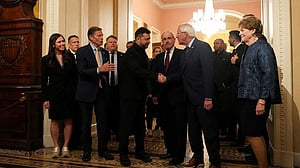
Ukraine’s success with hitting targets deep inside Russia brought praise from NATO leaders at the recently concluded summit of the North Atlantic Treaty Organisation in Ankara. By all accounts, President Trump was impressed and persuaded to restore US backing for Kyiv.
Drones and Propaganda
Only a year ago, Trump firmly believed Ukraine’s case was a hopeless one, that Kyiv had no cards to play, and that there was no reason to pump in any more money or weapons into this pointless war. Trump, therefore, needed to be convinced that Ukraine could “win”.
There are speculation that this “turning of Trump” may have been effected through a carefully planned propaganda campaign, in tandem with Ukraine’s drone offensive inside Russia.
A few months ago, Western leaders and commentators in the media began talking about the possibility of a “Ukrainian victory”, no matter how utterly outlandish that sounded. They all started using one particular line -- “the tide has turned” -- in their speeches, interviews and articles, some adding phrases like “Russia is collapsing”, or “Ukraine is winning” for good measure.
However, it is difficult to see where or how the tide of this conflict may have “turned”. There is hardly any good news for Ukraine from the front lines, where Russian troops continue to advance.
In reality, the “tide” has not turned since Ukraine’s dismal offensive in the Zaporizhzhia region in 2023. Since the defeat of Ukraine’s offensive, it is Russia which has held the whip-hand all along the front lines.
Russia has achieved significant victories in capturing heavily fortified cities such as Bakhmut in 2023, Avdiivka in 2024, Pokrovsk and Myrnohrad at the end of last year and Konstantinovka most recently. Russian forces are converging on Slavyansk and Kramatorsk, the last two remaining fortress-cities in the province of Donetsk.
FPV Drones Rule the Sky
One of Ukraine’s biggest challenges has been manpower. Despite more than eight rounds of mobilisation, Ukraine’s military suffers from chronic shortages. Millions of Ukrainians have left the country and many of those remaining are desperately trying to avoid getting drafted into the military.
As a result, men are often being forced into the military, and sent to the front without adequate training. This is making it increasingly difficult for Ukraine to defend cities or fixed defence lines. New technology, however, is creating a breathing space.
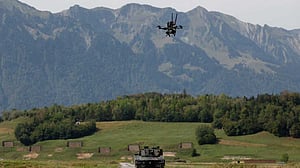
Short-range FPV drones carrying explosives that can disable even an armoured vehicle have become Ukraine’s prime tactical defence against the Russian onslaught. Russians have also been using FPV drones effectively during their advances, and pioneered the use of fibre optic cables to make the drones unjammable.
This is slowing down the Russian advance, and making it expensive in terms of men and material. But it has not stopped the advance, as the recent fall of Konstantinovka demonstrates.
Ukraine’s strategy for survival now rests on testing Russia’s pain threshold. The goal of the long-range strikes on energy infrastructure is to make the military conflict too costly for Moscow to continue.
This has the blessing of the NATO alliance which sees the weakening of Russia as a good outcome. Ironically, NATO also sees a heightened threat from Russia, even though the same Russia, according to their own narrative, is collapsing and losing.
The alliance is now planning to dramatically increase its military production in order to supply Ukraine as well as bolster its own defence.
Definition of ‘Victory’
Ukraine’s drone campaign, rather than any change in the battlefield dynamics, coupled with the constant “tide has turned” propaganda, may have finally succeeded in impressing President Trump.
The attacks on oil installations produce dramatic video footage of fire and plumes of black smoke rising high into the sky. Such optics help pro-Ukraine social media accounts to amplify their “Russia is collapsing” narrative.
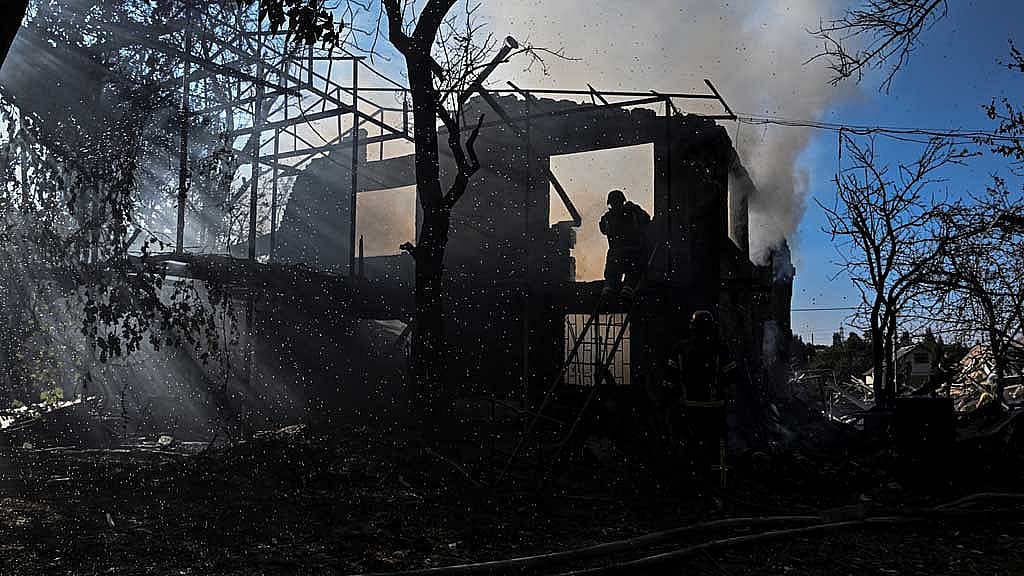
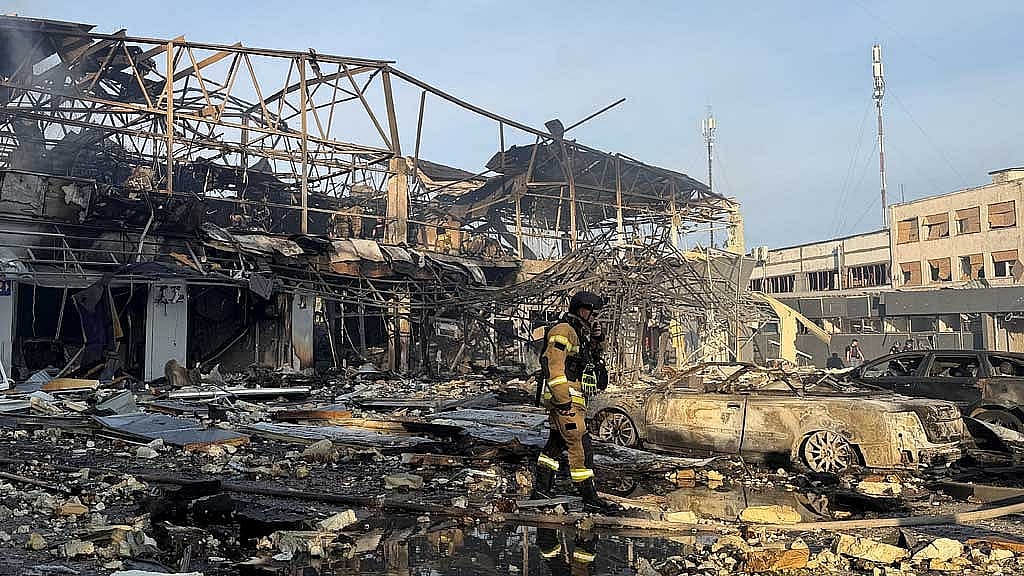
Ukraine’s attacks in Russia are coming with a major cost. Russia has vastly ramped-up its own drone and missile attacks on Ukrainian cities, particularly the heavily-defended capital Kyiv, targeting factories and warehouses manufacturing, storing and distributing drones and missile components.
Russia is currently fixated on the battlefield, with Slavyansk and Kramatorsk the next big prizes. There are indications Russia plans to envelope the twin cities in one big encirclement, with troops moving from north and south towards these sprawling urban centres.
For Russia, “victory” would mean total control over two Ukrainian provinces, namely Luhansk and Donetsk in addition to Crimea. Russia is receptive to the idea of freezing the existing frontline in two other provinces, Zaporizhzhia and Kherson.
But what Russia mostly wants is a final peace deal, which will explicitly bar Ukraine from joining NATO or deploying Western military forces in their territory. In short, Russia’s goals from the war have remained virtually unchanged since 2022.
The definition of a Ukrainian victory, on the other hand, has undergone a dramatic change over the past few years. In 2023, victory meant recovery of all Ukrainian land occupied by Russia including Crimea which Moscow seized in 2014. These days, compelling Russia to agree to an unconditional ceasefire, with the war “frozen” along all frontlines would be enough.
In addition, European countries such as Britain, France and Germany want to deploy their own troops in Ukraine as guarantors of Kyiv’s security.
From ‘Proxy’ to Real War
The Ankara summit has probably torpedoed any hopes of a negotiated settlement of the Ukraine conflict. The talk now is mostly about doing intolerable damage to the Russian economy through deep strikes, and making Crimea “unlivable” through a siege from the sky.
Inside Russia, pressure is mounting on President Putin to turn his “special military operation” into a full-scale military operation, by mobilising reservists and launching new offensives to take the war beyond eastern Ukraine. Putin has evidently ordered a major escalation in the missile and drone warfare targeting Ukraine’s industrial facilities. But a full mobilisation remains unlikely.
Russia’s goal is not to just defend its territory from drone attacks -- which can be a daunting task against drone swarms -- but to destroy the industrial capacity that produces those drones.
Russia’s evident willingness and ability to destroy Kyiv’s industry, has led to speculation that a lot of Ukraine’s drone and missile-making capacities may be shifted to locations in NATO countries.
This raises the stakes much higher: any Russian attack on those facilities will be viewed as an attack on a NATO country, thus triggering a direct response from the alliance, including deployment of troops in Ukraine in a combat role and use of Western aviation and naval powers against Russia.
For Russia, the West has always been “involved” in this conflict. Kremlin views this as NATO’s “proxy war” where Ukraine’s land and manpower is used by the alliance to deliver a strategic defeat to Russia.
Ukraine relies totally on financial support from the European Union, which recently granted Kyiv 90 billion Euros worth of loans. Ukraine’s fighting ability depends wholly on NATO, which supplies its weapons and ammunition, provides intelligence including targeting information, delivers training and advisors.
Without external financial and military support on a daily basis, the very survival of Ukraine as a functioning state would be at risk.
The rapidly escalatory nature of the drone and missile campaign from both sides, with an ever-increasing number of hits on high value assets, has the potential to drag NATO into a direct confrontation with Russia.
In that scenario, the “nuclear clock” will be close to midnight.
[Sabir Mustafa is a journalist, writer and podcaster. He is a former head of the BBC Bangla service and a former managing editor at VoA Bangla.]
He can be contacted at: sabir.mustafa@gmail.com