Published : 25 May 2026, 08:05 PM
Updated : 21 Aug 2026, 03:46 PM


More than 1.5 million Muslims from across the globe have gathered in Saudi Arabia to begin the annual Hajj pilgrimage amid intense summer heat and regional tensions in the Persian Gulf.
Pilgrims began converging on the tent city of Mina on Monday, marking the commencement of the multi-day spiritual journey.
Hajj is the fifth pillar of Islam, a mandatory religious duty for all physically and financially capable Muslims to perform at least once in their lifetime.
As part of the rituals, pilgrims must stay in Mina, Arafat, and Muzdalifah from the 8th to the 13th day of the Islamic month of Dhu al-Hijjah.
To avoid heavy crowds, some tour operators moved pilgrims to Mina on Sunday night immediately after the Isha prayers.
Mina is situated roughly nine kilometres from the Grand Mosque, Masjid al-Haram, in Makkah, with pilgrims arriving either by vehicle or on foot.
The pilgrims will return to their accommodations after six days, requiring them to carry essential personal items for their stay in Mina.
Before leaving their Makkah residences, male pilgrims perform ablutions and put on the Ihram -- two pieces of unstitched white cloth -- whilst carrying an extra set in their bags.
A small personal bag must be carried by each pilgrim containing a set of regular clothes, toiletries, a mobile phone with a charger, a sacrificial coupon purchased from the Islamic Development Bank for 720 Saudi Riyals, and light bedding for the night stay in Muzdalifah.
Tour operators only handle food arrangements, meaning individuals must manage their own luggage.
The Mecca Met Office and the Saudi National Center for Meteorology (NCM) issued a forecast indicating that the maximum temperature could climb to 47 degrees Celsius (°C) during the pilgrimage, advising everyone to use umbrellas for protection.
Pilgrims will spend the entire day on Monday, the 8th of Dhu al-Hijjah, in Mina.
Following the Fajr prayers on Tuesday, the 9th of Dhu al-Hijjah, they will gather at the plains of Arafat, located about 14km away, filling the air with the collective chant of "Labbaik Allahumma Labbaik" to signify their presence before Allah.
The gathering at Arafat forms the core ritual of the entire Hajj pilgrimage, where worshippers must remain until sunset.
From the Namira Mosque on the edge of the Arafat plains, the head Imam and Khateeb of the Prophet's Mosque, Al-Masjid an-Nabawi, Sheikh Ali bin Abdur Rahman al-Huthaify will deliver the traditional Hajj sermon.
Following the sermon, the congregation will perform the Zuhr and Asr prayers combined.
Afterwards, the pilgrims will depart for Muzdalifah, located about eight kilometres away, skipping the Maghrib prayer at Arafat.
Upon reaching there, they will perform the Maghrib and Isha prayers together and spend the night sleeping under the open sky.
During their stay in Muzdalifah, they will collect pebbles to pelt the devil.
Worshippers will perform the Fajr prayer on Thursday, the 10th of Dhu al-Hijjah, before heading back to Mina.
Subsequently, the pilgrims will offer animal sacrifices, shave or trim their hair, change into regular clothes, and proceed to Makkah to perform the Tawaf around the Kaaba.
Following the completion of the Tawaf and Sa'i—the ritual walking between the hills of Safa and Marwa --they will return to Mina to stay on the 11th and 12th of Dhu al-Hijjah, pelting the three structures representing the devil daily, though some choose to remain until the 13th.
Each symbolic devil must be pelted with seven pebbles. Walking from the Khaif Mosque towards Makkah, pilgrims first pelt the Jamarah al-Sughra (small devil), followed by Jamarah al-Wusta (medium devil), and finally Jamarah al-Aqaba (large devil).
According to Islamic tradition, Prophet Ibrahim was taking his son Ismail for sacrifice in Mina when the devil attempted to deceive him at Jamarah, prompting him to throw stones at the devil.
Pelting the three devil structures while reciting the Takbeer is an essential part of Hajj, serving as an expression of defiance against evil.
To prevent accidents during the stoning ritual, the Saudi Hajj authorities are sending pilgrims to the Jamarat complex in designated, organised groups.
The central Jamarat complex is completely air-conditioned, maintaining a steady temperature of 29°C.
The facility is equipped with multiple closed-circuit television (CCTV) cameras for continuous monitoring, alongside toilets, food stalls, barbershops, and a helipad for emergency medical evacuations.
To facilitate the ritual, pilgrims coming from the eastern side of Mina use the ground and first floors, those arriving from Makkah use the third floor, those from the north and Muaisem use the fourth floor, and pilgrims from Aziziyah use the fifth floor.
The structure features 12 designated entry and exit points, and pilgrims must perform the stoning ritual during specific time slots assigned to their respective tour operator numbers.
The City of Tents
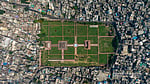
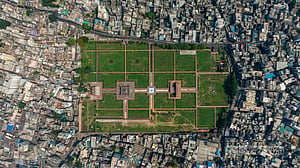
Mina is a city of tents as far as the eye can see -- air-conditioned, with lighting and bathroom facilities.
Open fires are strictly prohibited to prevent tent fires, so all food is cooked outside and brought in.
Food stalls are dotted throughout, open for just five days a year.
Traders rent stalls through a tender process from the Muallim, the licensed Hajj service providers responsible for managing pilgrims' accommodation, food and logistics in Saudi Arabia, and with such a short trading window, prices are several times higher than normal.
Most stall owners are Indian or Pakistani.
As all tents look alike, scouts and Hajj guides are on hand to help pilgrims find their way.
The Bangladesh Hajj Office has distributed maps marking each pilgrim's tent number at Arafat and Mina.
No vehicles move through Mina during Hajj except police cars and ambulances.
Outside the five Hajj days, the entire area is sealed off -- gates locked, electricity cut, water and telephone lines disconnected. The gates reopen two days before Hajj and close again two days after.
This year, no one may perform Hajj without a digital Nusuk card, which carries all necessary pilgrim information and must be shown to enter Mina, Arafat, Muzdalifah, and Masjid al-Haram.
Transporting anyone without Hajj authorisation carries a penalty of six months in prison and a fine of 50,000 Saudi riyals.
Anyone found in Mina or Arafat tents without a Nusuk card faces a financial penalty.
A total of 79,164 Bangladeshis have travelled to Saudi Arabia for Hajj this year.