Home
+
Published : 11 Oct 2025, 06:32 PM
The Bangladesh Army has said it took 15 of its officers into custody following warrants issued against 30 over alleged involvement in enforced disappearances and crimes against humanity.
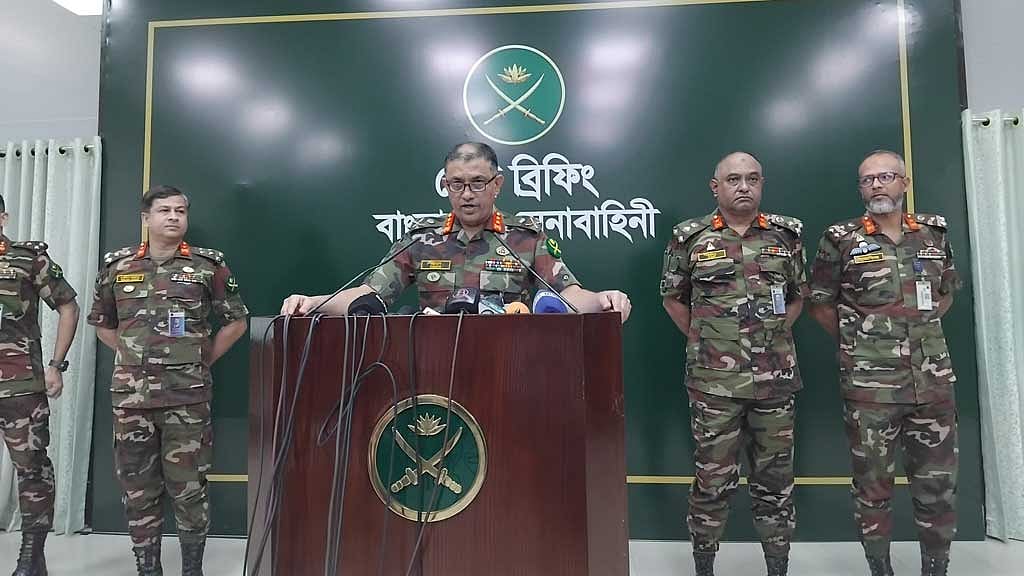
The disclosure came at a media briefing at Army Headquarters on Saturday, where Adjutant General Maj Gen Md Hakimuzzaman, confirmed the development amid calls to arrest and prosecute the suspects.
The International Crimes Tribunal on Wednesday issued arrest warrants after accepting charges filed by the prosecution in two cases involving crimes against humanity for the abduction and torture of political dissidents during the Awami League regime.
Of the suspects, 17 were allegedly involved in torture at the Rapid Action Battalion’s Taskforce Interrogation (TFI) Cell, while 13 others face charges involving abuses inside the Joint Interrogation Cell (JIC).
Deposed prime minister Sheikh Hasina was named the key suspect in both cases. Her defence and security advisor retired Maj Gen Tarique Ahmed Siddique and five former heads of the Directorate General of Forces Intelligence (DGFI) were also among those facing charges.
According to Hakimuzzaman, 25 of the 30 suspects are either serving or former Army officers. Of them, 9 are retired, one is on post-retirement leave (LPR), and 15 are currently in service.
“After the chargesheets were filed on the 8th of October, 16 personnel in service or on LPR were instructed to report to Army Headquarters,” he said. “Notices were issued for their appearance by the 9th of October.”
“Except for Maj Gen Kabir Ahmed, the remaining 15 officers complied and were taken into custody. They have been separated from their families,” he added.
Speaking about Kabir -- a former director of both CTIB and DGFI -- Hakimuzzaman said: “He left home on the morning of the 9th of October and has been missing since.”
The briefing noted that the officers were being held “as part of the legal process” and that action would be taken “as required”.
SUSPECTS IN TFI CELL TORTURE CASE
• Former prime minister Sheikh Hasina
• Former defence and security advisor Maj Gen (retd) Tarique Ahmed Siddique
• Former home minister Asaduzzaman Khan
• Former IGP Benazir Ahmed
• Former RAB director general M Khurshid Hossain
• Former RAB director general Md Harun-Ar-Rashid
• Former RAB additional director general (ops) Col Anwar Latif Khan
• Former RAB additional director general (ops) Brig Gen Md Jahangir Alam
• Former RAB additional director general (ops) Brig Gen Tofail Mostafa Sarwar
• Former RAB additional director general (ops) Col KM Azad
• Former RAB additional director general (ops) Brig Gen Md Kamrul Hassan
• Former RAB additional director general (ops) Brig Gen Md Mahbub Alam
• Former RAB additional director general (ops) Col Abdullah Al Momen
• Former RAB director (Intelligence Wing) Lt Col Md Sarwar Bin Quasem
• Former RAB director (Intelligence Wing) Lt Col (retd) Md Khairul Islam
• Former RAB director (Intelligence Wing) Lt Col Md Moshiur Rahman Jewel
• Former RAB director (Intelligence Wing) Lt Col Saiful Islam Sumon
JIC TORTURE CASE SUSPECTS
• Former prime minister Sheikh Hasina
• Former defence and security advisor Maj Gen (retd) Tarique Ahmed Siddique
• Former DGFI director general Lt Gen (retd) Md Akbar Hossain
• Former DGFI director general Maj Gen (retd) Md Saiful Abedin
• Former DGFI director general Lt Gen (retd) Md Saiful Alam
• Former DGFI director general Lt Gen (retd) Ahmed Tabrez Shams Chowdhury
• Former DGFI director general Maj Gen (retd) Hamidul Haque
• Former DGFI (CTIB) director Maj Gen (retd) Md Touhidul Ul Islam
• Former DGFI (CTIB) director Maj Gen Sheikh Md Sarwar Hossain
• Former DGFI (CTIB) director Maj Gen Kabir Ahmad
• Former DGFI (CTIB) director Brig Gen Md Mahbubur Rahman Siddique
• Former DGFI (CTIB) director Brig Gen Ahmed Tanvir Mazahar Siddiqui -- also former media chief of the agency
• Lt Col Mokhsurul Hoque
FINDINGS OF DISAPPEARANCE COMMISSION
Under the Awami League government, many opposition figures were allegedly abducted and held at undisclosed locations without trial, referred to symbolically as “Ayna Ghor”.
The interim government formed a commission led by retired justice Moinul Islam Chowdhury in August last year to investigate these enforced disappearances.
The commission’s first interim report submitted in December found evidence linking ousted prime minister Hasina to directives for abductions during her administration.
It also implicated several senior officials from her administration, including her former defence advisor Tarique, former NTMC director Maj Gen (dismissed) Ziaul Ahsan, and police officers Monirul Islam and Harunor Rashid.
The second interim report, tabled on Jun 4, outlines roles played by police, RAB, DB, and CTC units in these disappearances -- many victims and their families have accused these forces as “primary agents”.
The commission also pointed to the involvement of DGFI, NSI, and Border Guard Bangladesh (BGB) in some cases.
According to the report, DGFI is alleged to have run “black sites”, the most notorious of which was “Ayna Ghor”, where detainees were held in complete isolation and tortured.
On Feb 12, Chief Advisor Muhammad Yunus visited three secret detention facilities, infamous during the previous administration.
At a briefing on Jul 3, Col Md Shafiqul Islam of the Directorate of Military Operations, said personnel on deputation were not under the direct control of the Army.
He noted that some deputed officers had been accused of involvement in enforced disappearances, and investigations were ongoing.
“If evidence of involvement in disappearances is found, the Army will take action against them. The Bangladesh Army has fully cooperated in these investigations and will continue to do so,” he said.
The interim government has already agreed in principle to introduce the death penalty as the maximum punishment for enforced disappearances.
On Aug 25, the Advisory Council approved in principle the draft of the Enforced Disappearance Prevention, Redress Ordinance 2025.
The proposed ordinance defines enforced disappearance as a criminal offence punishable by death and makes the establishment or use of secret detention facilities a punishable act.
It also grants the National Human Rights Commission the authority to receive and investigate complaints related to disappearances.