Published : 13 Apr 2026, 04:23 PM
Updated : 28 Aug 2026, 01:33 AM


Five varied motifs at the heart of the “Baishakhi Shobhajatra” will carry a message of democratic transition with the arrival of the Bengali New Year.
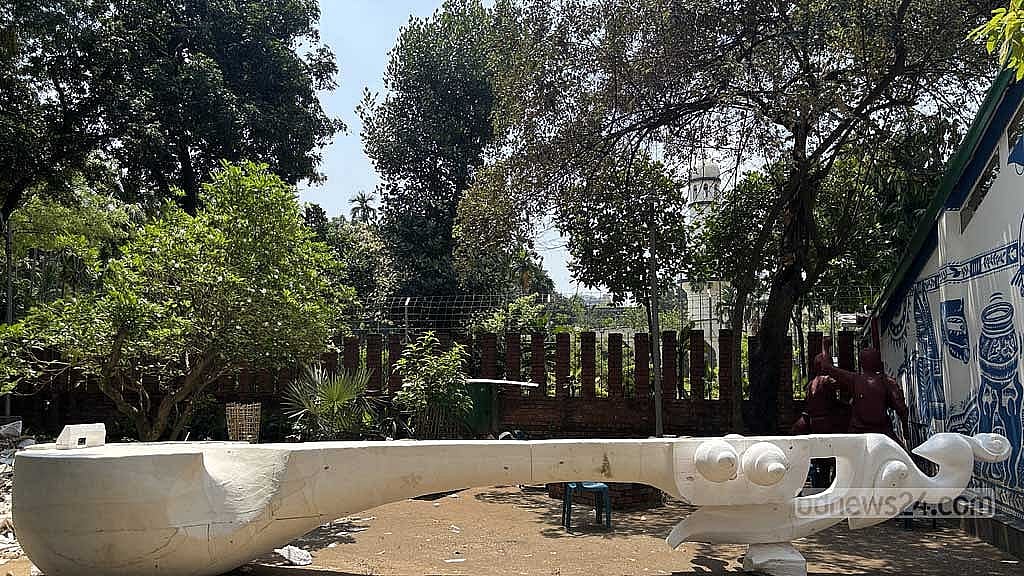
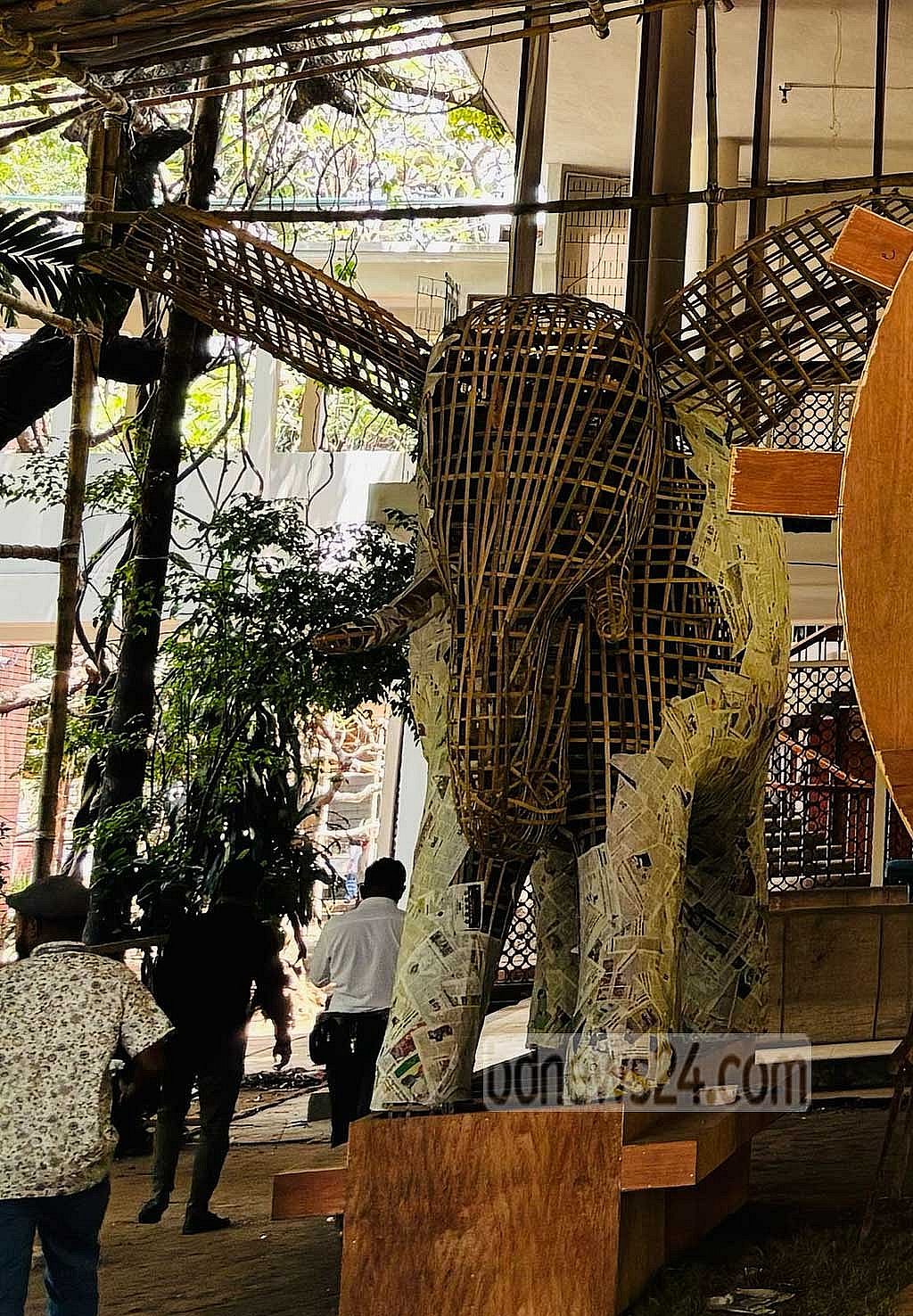
These artistic creations include a rooster, an elephant, a pigeon, a Dotara -- a traditional Bengali string instrument -- and a horse.
Azharul Islam Sheikh, dean of the Faculty of Fine Arts at Dhaka University, notes that the rooster has been chosen to represent democratic rebirth.
He told bdnews24.com that Bangladesh had remained under what he described as an authoritarian system for 18 years and has now moved towards a democratic path through elections.
He said the motifs reflects a new dawn, a new country, and a renewed democratic beginning.
“The rooster has been chosen as a symbol of that awakening. Like the bird that calls before sunrise, we see it as a sign of democratic renewal,” he said, adding that the faculty hopes for the return of justice in the country.
The Faculty of Fine Arts has, for years, organised the procession by drawing on contemporary social and political themes, making it a key feature of Bengali New Year celebrations.
This year’s observance is themed “New Year’s harmony, Revival of Democracy”.
According to Prof Azharul, this year’s Dotara motif has been included to protest against attacks on Baul singers across the country, as well as to highlight concerns over the fading tradition of folk music.
He said folk music traditions are gradually fading and the initiative aims to revive and strengthen them.
The procession will also include symbolic elements representing peace and heritage.
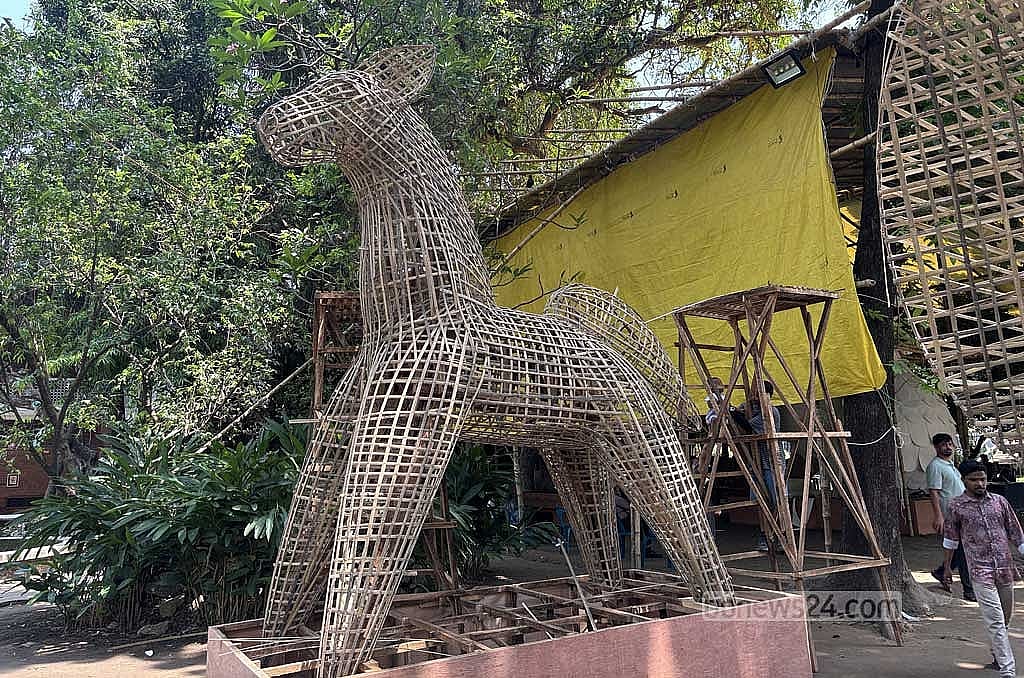
The pigeon has been chosen as a sign of peace, while traditional crafts are reflected through a wooden elephant inspired by the folk art museum in Narayanganj and a Tepa-style horse (traditional handmade clay horse figurine) from Kishoreganj.
Rakin Nowar, a teacher in the Department of Craft, said the elephant motif has been designed based on wooden elephant sculptures preserved at the Narayanganj Folk Art Museum and adapted from an academic perspective.
He said the pigeon represents peace amid ongoing global unrest, adding that the initiative seeks to promote harmony among people.
He also noted that the Tepa-style horses of Kishoreganj are an important example of Bangladesh’s cultural heritage, and their inclusion aims to preserve and promote local artistic traditions.
Alpana, Patchitra
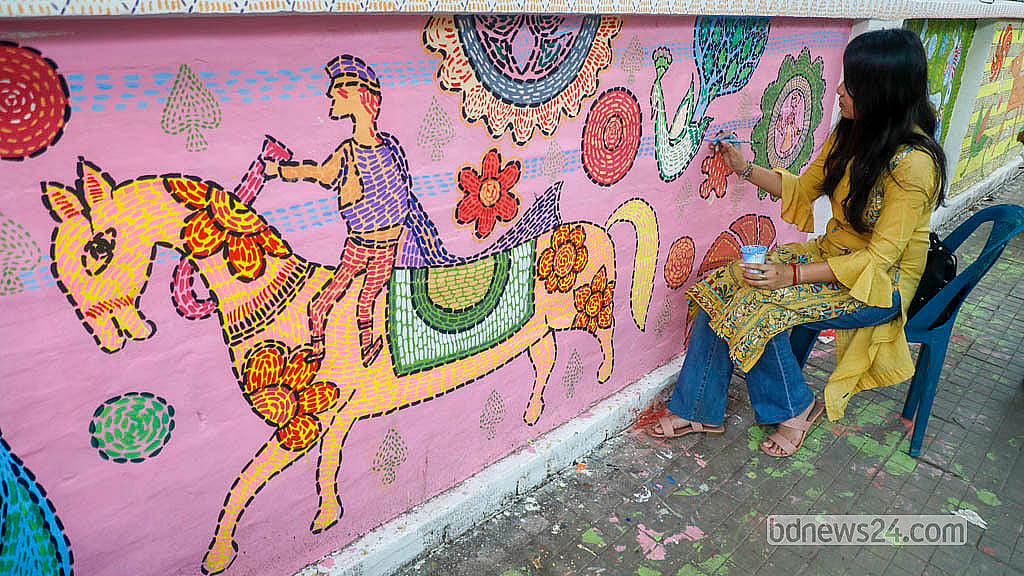
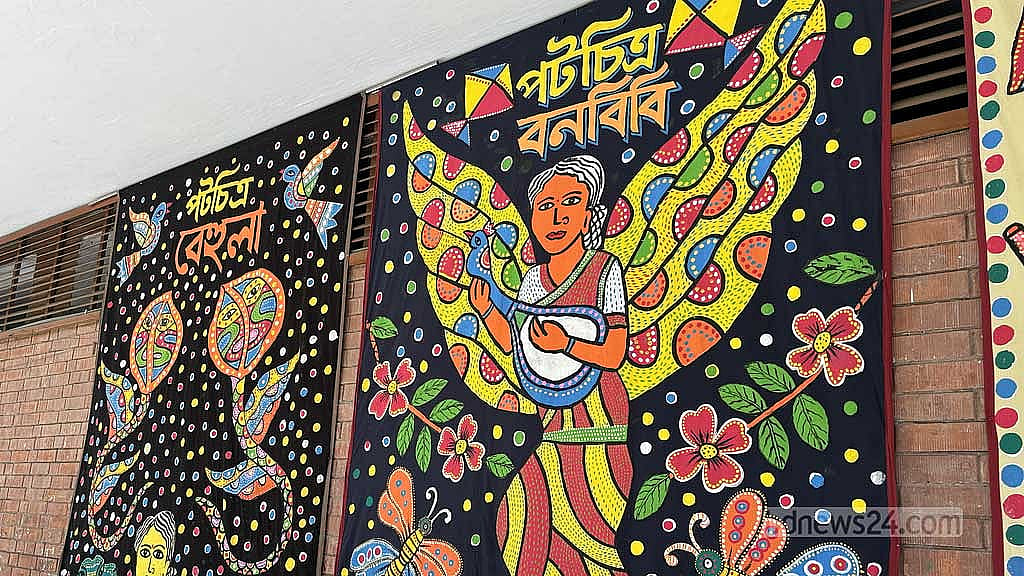
Alpana inspired by Nakshi Kantha, a traditional Bengali embroidered quilt art form, has been drawn along the boundary walls of the Faculty of Fine Arts.
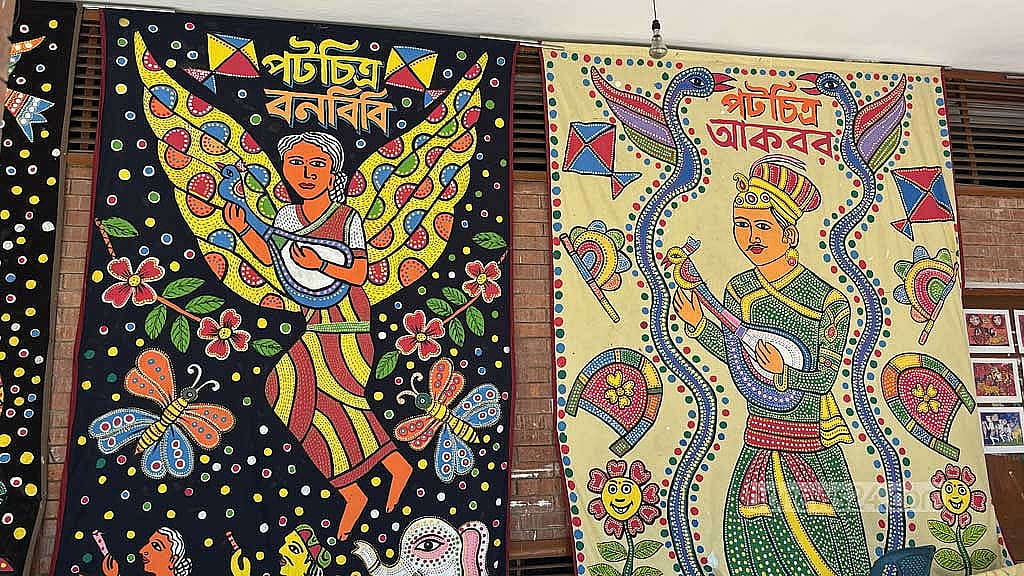
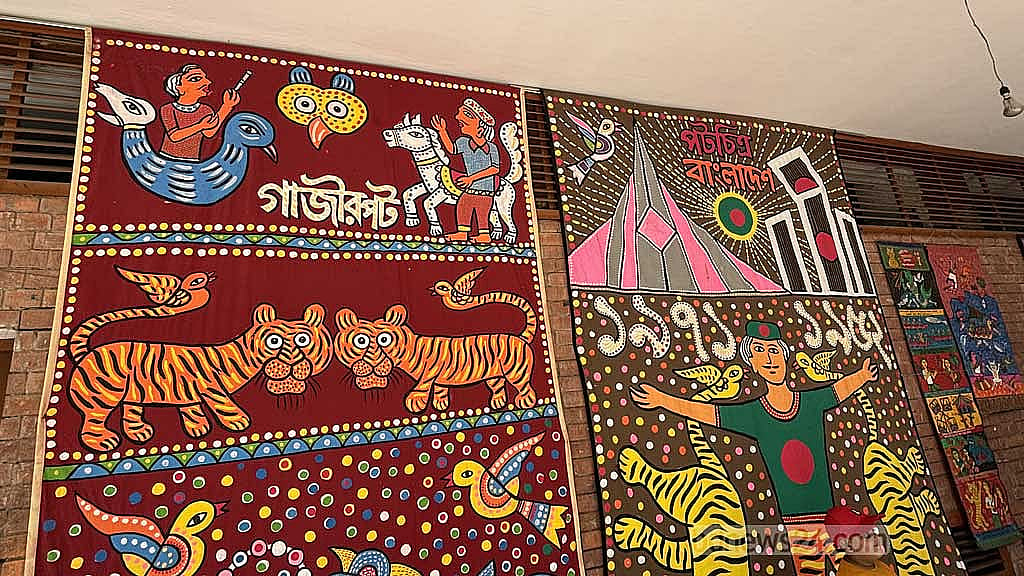
Inside the campus, five Patchitra, traditional Bengali scroll paintings used for narrative storytelling, have been displayed.
The works feature Bonbibi, the forest deity of the Sundarbans, Mughal Emperor Akbar associated with the introduction of the Bengali New Year, the emergence of Bangladesh, anti-autocracy movements, Gazi’s Patchitra -- a folk scroll tradition linked to the legend of Gazi Pir -- and Behula, a central character in the “Manasamangal” epic.
Patchitra artist Tiger Nazir said the works aim to present historical and cultural narratives through visual storytelling.
He said this year’s display also includes a piece titled “Pattachitra Bangladesh”, featuring scenes from the Language Movement of 1952, the Liberation War of 1971, the 1990 uprising, and 2024 July Uprising.
The aim is to strengthen cultural memory and connect younger generations with national history, he added.
Explaining the wall design, Dean Azharul said the faculty adopts different themes each year.
He said last year’s theme featured “Shokher Handi” (decorated traditional clay pots), while this year focuses on Nakshi Kantha.
He said Bangladesh’s cultural heritage is vast and diverse, adding that the aim is to bring different traditions into public artistic expression.
Live Horse in Procession
A live horse will once again take part in the Shobhajatra, continuing a practice from the previous year.
Plans to include a live elephant were dropped due to unavailability, the dean said.
He added that police horse units will also participate in the procession, as in earlier editions.
4-Day Cultural Programme
The overall celebration spans four days.
The final day of the outgoing year will feature “Chaitra Sankranti” celebrations at Bakultala, including dance, music, poetry recitation and theatre performances.
The “Baishakhi Shobhajatra” will begin at 9am from the Faculty of Fine Arts, pass the Raju Sculpture, Doel Chattar and Bangla Academy, before returning to campus.
In the following two days, Jatra Pala and folk performances will be staged.
On Apr 15, students will present a production titled “Bagdatta”.
The next day, a troupe from Netrokona will stage “Bibi Sultana”.
Security concerns
Prof Azharul said there are no concerns over security for this year’s programme.
He said police and university proctorial teams will remain present throughout the events and added that coordination is in place to ensure smooth proceedings.
Last year, incidents of vandalism were reported involving certain motifs, after which installations had to be remade.
The Dhaka University administration has introduced strict security measures for this year’s celebrations.
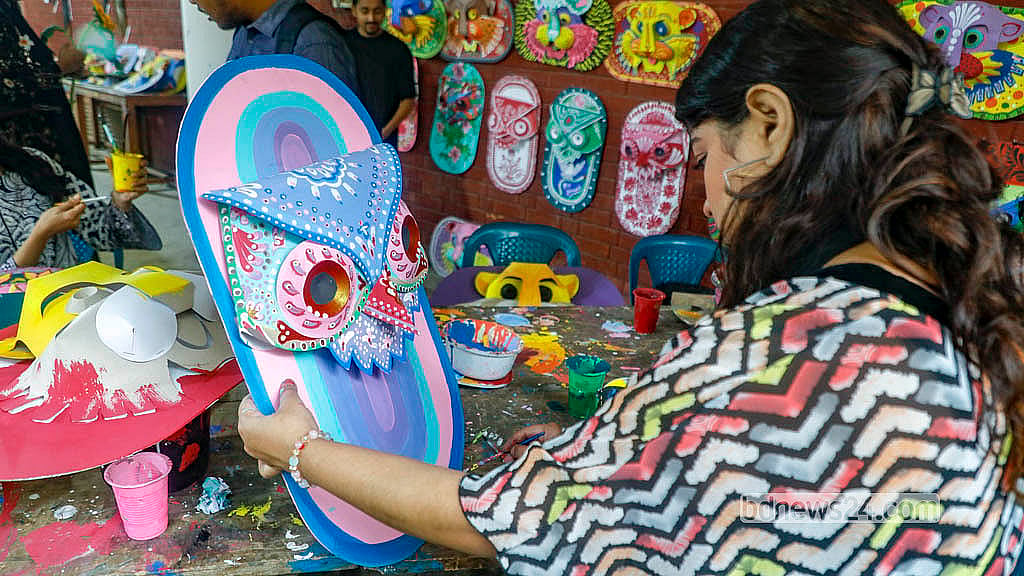
Entry with masks or bags will not be allowed, although hand-held masks prepared by the fine arts faculty will be permitted.
Vuvuzelas are banned and all events must end by 5pm.
From Monday evening, only vehicles with university stickers will be allowed inside the campus.
Motorcycles will remain fully restricted on Pahela Baishakh.
Has Student-Teacher Gap Narrowed?
The Baishakhi procession traces its origins to the 1980s, when it began as a protest against military rule.
It later evolved into the “Mangal Shobhajatra” and was recognised by UNESCO in 2016 as an Intangible Cultural Heritage.
Religious groups have opposed the procession over the years.
Following the fall of the Awami League government, opposition to the procession grew stronger.
In 2025, “Mangal Shobhajatra” was dropped and renamed “Barshoboron Ananda Shobhajatra”.
This year, it has been renamed again as “Baishakhi Shobhajatra”.
Amid repeated name changes, debates over themes and mounting political debate, last year’s New Year celebrations saw divisions within the fine arts faculty.
A group of 26th batch students boycotted the event, describing it as influenced by political interests and marked by what they called nepotism during a period of national transition.
The continued disputes over naming this year has added to student dissatisfaction.
Sculpture department student Mridha Raiyan said many students had boycotted last year’s event.
“Last year, most students boycotted the Ananda Shobhajatra. The organisers changed names and arrangements according to their own preference… previously, we used to manage everything ourselves,” he said.
He added that repeated changes risk excluding students from the process. “If it continues like this, we will end up being left out.
“But it is better to participate than not to be there, so we are involved.”
Another student said the cultural programme had been shaped by “political influence” over successive years.
“Last year, the Ananda Shobhajatra was held under the complete control of the cultural affairs ministry. This year, the Baishakhi Shobhajatra is happening under BNP influence.”
“If we keep suffering from insecurity about culture during political transitions, the nation will never move forward. Even our teachers are aligning with political groups to stay close to power,” the student added.
But Dean Azharul dismissed claims of a gap between students and teachers.
He said allegations of a boycott were “politically motivated” and added that students and teachers are working together this year.
On the issue of naming, he said such decisions are not under the faculty’s control and may be changed by the authorities.
“We are not the only stakeholders. There is a wider group involved. We focus on work rather than names,” he said.