Published : 21 Jul 2026, 11:34 PM
Updated : 08 Sep 2026, 09:26 AM


A Fatal Cascade
Aircraft cleared: Investigators found no technical defect in the F-7BGI training jet
Failures exposed: The commission blamed pilot error, inadequate supervision and structural shortcomings at the school
Still unanswered: Authorities have yet to explain why the report has not been officially published despite recommendations to do so.
A government-formed investigation commission has found no technical fault with the Bangladesh Air Force training fighter aircraft that crashed into Milestone School and College in Dhaka’s Diabari.
The panel's report broadly blamed a "lack of consistent training" on the pilot's part, a "lack of supervision" by the ground or commanding supervisor, and "flaws" in the building's construction for the devastating accident.
The investigation commission submitted its report to then chief adviser of the interim government Muhammad Yunus on Nov 4 last year.
bdnews24.com has had access to a copy of the report.
It says, "On overall review, the root cause of this aircraft crash can be identified as human error, accelerated by environmental factors."
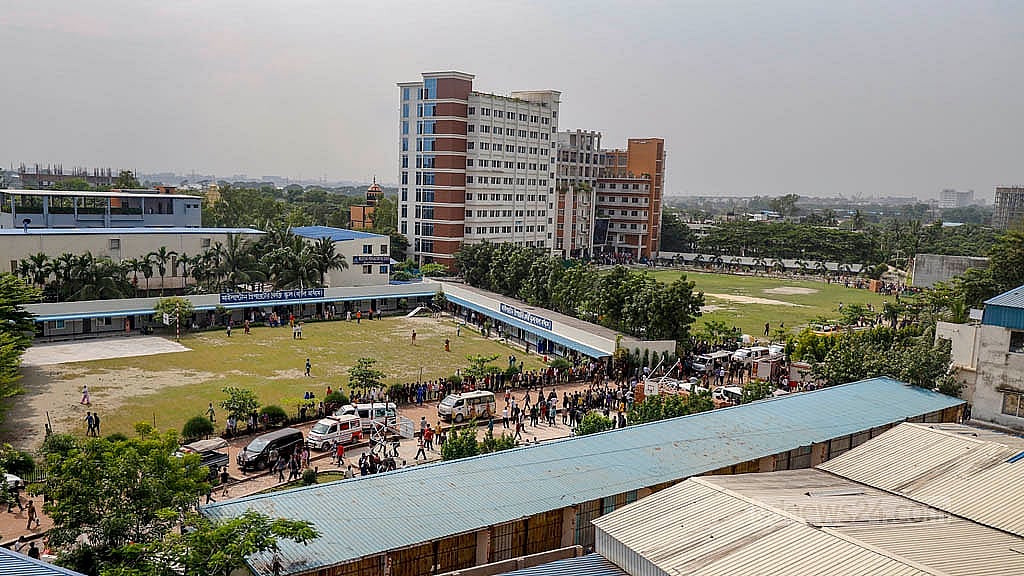
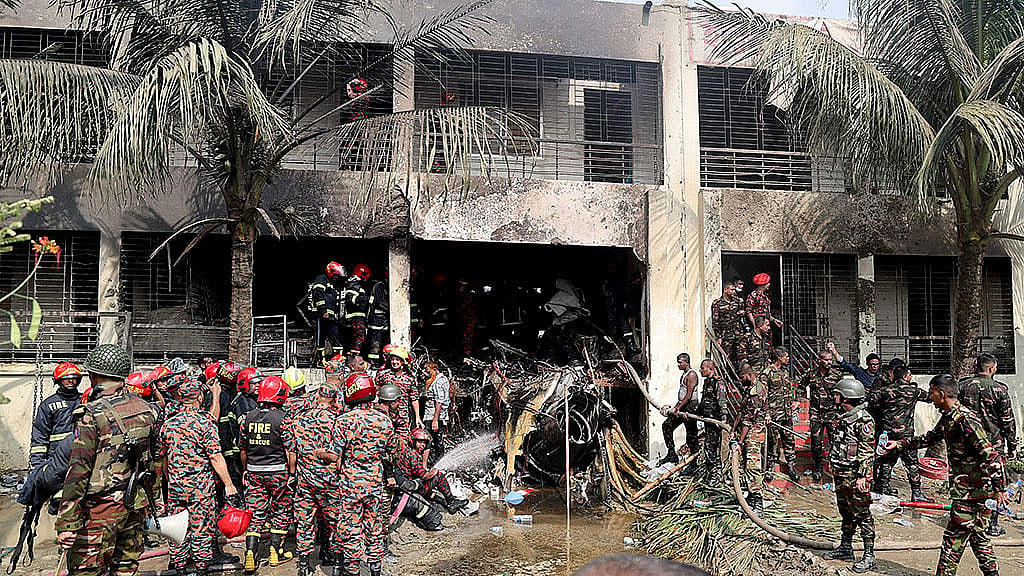
An Air Force F-7BGI fighter jet crashed into Milestone School and College's Haider Ali building on Jul 21, 2025.
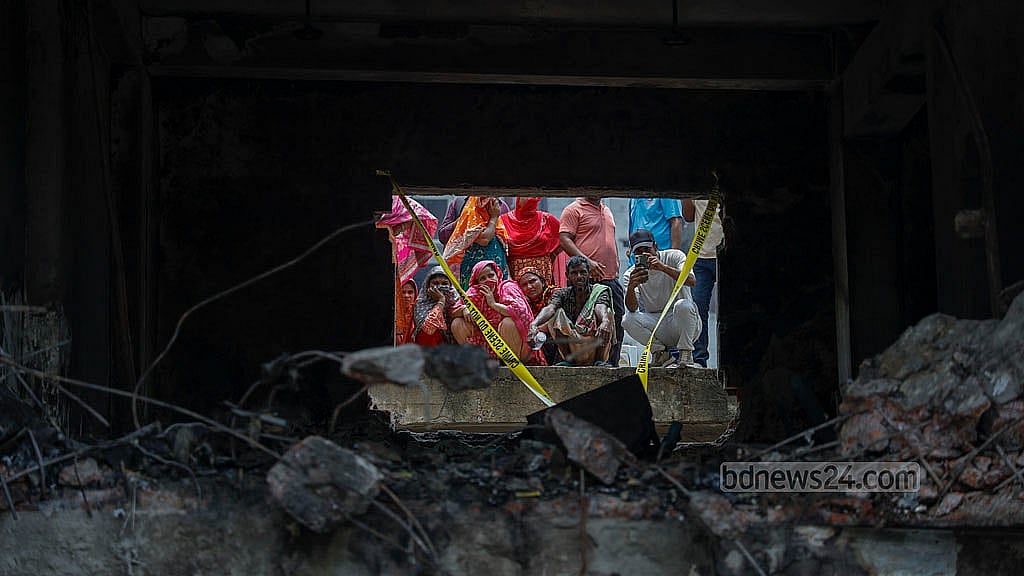
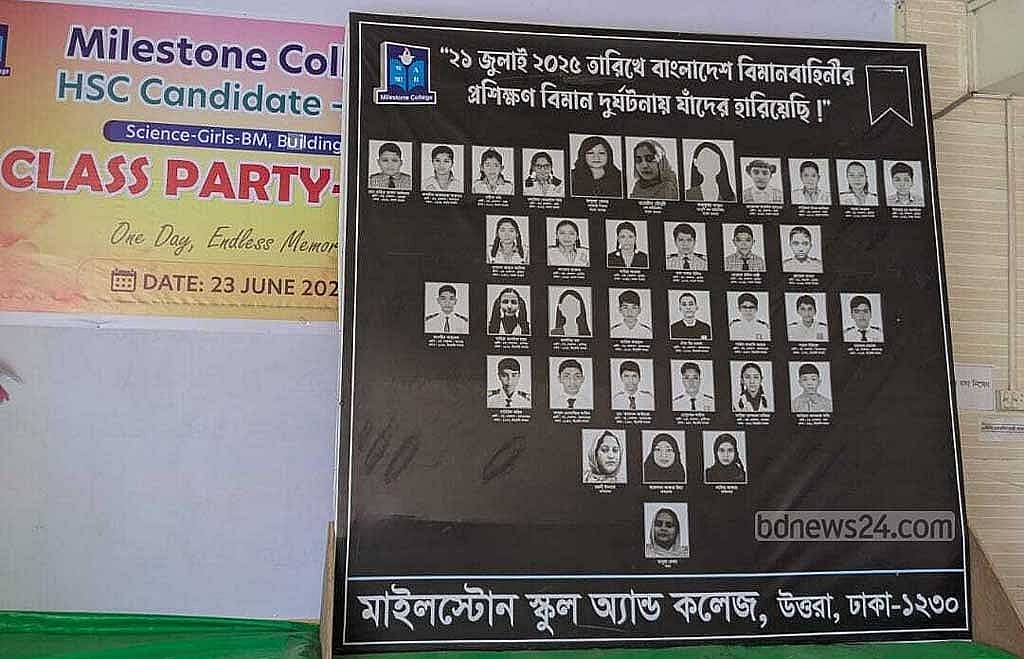
The crash killed 36 people, including the pilot. Among the dead were 28 students, three teachers, three guardians and one school staff member.
According to the investigation report, the aircraft suddenly banked beyond its intended limit, entering a stall, before crashing into the front of the staircase of the Milestone school building.
The aircraft's fuel tank then ruptured, and the roughly 2,100 litres of fuel remaining exploded from the intense heat and caught fire.
With only one staircase serving the building's 19 classrooms, meant for 737 students and more than 50 teachers, children and teachers trapped inside were unable to escape at the time.
The three-storey building, built in 2006, had its ground floor sink below ground level due to soil filling around it, with classes running on the remaining two floors.
School authorities were unable to produce any approval for the building's construction.
Commission member and urban planner Adil Mohammed Khan said, "This report needs to be discussed. What it contains, or doesn't, needs to be brought before the public.
“The public safety questions it raises need to be discussed, so that accidents like this don't happen again in future."
What Happened
As per the report, the weather was good that day. Pilot Flight Lieutenant Towkir Islam was "fit" to fly. There was no issue with the FT-7BGI model fighter aircraft either.
The aircraft's overhaul and other maintenance work had been carried out on schedule. Pilot Towkir took off in that aircraft to complete a training mission flight.
Every aircraft has its pilot's communication with the control tower recorded. Aircraft also carry a flight data recorder (FDR).
Whatever the pilot does with the joystick and other panel controls, whether adjusting speed, turning left or right, or moving up or down to control the aircraft, all of it gets recorded in the FDR.
Following the crash, the aircraft's FDR was sent to its manufacturer in China to extract its data.
Citing the FDR data, the investigation report says no warning signals were received from the engine, hydraulic system or control system while the aircraft was in flight.
However, while turning from "base" to "final”, the aircraft's bank angle (the degree to which it tilts left or right) rose from 59 degrees to 65.30 degrees within just four seconds.
At that point, the pilot suddenly pulled the control stick hard, causing the angle of attack (the nose's up-down position) to reach 23.20 degrees within one second, and 27.30 degrees the next second.
The aircraft's critical angle of attack is 24 degrees. Once that limit was crossed, the aircraft entered a stall. The pilot then tried but failed to reduce the bank angle and regain control of the aircraft. As a result, it kept losing altitude and crashed.
The angular measurement of how far left or right an aircraft is tilting is called the bank angle. It is measured as the angular distance of the rear wing from the aircraft's imagined level position when tilted.
Its nose's up-down position is measured through the angle of attack, the angular distance between the nose and tail relative to level ground.
Both the bank angle and angle of attack are displayed on the aircraft's dashboard.
In most aircraft, the dashboard is designed to alert the pilot if either exceeds its set limit.
‘Inexperience, Negligence’
On the sudden stall and crash, the investigation report cites the pilot's “inexperience alongside negligence” on the part of the ground supervisor or commanding officer.
That day, the pilot's commanding officer, a wing commander, was maintaining radio contact with Pilot Towkir from an air force mobile van.
It was Flight Lieutenant Towkir's first solo flight.
The commission also analysed the full recording of that communication. The report states the pilot first established contact with air traffic control (ATC) at 12:43pm, taking off at an altitude of 1,500ft to practise circuit flying.
After completing the first circuit, the officer commanding instructed the pilot to return to the "initial" position and begin a second circuit.
The pilot acknowledged the instruction by saying "copy" (meaning, in radio communication, that he had received the instruction).
At 1:11pm and 57 seconds, the commanding officer instructed the pilot to make a base turn.
The pilot acknowledged it and responded at 1:11pm and 59 seconds with "Roger, turning left" (Roger meaning he understood and was following the instruction).
That was the last exchange between the pilot and his commanding officer.
According to the commanding officer's account, the aircraft began losing altitude shortly after reaching “initial”.
The officer commanding then gave a "getting low" call. Seeing the altitude continuing to drop, he gave the "recover" instruction twice.
Watching the aircraft continue to bank left and descend, the commanding officer issued the "eject" command three times, instructing the pilot to use the ejection system to get out of the aircraft.
Around 1:14pm, the aircraft crashed into the sole entrance, the staircase, of Milestone's Haider Ali building.
Based on the ATC communication and Bangladesh Air Force's own report, the investigation commission said the commanding officer's instruction for the pilot to return to "initial" was "inconsistent" with the mission profile of a first solo flight.
Citing the air force's internal investigation report, the government investigation commission's report states that CCTV footage from Milestone school shows a "black mark" on the aircraft's windshield before the crash.
This black mark could have resulted from a bird strike or collision with some flying object.
"It is possible that the pilot suddenly pulled the control stick to change the aircraft's course in order to avoid this impact, which may have caused the sudden abnormal rise in bank angle. This suggests that surrounding factors may have played a role in this incident."
In such situations, pilots typically alert the control tower from the cockpit by saying "bird hit" or something similar.
However, no such statement from Pilot Towkir was found in the ATC records.
The report says, "[Pilot Towkir] had a lack of consistency in his training, which negatively affected his acquisition of proficiency skills. As a result, a lack of competence was observed in maintaining the relevant parameters during this flight.
"At the same time, due to situational unawareness, inadequate action was observed in stall recovery, along with a slow reaction in dealing with the high-pressure situation."
The investigation commission said, "On overall review, it appears that due to the pilot's insufficient consistent training, situational unawareness and inadequate supervision by the officer commanding, the pilot failed to maintain the proper flight parameters during the flight.
"As a result, due to the pilot's inadequate response in the critical situation, the aircraft suddenly entered a stalling condition, from which the pilot, despite trying again, could not restore the aircraft to a normal state."
The commission also expressed the view that, as an "environmental factor”, a bird or other flying object striking the aircraft's windshield may have played an indirect role in the incident.
Recommendations
Following the Milestone crash, the then interim government formed this nine-member investigation commission on Jul 27, 2025, headed by former secretary AKM Zafar Ullah Khan.
The commission was tasked with determining the circumstances, causes, responsibility and extent of damage from the crash, and identifying other related matters.
The commission submitted its report to Yunus on Nov 4 last year, making 30 recommendations to prevent similar accidents in future.
These include the air force exercising maximum caution and adopting all systemic reforms and corrections as quickly as possible, along with taking action against the pilot's supervising officer.
The recommendations also call for building new airports outside densely populated areas, acquiring a new aircraft fleet for the air force, and setting up training bases outside Dhaka.
A writ petition was filed with the High Court seeking the report's official publication by the government.
In response, the High Court issued a rule on Mar 8, asking why the authorities' "inaction" in publishing the investigation commission's report to the media and providing copies to victims should not be declared “without lawful authority”.
No official statement has been made by the government explaining why the report has not been published, despite the commission's own members recommending its release.
bdnews24.com is seeking a response from the Inter-Services Public Relations (ISPR) on whether the air force has taken any steps based on the report's recommendations.