Published : 30 Nov 2025, 07:43 AM
Updated : 21 Aug 2026, 02:49 PM


Centuries-old architecture and narrow alleyways preserve Old Dhaka’s heritage, yet these same traits amplify the risks posed by disasters like earthquakes.
The day after the country’s deadliest recent quake, three more tremors intensified fear among Old Dhaka’s residents.
Following the 5.7-magnitude quake on Nov 21 -- the strongest in decades -- the last few days have brought renewed anxiety across several Old Dhaka neighbourhoods.
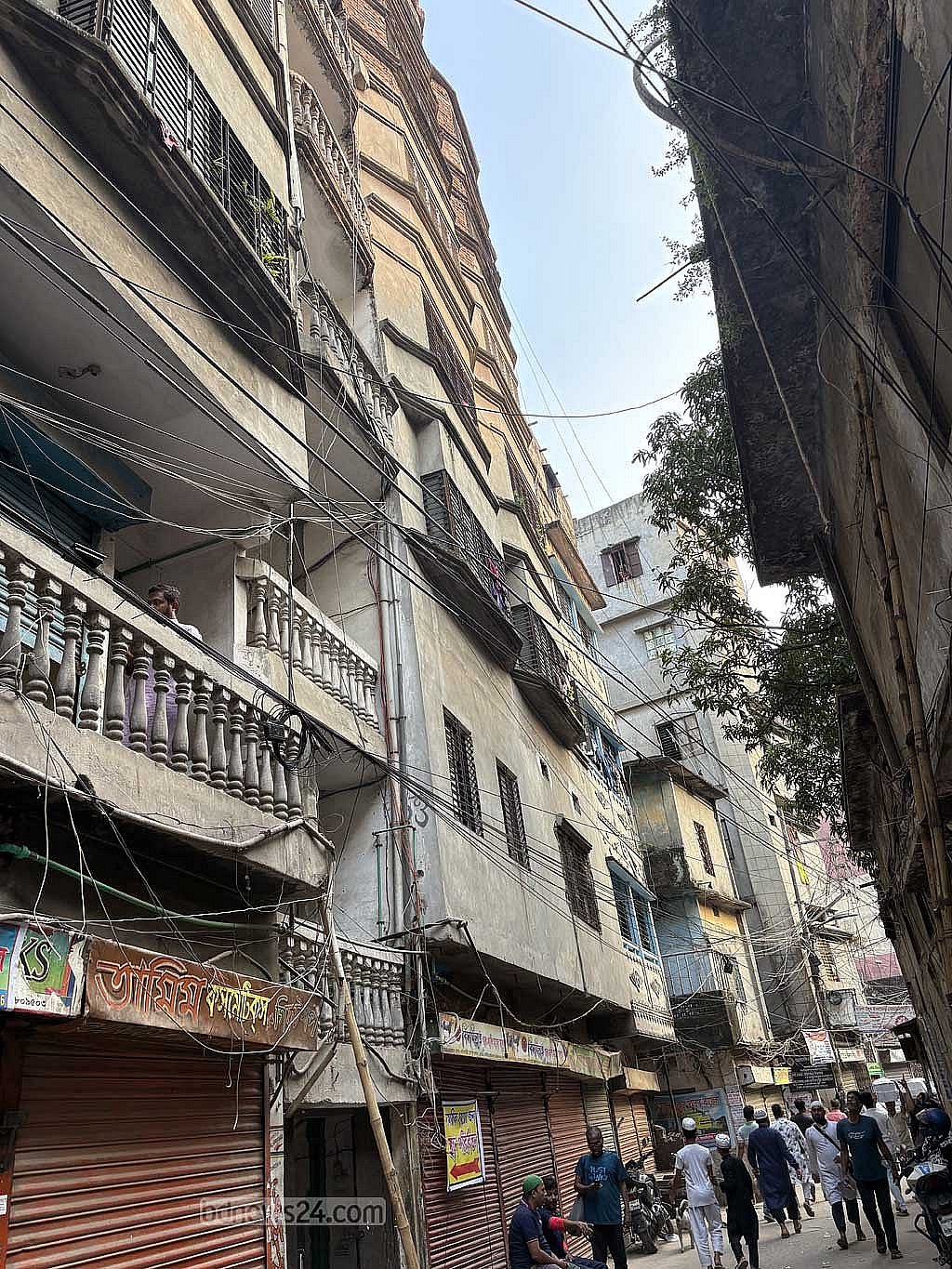
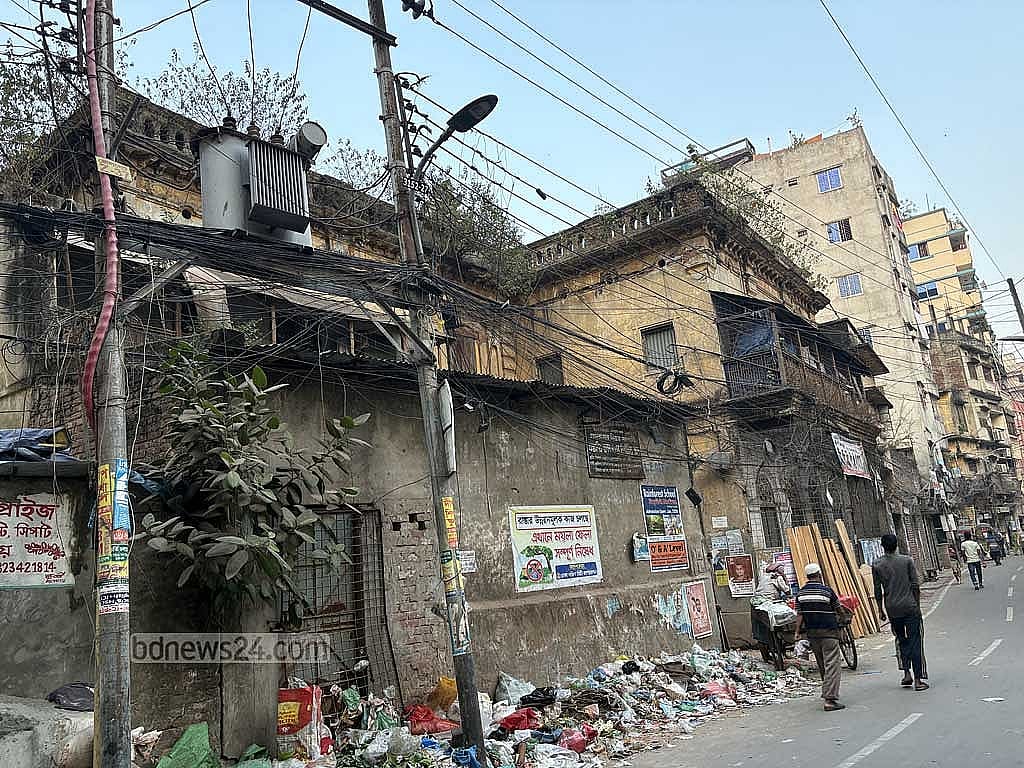
Areas including Banglabazar, Shankharibazar, Tantibazar, Sutrapur, Gendaria, Lokkhibazar, Kaltabazar, Narinda, Babubazar, and Armanitola remain densely packed. Centuries-old buildings are so tightly clustered they appear fused together.
After three tremors on Nov 22, residents have begun realising that even mild to moderate shocks can jeopardise these structures. Tragedy struck one building the previous day, when a railing collapsed, killing three people.
Within a week, on Thursday afternoon, another mild quake shook the city, preceded by two deep-night tremors recorded by the European-Mediterranean Seismological Centre (EMSC).
Most alleys in Old Dhaka are too narrow for vehicles, used solely for pedestrian traffic. Residents have long faced uncertainty over whether emergency vehicles could navigate these lanes in a disaster.
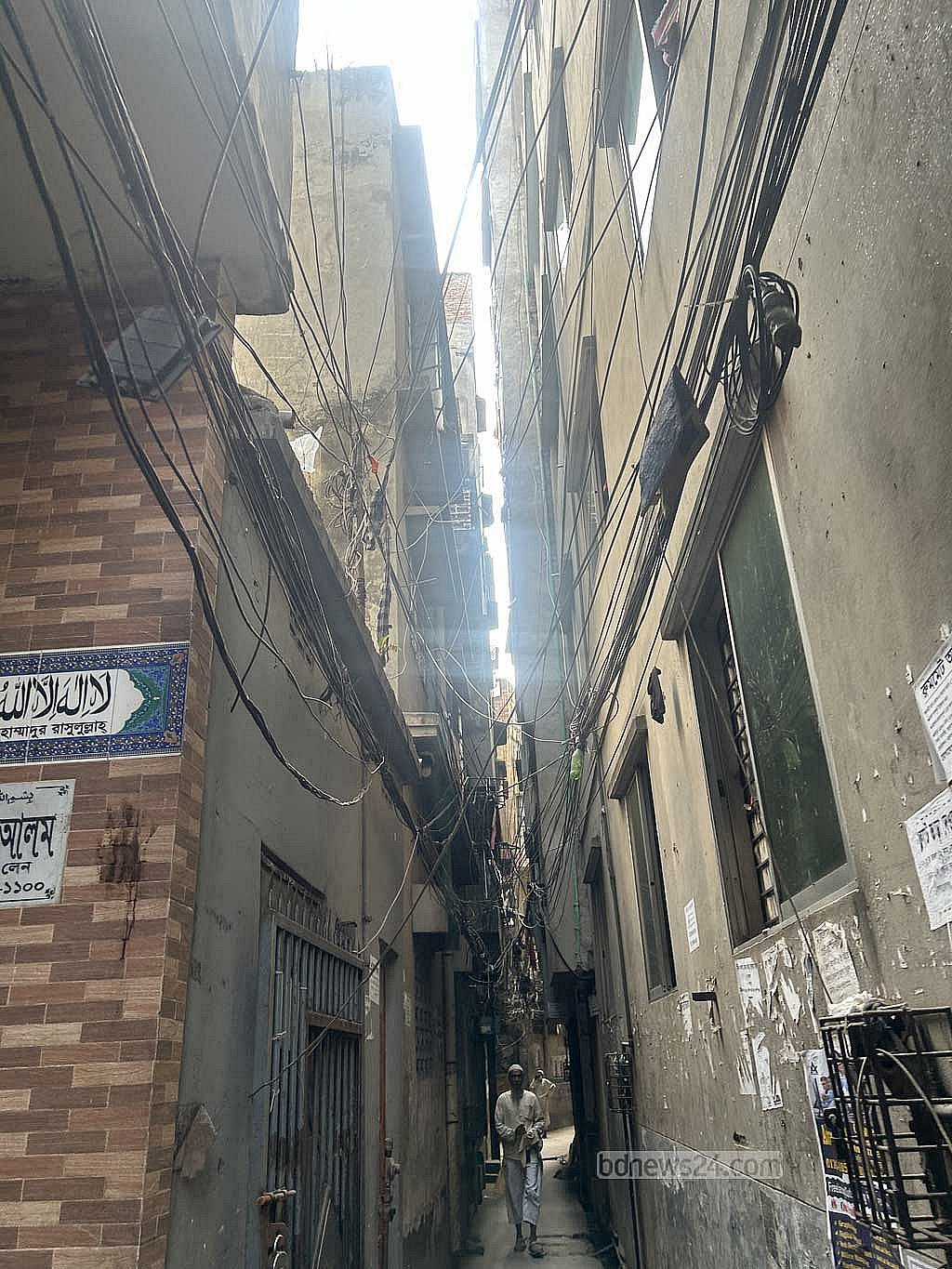
Mohammad Robayet Hossain, who has lived in Narinda’s Begumganj Lane for 35 years, explained that decades ago, there were far fewer buildings.
“Old structures existed, but none pressed so closely against each other. Over the last two decades, unplanned construction has filled every available space. Alleys barely allow two rickshaws to pass side by side. I see no way a rescue vehicle could reach us if a major disaster strikes.”
According to a RAJUK survey, a 6.9-magnitude quake along the Madhupur Fault in Tangail could collapse 40 percent of Dhaka’s buildings. The tremor on Nov 21, though only 5.7, already left residents in fear.
In Armaniola’s Koshaituli, an eight-storey building shed bricks and plaster from its walls and cornices, killing three.
On Tuesday, several streets in Old Dhaka revealed buildings with crumbling roofs and walls, a daily hazard. Residents fear an accident similar to Koshaituli could occur at any moment.
In Bangshal’s Abul Khairat Road (Tara Mosque), an old house once belonging to Zamindar Sobhan, a feudal lord, is still inhabited by his descendants.
Though they later moved to Sobhanbagh, family members have occupied the ancestral home for almost 200 years. Inhabitants of Old Dhaka fear the decayed structure could collapse in an earthquake.
Nearby, Nawab Khwaja Salimullah’s building -- still in use without repairs -- remains occupied by relatives of the fourth Nawab.
PANIC IN ARMANITOLA
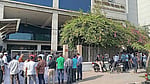
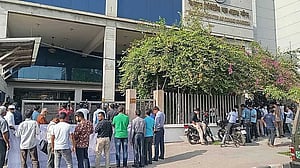
During the violent tremor, tragedy struck on KP Ghosh Street in Koshaituli, where three people lost their lives as a railing from the No. 20 building gave way, collapsing in front of a school.
Beneath the structure, a bustling meat shop and a restaurant operated, and at the time, at least 40–50 people were present, including twenty employees of the shop.
Mohammad Sazal, who works at the meat shop, recounted the ordeal: “It was busier than usual because it was Friday. We survived only because a tarpaulin had been stretched over the balcony. Without it, 20–30 people might have died. One of our colleagues broke his hand.”
Following RAJUK’s directive to close the shops, the owners and staff were left idle, while inside the building, no responsible party could be located.
A tenant, who requested anonymity, described the lingering fear: “Seeing the damage sent chills down my spine. Now, we live under constant anxiety. Many buildings here are fragile, and the upper floors of this one were poorly maintained -- hence the railing collapse. We are seriously considering moving.”
Though not centuries old, the seven-storey building is roughly 18 years of age. Its construction was gradual -- initially three floors, with an additional one or two levels added later -- and the upper floors were left without plaster, exposing them further to structural risk.
Local lawyer Nazim Mia told bdnews24.com, “Old Dhaka has always been vulnerable -- fires, earthquakes, all pose threats. But after this railing gave way, fear has gripped the community.”
Locals’ attention has now turned to other deteriorating structures across the neighbourhood. Outside Hazi Nanna Biryani in Becharam Deuri stands a 200-year-old, three-storey building, its precarious condition equally alarming. Residents declined to comment on the house’s history or age.
Ahsan Ullah, 75, explained that the building belongs to a Hindu family, and current tenants continue to occupy it without undertaking any repairs.
“Shops and a hotel operate below. Any mishap could claim many lives. We are powerless, and fear pervades our daily lives.”
Since the quake, Sutrapur residents remain tense.
A resident of the zone, Shafik Mia said: “Renters can return to their villages if they wish, but for us locals, this is our final address. We live in constant uncertainty with our families, particularly the children and women. The government must prioritise our safety.”
Urban planner Prof Adil Mohammed Khan said, “Old Dhaka’s current state reflects decades of mismanagement. Most buildings are pressed on three sides by neighbouring structures, leaving only narrow lanes in front.
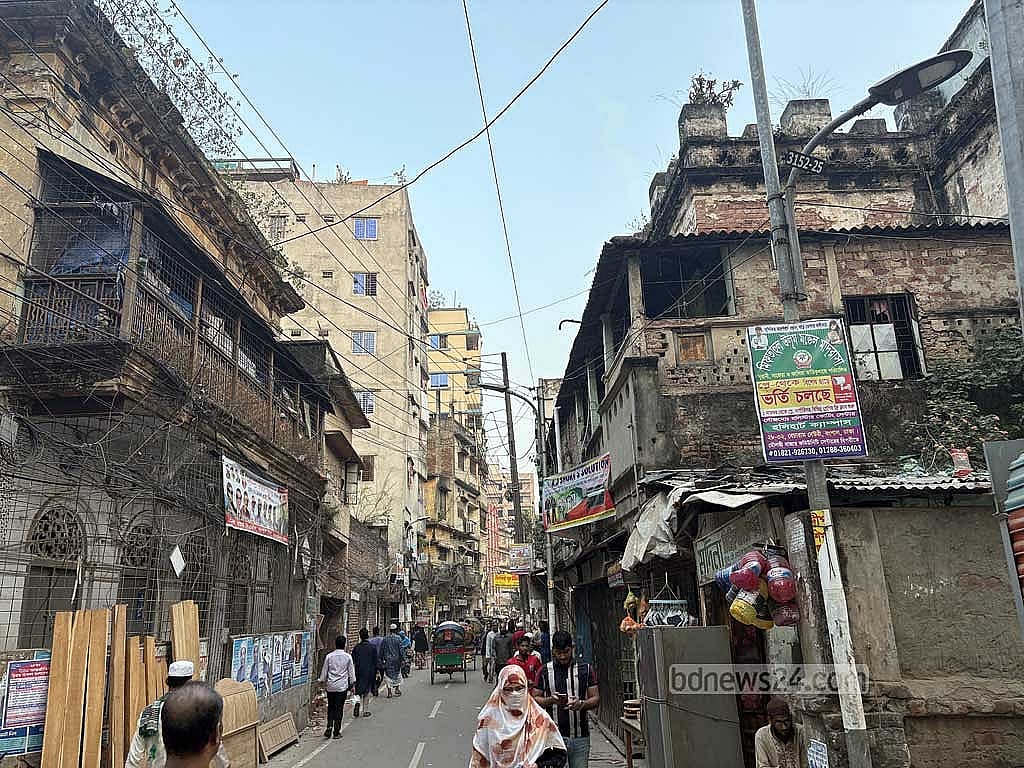
“Fire trucks cannot access disaster sites effectively. Even if they enter, reaching the exact location is uncertain, and manoeuvring large vehicles in emergencies is extremely difficult.”
On the impact of a major earthquake on Old Dhaka, he said: “It won’t be just one or two buildings. Rescue operations may need to cover 100 or 200 buildings. Our Fire Service doesn’t have that capability. They can work on only one or two buildings at a time.
“In such a scenario, the area may have to be declared abandoned.”
Buildings in Old Dhaka that are unsuitable for renovation must be identified and demolished. Those that can be restored should be repaired promptly, advised Adil, the president of the Bangladesh Institute of Planners (BIP).
He also recommended having sufficient volunteer teams ready for emergencies like earthquakes or fires and ensuring that electricity and gas lines do not cause additional hazards.
Despite long-standing warnings about earthquake risks in the country, no adequate measures have been taken in Dhaka, particularly for Old Dhaka’s old, vulnerable, irregular, or illegal structures.
The responsibility to ensure compliance with building laws rests with the RAJUK.
Ashraful Islam, RAJUK’s chief town planner, said: “First, we need to address buildings showing cracks or tilting after an earthquake. We are identifying them through calls and inspections by our personnel.
“We will then train staff under BUET supervision to assess which buildings are risky, highly risky, or moderately risky.”
Highly vulnerable buildings should undergo detailed engineering assessments and be restored if feasible.
“If repair is impossible, then the buildings must be demolished,” he added.
“In some cases, minor plaster work, joint reinforcement, extra columns, or rods may provide an engineering solution. We also will not approve buildings above six storeys, and narrow streets will be widened.”
Asked about Dhaka South City Corporation’s comprehensive urban plan, Ashraf replied: “We will not approve buildings over six storeys. Existing buildings will be maintained, demolished, or streets widened as necessary. Our master plan is integrated within these measures.”
Md Sirajul Islam, the city corporation’s architect and chief city planner, said for now Dhaka South City will implement RAJUK’s plan for vulnerable buildings in Old Dhaka, following its guidance.
Asked if the Fire Service could manage large-scale rescue operations in case of a major earthquake, Deputy Director (Operations and Maintenance) Mamunur Rashid said it would be impossible.
“I have witnessed Turkey’s earthquake, where only heavy equipment could enable operations. Our light equipment is insufficient.”
“For minor incidents, our equipment can assist with rescuing those lightly trapped. If an earthquake exceeds magnitude 6 or 7, we cannot cope,” he added.
JNU STUDENTS IN FEAR
Students of Jagannath University in Old Dhaka are also living in fear.
Rudra Banik, who stays in a six-storey building in Narinda, said: “I have never faced such a terrifying situation. The fear persists. Every time I scroll Facebook, I see that my residence in Old Dhaka is highly vulnerable. Chairs and beds seem to shake; it feels like another quake is happening. I am living in constant anxiety.”
Ankita Saha, a history student and resident of Nawab Faizunnesa Choudhurani Hall, said: “After Saturday’s earthquake, we were evacuated to Banglabazar field.
“All students were scared. The building felt like it would collapse. Families are pressuring us to return home. I heard the university closed the hall in the afternoon.”
After the Rana Plaza collapse in 2013, BUET experts were assigned to assess Jagannath University buildings for vulnerability. Their survey identified four high-risk buildings.
A decade later, on Feb 13, 2023, RAJUK sent a letter giving two months to demolish these buildings, which included four- and five-storey structures.
The university later attempted repairs but did not achieve a permanent solution.
On Apr 29 this year, part of the railing on the third floor of the four-storey “Obokash Bhaban” collapsed, injuring Shakil Sikder, an employee of the Office of the Chief Engineer.
This building houses the university café on the ground floor and cultural, social, volunteer, and journalist offices on the upper floors.
The 112-year-old administrative building has also undergone patchwork repairs for continuing operations.
Repeated earthquakes have made these structures increasingly vulnerable, according to university faculty, students, and staff.
Vice-Chancellor Prof Md Rezaul Karim said, “We are currently focused on stabilising the situation. We can’t comment on demolishing the four buildings yet.”