


Published : 12 Aug 2026, 05:13 PM
Updated : 08 Sep 2026, 09:32 AM


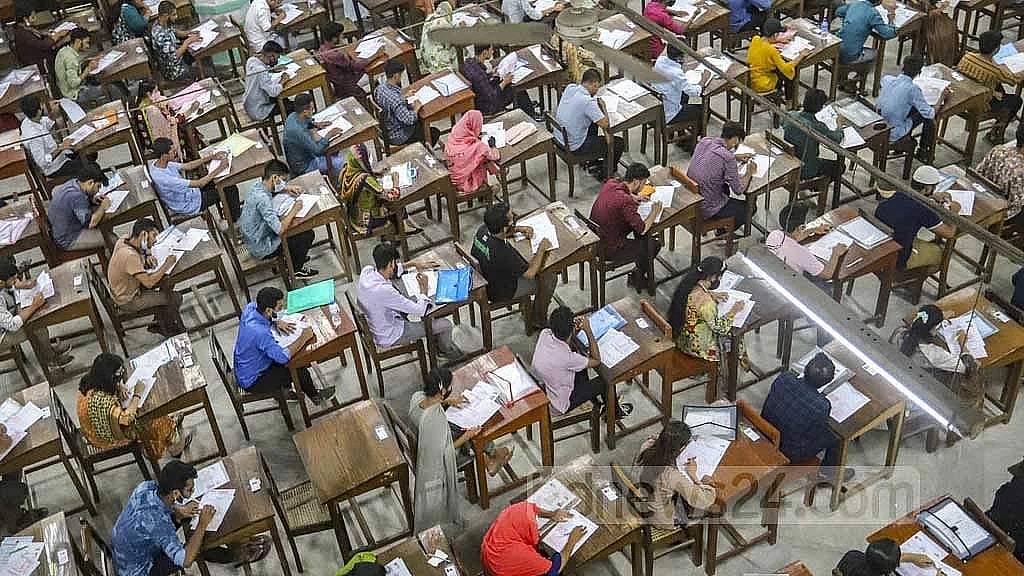
The University of Dhaka will prepare a separate question paper for students from English-medium schools in this year’s admission test for the Faculty of Science, a decision educationists believe could fuel inequality in higher education.
Some also believe the decision could benefit the market for English-medium education.
Questions have also been raised as to why students from madrasah or technical education boards should not be given separate question papers if English-medium students are.
On Aug 2, the University of Dhaka authorities published the application schedule for admission tests for the 2026-27 academic year.
Citing a decision taken at a meeting of the General Admission Committee that day, a university press release said: “It has been decided that a separate question paper will be prepared for English-medium students for the Science Unit admission test for the 2026-27 academic year, in accordance with their curriculum.”
Although the decision to prepare a separate question paper has been made, no policy has yet been formulated on the eligibility criteria for English-medium students or whether a specific number of seats will be reserved for them, members of the admission test committee said.
Prof Abdul Karim, acting dean of the Faculty of Biological Sciences, told bdnews24.com: “So far, only the decision to hold the test with a separate question paper has been made. No meeting has been held and no policy has been formulated yet. Everything will be worked out gradually.”
Prof Upoma Kabir, acting dean of the Faculty of Engineering and Technology and a member of the Science Faculty admission test committee, also said no policy had yet been formulated.
“The university authorities have informed us of the decision. We may have a meeting on Wednesday. A decision may be taken there through discussion,” she told bdnews24.com.
Asked whether questions could arise because the decision was made before a policy was formulated, she said, “Questions will certainly be raised. But surely the university administration will have an answer to that.”

Asked how the new decision was taken without any policy, Pro Vice Chancellor (Education) Prof Abdus Salam told bdnews24.com: “We (the university administration) make decisions. The admission committee will formulate the policy for this. Our existing policy will also be followed in this way.”
Asked how the two question papers would be made equivalent, he said: “The admission test committee will decide that. They will surely prepare the questions in a way that there is no discrimination. This decision has been taken to eliminate discrimination, not to create it.”
Asked whether holding the same examination with two separate question papers could create inequality, he said, “I do not think there will be any discrimination here.”
Asked why there should not be a separate admission test for madrasa students, the professor said, “This did not come up in the meeting. If it comes up for discussion later, a decision will be taken on it.”

Decision Taken in Violation of Rules?
The Academic Council is the principal forum for making new rules concerning academic matters at the University of Dhaka. But the decision was taken at a General Admission Committee meeting on Aug 2 without a decision from the Academic Council, which former vice-chancellors and pro-vice-chancellors of the university see as a departure from the rules.
A former pro-vice-chancellor, speaking on condition of anonymity, said: “If Dhaka University is to make any policy decision, it must first be discussed by the Academic Council. If it is approved there, the admission committee can then discuss the procedure for implementing it. Such a major decision cannot be taken without a recommendation from the Academic Council.”
Prof Mainul Islam, former acting dean of the Faculty of Social Sciences at DU, said: “The Academic Council is the only body authorised to make policy decisions at the University of Dhaka. No policy decision can be made without discussion there. In this case, the General Admission Committee, which made the decision, can explain it better.”
Pro Vice Chancellor Abdus Salam said, “A recommendation regarding holding this examination came from the last meeting of the Deans’ Committee. It was later finalised by the academic committee.”
However, there is no committee called the “Deans’ Committee” under the University of Dhaka Ordinance. Moreover, none of the current deans at the university have been elected. This has also raised questions about whether they can make such recommendations.
Prof Salam explained, “The Deans’ Committee has been making decisions at the University of Dhaka for a long time. We have taken the decision accordingly.”
Under the University of Dhaka Ordinance, the Academic Council was formed to regulate and oversee teaching, examinations and academic standards at the university, and to advise the Syndicate on these matters.
Section 2 of Part III of the ordinance says the General Admission Committee is a committee formed by the Academic Council to work on the admission process.
Asked whether such a policy decision could be taken without discussion in the Academic Council, Pro-Vice-Chancellor Salam said: “It will go to the Academic Council. It will come back after being approved there.”
When asked whether taking the decision before sending it to the Academic Council constituted a violation of the rules, he said: “Before something becomes a violation of the rules, certain matters can be dealt with by taking time and other considerations into account, and supplementary approval can later be obtained from the Academic Council.”

What Academics Say
bdnews24.com spoke to 10 teachers from the Faculty of Science at DU.
According to them, whenever a new rule is added to or removed from the admission test system, its feasibility should be assessed for two to three years before the rule or policy is introduced. Otherwise, a new rule could create various problems.
Prof Aminul Islam Talukdar, chairman of the Department of Physics at the University of Dhaka, told bdnews24.com: “The issue of preparing a separate question paper for English-medium students in this year’s admission test was discussed by our academic committee. We recommended that instead of separate question papers, the national and English-medium curricula should be integrated for the examination. Otherwise, it could create discrimination.
“When an examination is held with separate question papers, it is not possible to ensure equal competition and equivalence in the standard of the questions. This was the unanimous recommendation of our department. However, the final decision will be taken by the university authorities or the Academic Council.”
Prof Mujib Rahman of the Institute of Education and Research said, “If an examination is held with two separate question papers, some people will face discrimination. There is always a possibility of disparity between two question papers for the same examination.”
The professor suggested, “Dhaka University could prepare a basic question paper based on what a student learns up to higher secondary level. That would ensure that no one is disadvantaged.”
Prof Mamunur Rashid, a teacher at the Institute of Education and Research at the University of Dhaka, said, “We welcome the new decision. Now it will depend on the policy whether this examination creates discrimination or establishes equality.”
Abdullah Zaman, principal of two English-medium educational institutions — WIT International School and Guidance International School — believes the new decision could be harmful to the education system.
In a recent article in Prothom Alo, he wrote: “I myself run two international (English-medium) schools. The reality is that if the country’s top university creates separate advantages for English-medium students, it may be personally beneficial for my institutions. More parents will turn to English-medium education, the number of students will increase and the market will expand.
“But, as a conscious citizen of the country, I believe national interest is more important than business profit. It would not be ethically right to support a policy that may be beneficial to my institutions but harmful to the country’s education system.”
In his view, the decision conflicts with the principle of a single academic standard in higher education.
In the article, titled “University of Dhaka Admission Test: What Message Will a Separate Question Paper Send for National Education?”, he wrote: “A university admission test does not test the textbooks of any particular board. It assesses a candidate’s analytical ability, conceptual skills, language proficiency and suitability for higher education.
“So, the question should not be, ‘Which board did you study under?’ Rather, it should be, ‘Have you acquired the qualifications needed to study at university?’ If the standard for entering a university is the same, the standard of assessment should also be the same.”
Zaman believes that, “if there is a separate question paper for English-medium students today, tomorrow the Madrasah Education Board will make the same demand. Their argument will also be, ‘Our curriculum is different.’ Then the Technical Education Board will make the same demand.”

What Students and Parents Say
Students of the DU’s Faculty of Science said everyone should have the opportunity to sit for the university’s admission test. But they believe this cannot be ensured through separate question papers.
Tanmay Ahmed, a student of Clinical Pharmacy at the University of Dhaka, said: “The University of Dhaka was established to educate children from marginalised sections of society in this region. But with the passage of time, we now have to move forward with everyone. Giving someone special privileges in this regard is discrimination.
“Physics and chemistry at the higher secondary level are the same. There is no English-medium student who would be unable to answer questions designed for Bangla-medium students. If they have a language problem, the question paper could instead be provided in English.”
Ahnab Rafi, a student of Applied Mathematics at DU, said: “Five thousand students will sit for the examination using one question paper, while 150,000 will sit using another. How can equal competition be ensured here? Instead, if this happens, we may see 1,000 students admitted from English-medium schools and 500 from Bangla-medium schools. That would further intensify discrimination.”
Syeda Rezaunnahar Shifon, mother of an HSC student in Uttara, told bdnews24.com, “Students who have studied under all types of curricula should have the opportunity to gain admission to an institution like the University of Dhaka.
“However, I believe the proposal to hold the examination with separate question papers will put Bangla-medium students at a major disadvantage.”





