Published : 08 Aug 2025, 10:59 AM
Updated : 28 Aug 2026, 01:24 AM


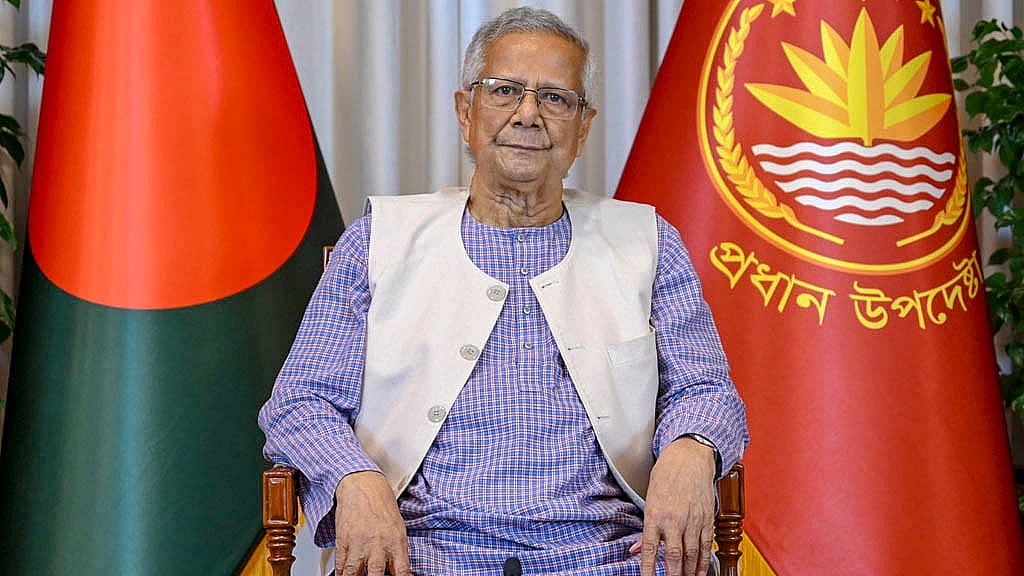
A year has elapsed since Muhammad Yunus’s interim government took charge.
Since the tumultuous mass uprising toppled the Awami League government, the interim administration spent 12 months fraught with grappling issues involving declining economy, political turmoil, trials for crimes during July protests, among others.
Installed following a dramatic 36-day mass mobilisation that ended on Aug 5 last year, the interim government began with sweeping promises to restore democracy and reform state institutions.
It declared the slain protesters of the July Uprising as “National Heroes” and is currently drafting the National Charter, aimed at structural reform. Trials are under way against those accused of repression under the previous Awami League regime.
Among its self-declared achievements, the government lists 12 key successes, including the formation of a timeline for elections and initiation of trials related to last year’s killings. Critics and the public, however, point to visible failures.
Analysts question the government’s inability to reverse economic stagnation, boost investments, or create jobs for youth. Inflation remains high, with little visible improvement in living standards. Although the Awami League’s authoritarian rule was ousted, concerns about political violence persist.
Waves of protests -- from police and Ansar personnel to students and government employees -- have tested the administration. While some demands were met, others were quashed with force.
The repeal of the controversial indemnity law for the energy sector has not led to the cancellation of earlier contracts. With no major advances in domestic gas exploration, the country remains reliant on imports.
Some amendments were made to criminal and civil codes, but Section 54 -- notorious for allowing arbitrary arrest -- remains intact.
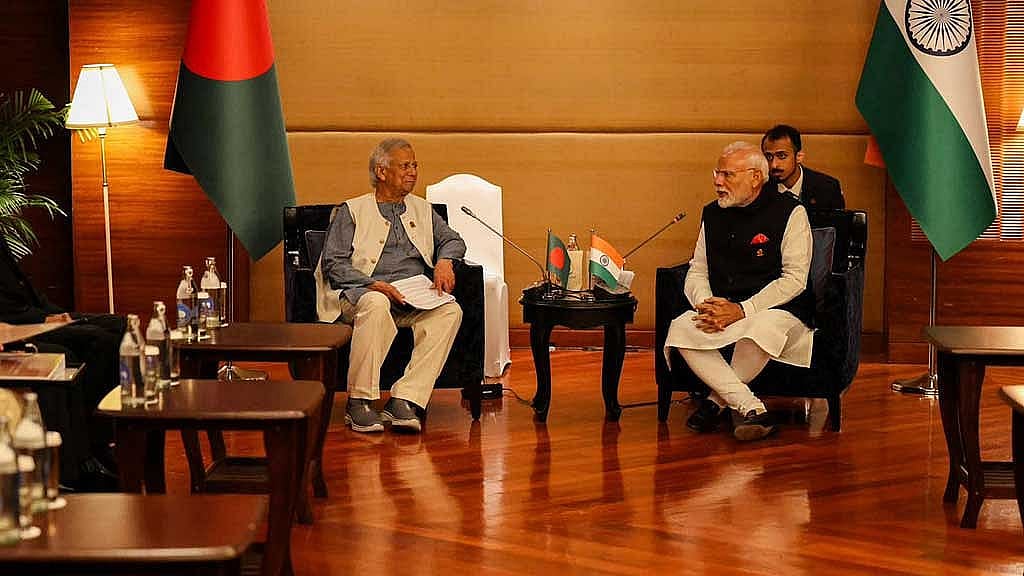
Diplomatically, there has been no major breakthrough. Relations with Pakistan improved, but tensions with India persisted despite Chief Yunus’s meeting with Narendra Modi during the BIMSTEC summit.
India later imposed new trade restrictions. Promises of deeper ties with China have yet to yield significant agreements. The government has made no visible progress on reviving SAARC or gaining ASEAN membership.
Facing public backlash, the administration withdrew a plan to create a “humanitarian corridor” into Rakhine, and Yunus faced criticism for resisting calls to hand over control of Chittagong Port to foreign powers.
Dhaka University’s Professor Zobaida Nasreen told bdnews24.com that while the Uprising aimed to establish neutrality in state institutions, “we’re seeing that personnel have changed, but the exercise of power remains.”
She questioned the credibility of the upcoming election, saying: “Will it be another power-sharing deal? There are overt and covert compromises with political parties, but the right to vote in a secure, peaceful environment is still uncertain.”
Still, she said the election must happen. “Without transferring power to democratic forces, the political situation could deteriorate dangerously.”
Kazi Mahbobor Rahman, a professor of DU’s political science department, echoed the concern over law enforcement: “While improvements have been made, not all law enforcement is citizen-friendly. To honour the spirit of the July Uprising, we must rid the state of undemocratic policing practices.”
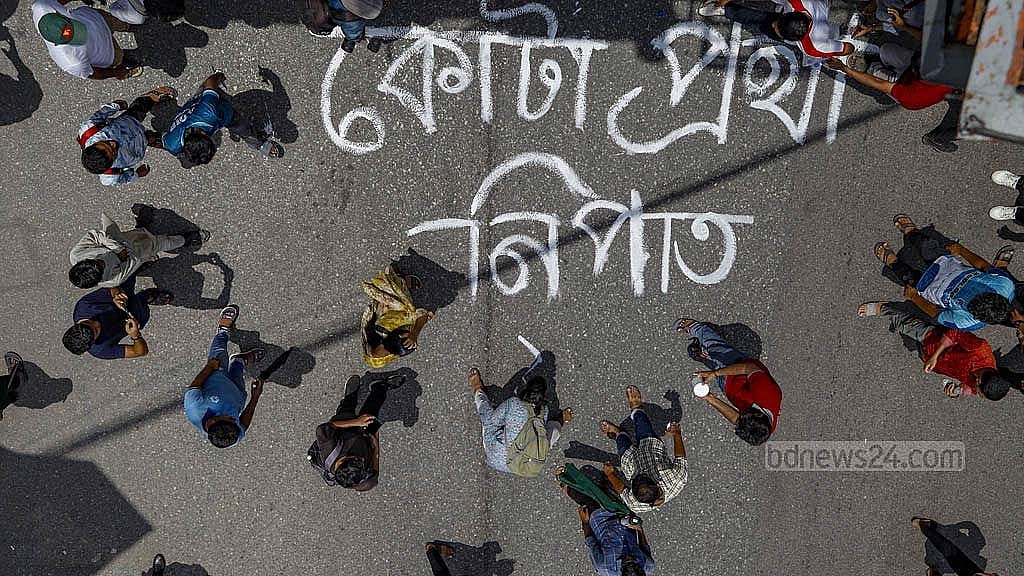
The Uprising had grown from a demand to abolish discriminatory quotas in public service into a nationwide revolt against authoritarianism, censorship, joblessness, and inflation.
The government's response was brutal -- bullets, tear gas, internet shutdowns, and mass arrests -- leading to its collapse within 20 days of bloodshed.
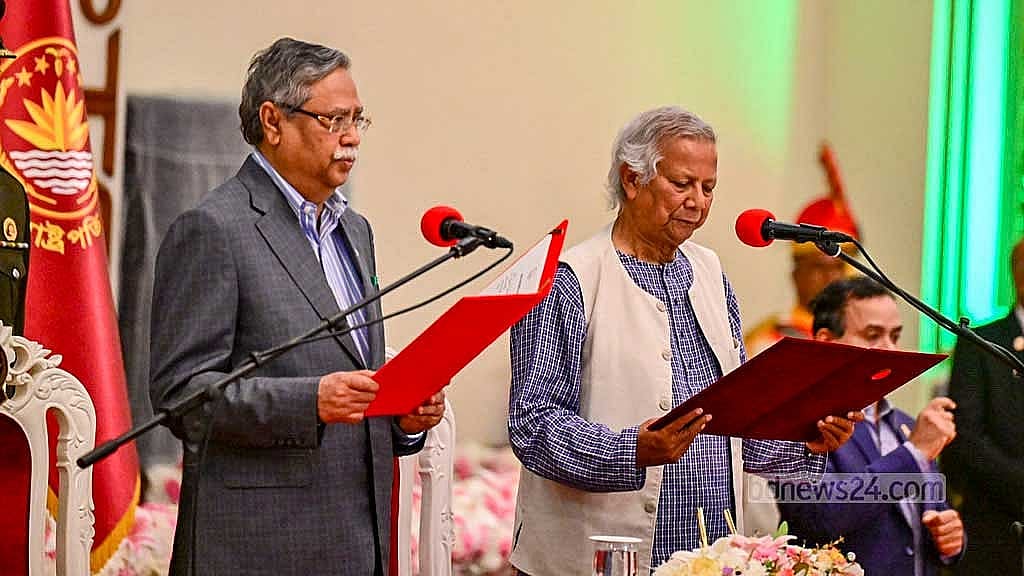
After ruling for over 15 years, prime minister Sheikh Hasina fled to India along with key allies. The country remained government-less for three days until Yunus was sworn in on Aug 8.
The interim government pledged justice for the July Uprising’s victims.
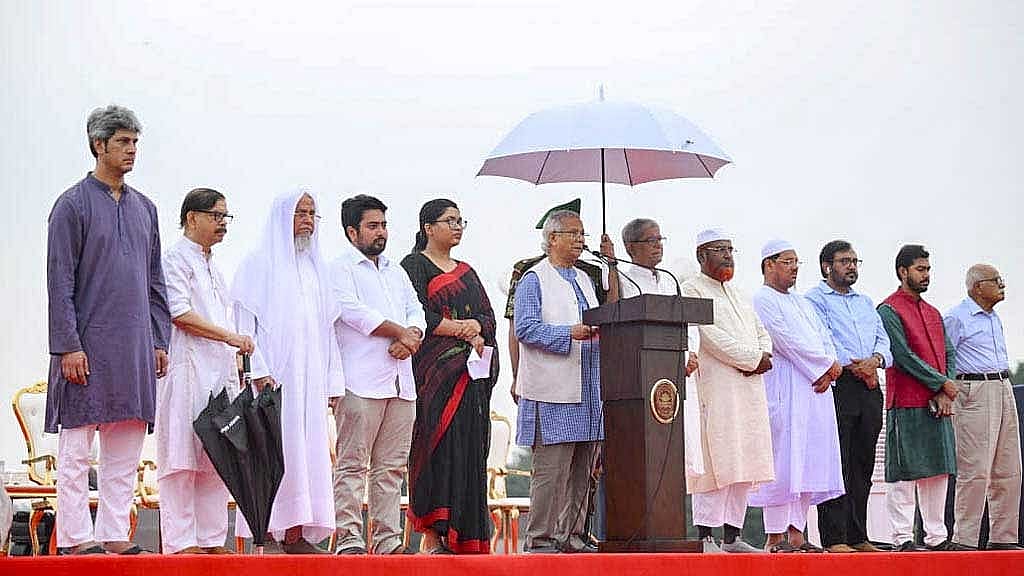
According to a UN Human Rights Commission fact-finding report, about 1,400 people were killed and several thousand injured between Jul 16 and Aug 5.
By July this year, police reported 1,601 cases related to killings and repression during the Uprising, including 637 murder cases. Fifteen charge sheets have been submitted so far, with officials claiming “satisfactory progress” in 70 percent of investigations.
Over 300 of those accuse Hasina, and more than 300 additional complaints have been filed with the International Crimes Tribunal.
Police personnel have also been named in 1,059 cases, with 41 officers arrested so far.
On Jul 10, the tribunal began formal trials against Hasina, former home minister Asaduzzaman Khan, and ex-police chief Chowdhury Abdullah Al-Mamun.
The latter has turned state witness, while the other two are being tried in absentia.
They face five charges: incitement to kill, issuing orders, superior command responsibility, and joint criminal enterprise. Prosecutors submitted an audio clip purportedly featuring Hasina ordering lethal force.
In a separate trial that began on Jul 14, eight former police officer are accused of crimes against humanity for the murder of six people in Dhaka’s Chankharpul. Four of the accused are being tried in absentia, including ex-DMP commissioner Habibur Rahman.
REFORM DRIVE ANCHORED IN NATIONAL CHARTER
After the fall of the Awami League government, discussions around structural weaknesses intensified, with demands for sweeping reforms in the Constitution and governance system to ensure no future slide into authoritarianism, end decades of injustice and corruption, and move toward a true welfare state.
To fulfil these aspirations, the interim government formed 11 reform commissions.
According to Yunus, several urgent, short-term reforms proposed by key commissions -- covering the economy, judiciary, and civil administration -- have already been implemented. These reforms, he said, are bringing greater dynamism, transparency, and accountability while reducing corruption, irregularities, and harassment.
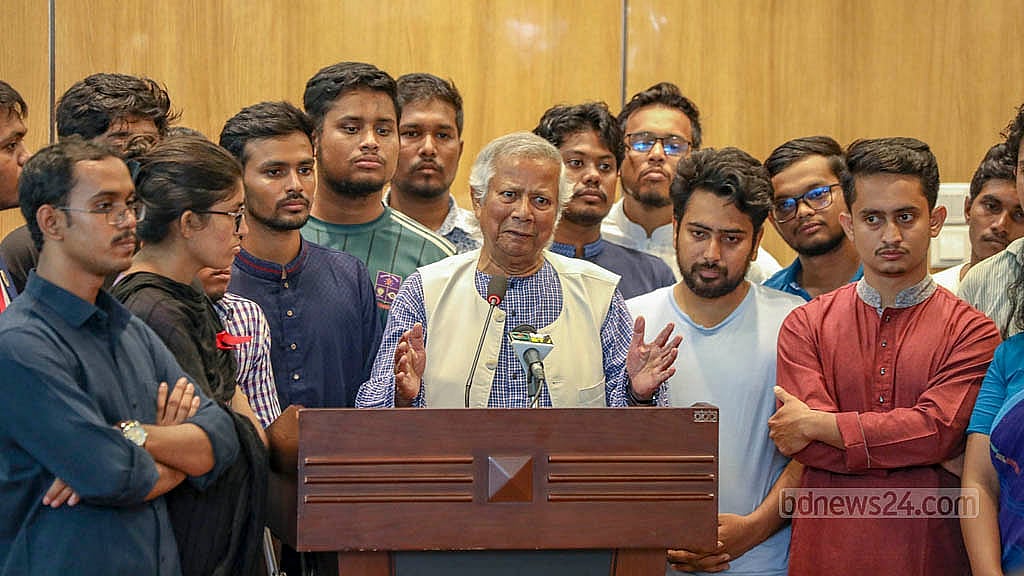
To build political consensus on reform, the government established the National Consensus Commission, chaired by the chief advisor himself.
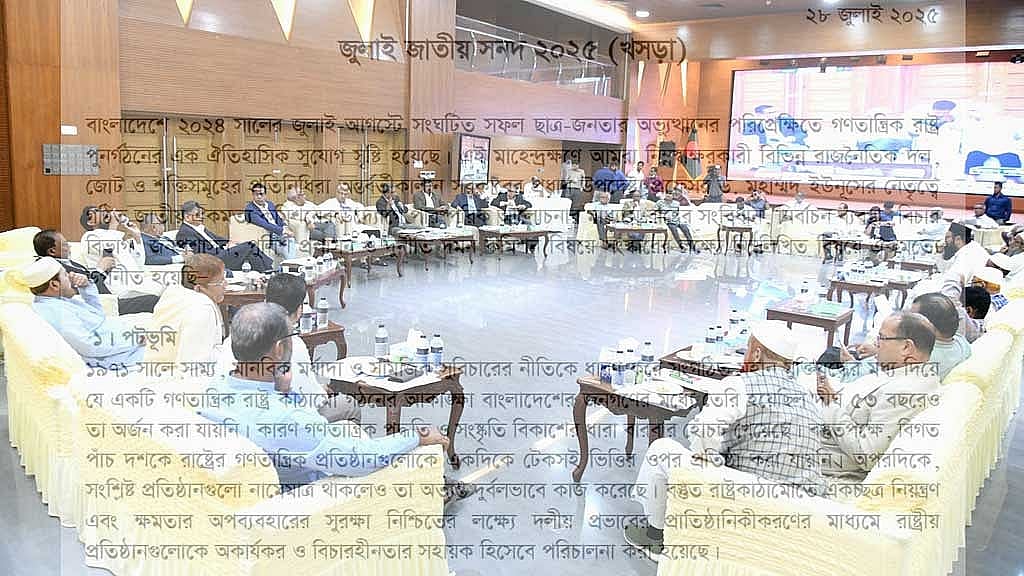
The commission held dialogues with political parties on 166 recommendations from five of the 11 commissions -- constitution, electoral, judiciary, anti-corruption, and public administration.
In the first phase, from Mar 20–May 19, consensus was reached on 62 of these proposals. In the second phase, running 23 days until Jul 31, nearly 30 parties were engaged in intensive talks, resulting in 19 agreed items, 10 of which were subject to formal notes of dissent.
Some of these agreed-upon reforms will be implemented directly by the interim government via ordinances. Others will require approval by the next parliament, with parties pledging to pass them under the National Charter, also known as the July Charter.
The commission has already drafted the Charter, summarising the agreed reforms and binding political parties to implement them within two years of the next election. The document will include the commission’s background, objectives, and endorsed proposals.
The final version will be signed by political party leaders, the chief advisor, and commission members.
In his national address on the anniversary of the July Uprising, Yunus said: “We have reached our reform goal. The July Charter is now ready after continuous, all-party dialogue -- this is a historic milestone in our political evolution. Both the document and the process of its creation will be remembered.”
As reform gained traction, pressure mounted for an election roadmap. Despite reassurances from Yunus and his advisors about polls by June 2026, the BNP demanded elections by December 2025.
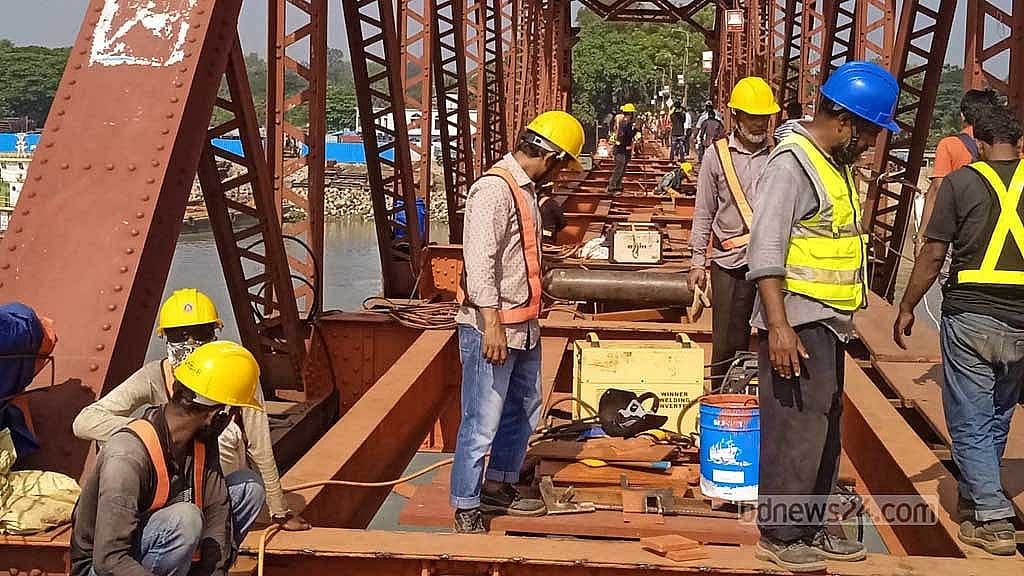
The Jamaat-e-Islami and the National Citizen Party (NCP) -- comprising student leaders of the Uprising -- instead called for local government elections first.
Tensions rose as the BNP escalated its opposition, accusing the government of stalling and holding demonstrations. Then, on the eve of Eid-ul-Azha, Yunus brought forward the tentative election window, proposing early April 2026.
Still, the BNP remained adamant about a December 2025 poll.
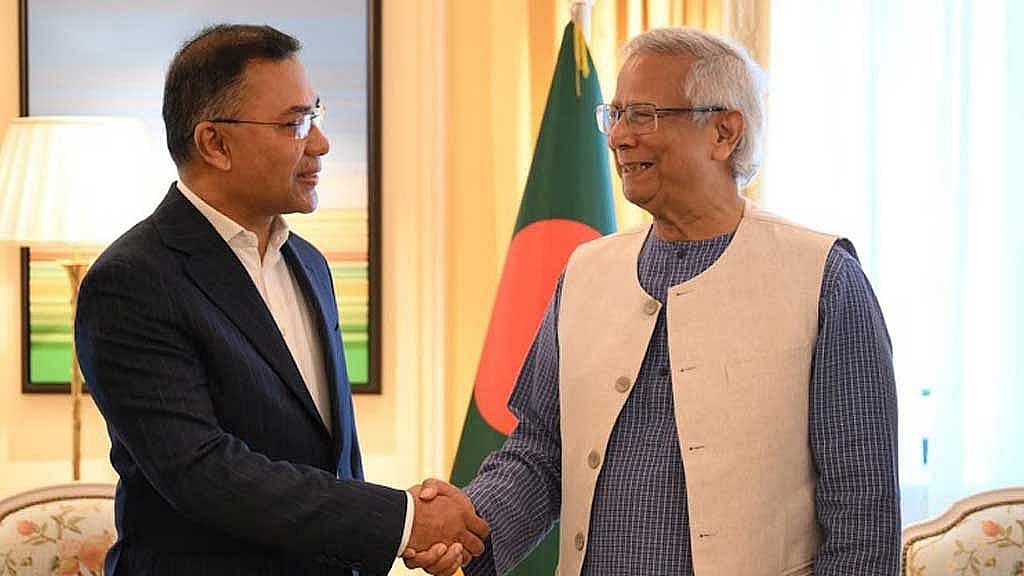
Amid concerns over the impasse and the stalled pace of reforms and justice for July's killings, Yunus met the BNP’s Acting Chairman Tarique Rahman in London on Jun 11. Their joint statement floated an earlier vote, possibly before Ramadan in early 2026, conditional on significant progress on reform and justice.
That ambiguity ended on July Uprising Day, when Yunus announced in his address that elections would be held before Ramadan in February 2026, saying: “With this announcement, we enter the final and most crucial chapter -- handing over to an elected government.”
The next day, the Chief Advisor’s Office formally instructed the Election Commission to begin preparations for the national election in the announced timeline.
Political leaders from the BNP, Jamaat, and others welcomed the announcement and expressed readiness for the poll schedule.
Election experts say the declaration ends months of speculation and provides much-needed clarity.
WHERE ECONOMY STANDS
The interim government has frequently claimed its priority lies in financial sector reform and the recovery of illicit capital sent abroad. A white paper was also published under government initiative, outlining systemic corruption in the financial sector during the Awami League era.
In his July Uprising Day address, Yunus said: “When our interim government inherited a devastated economy a year ago, wrecked by 16 years of continuous looting and mismanagement, few believed it could be revived.
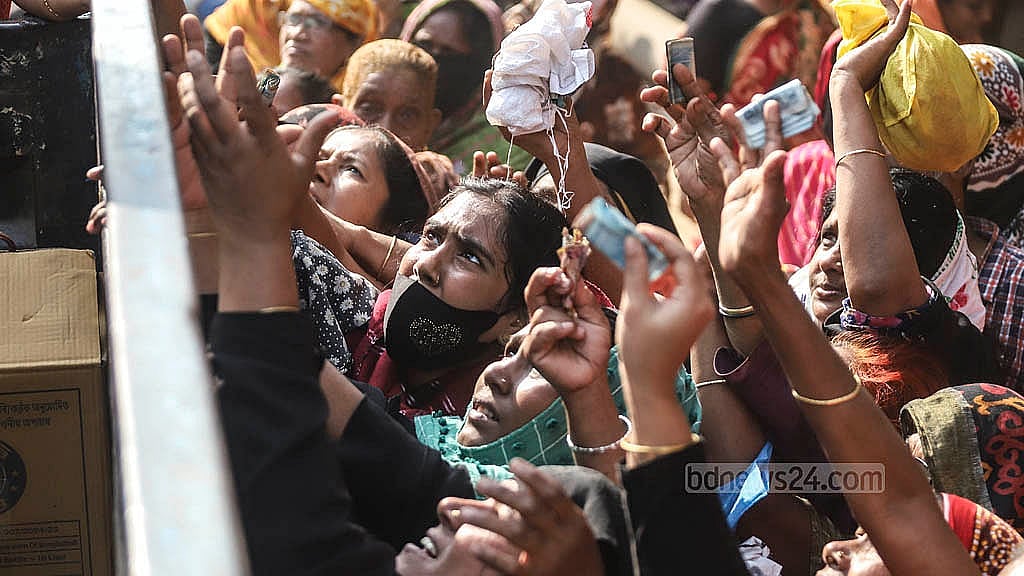
“But in just one year, we have covered a distance that was unimaginable. The economy has turned around. Now it is time to move forward at full speed.”The government has attributed this claimed turnaround to declining inflation, 9 percent export growth, repayment of $4 billion in foreign loans, renewed foreign investment, and initiatives to recover siphoned-off wealth.
However, underlying data suggests mixed outcomes. A major source of recent macroeconomic stability has been strong remittance inflows, bolstered by a weaker taka. This helped improve reserves and the balance of payments, despite ongoing uncertainty surrounding potential US tariff actions.
While the government views a 20 percent supplemental duty, imposed relative to other countries, as favourable, the long-term risks remain.
Annual Development Programme (ADP) implementation, however, has hit a two-decade low. Just 67.85 percent of the revised allocation for FY2025 was utilised, down from 80.63 percent the previous year. Revenue collection has also declined, falling from over Tk 3.82 trillion in FY2024 to Tk 3.68 trillion in FY2025.
Following the fall of the Awami League, inflation initially fluctuated between 9–10 percent. The government claims this has since come down. June inflation was reported at 8.48 percent -- a 35-month low -- but wage growth lagged behind at 8.18 percent.
In July, inflation ticked up slightly to 8.55 percent, while wage growth rose marginally to 8.19 percent.
Despite these figures, everyday life remains strained.
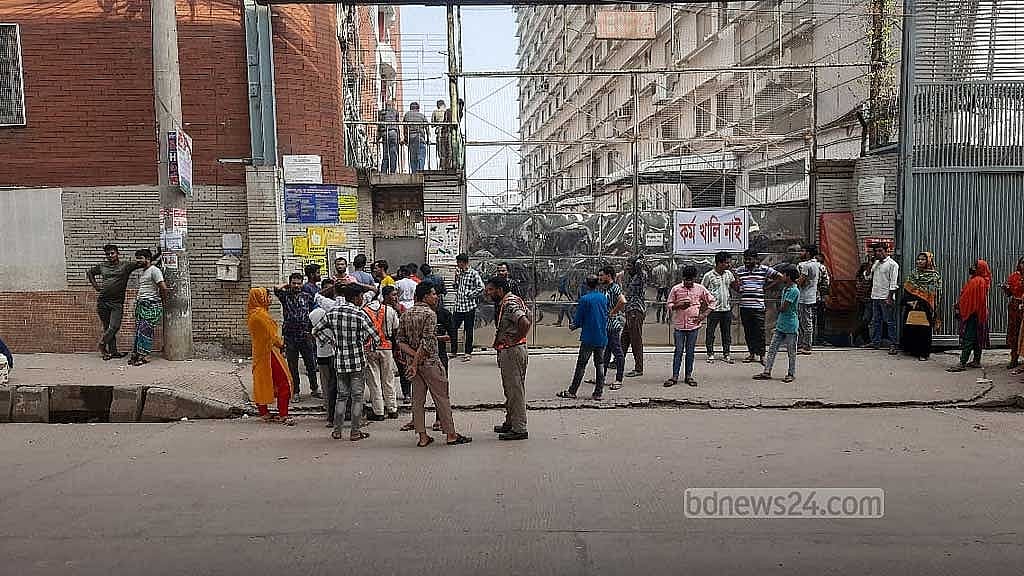
On Aug 1, traders reported vegetable prices had jumped by Tk 10–20 per kg, and chicken prices saw similar increases. Onion prices rose by Tk 10 per kg. Rice continues to retail at high levels: miniket at Tk 82–92, nazirshail at Tk 84–90, swarna at Tk 55, and BRRI-28 at Tk 65.
Fish prices climbed from mid-July, and egg prices surged to Tk 140 per dozen in August, up from Tk 110–120 in July. Prices of some goods decline only for others to spike, leaving consumers with no relief.
Bangladesh Bank aims to bring inflation down to 7 percent by December. The FY2026 budget targets 6.5 percent. To support this, the central bank has continued a tight monetary stance, keeping the policy rate unchanged at 10 percent for July–December.
Governor Ahsan H Mansur has said the rate will not drop until inflation falls below 7 percent.
A higher policy rate raises banks' borrowing costs from the central bank, translating into higher lending rates for businesses.
The private sector credit growth target has been cut to 7.2 percent, from 9.8 percent in the previous policy. June data revealed private credit growth had fallen to 6.4 percent, the lowest in 22 years, underscoring a sharp drop in investment appetite.
This follows an earlier dip to 6.82 percent in February, lower even than during the pandemic when growth stayed above 7.5 percent.
Foreign aid disbursement has also slowed. Despite verbal assurances from development partners, bureaucratic delays and austerity policies constrained disbursement.
From July to May, foreign fund release declined by 20 percent year-on-year, while debt service payments rose 23 percent. Aid commitments also fell -- to $5.49 billion, down from $7.93 billion in the same period the previous year.
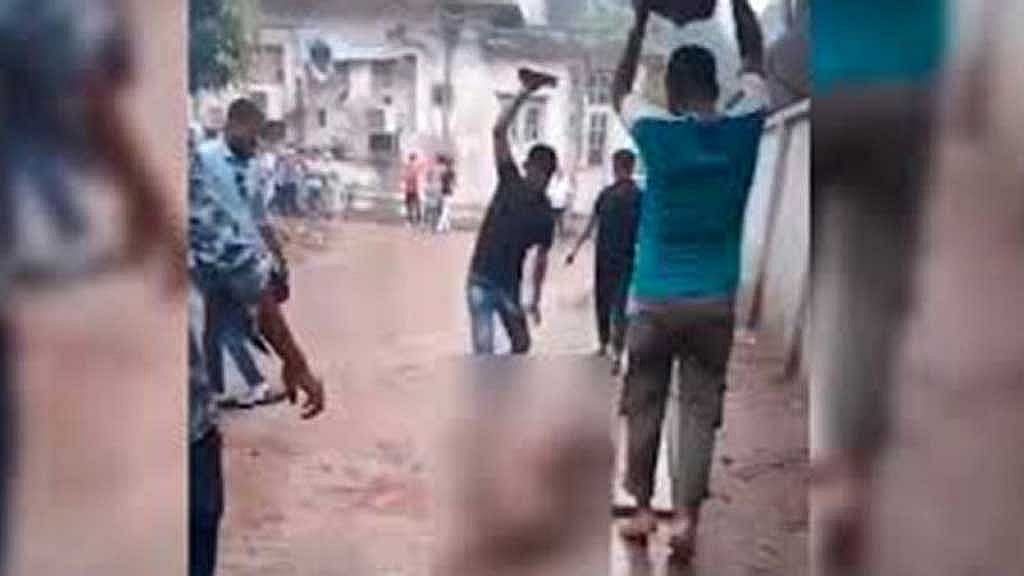
Still, Yunus reported that Tk 105 billion in foreign direct investment (FDI) came in during the first three months of this year -- more than double the same period last year.
Counting from October, total FDI reached Tk 165 billion in six months, again double the amount seen in the last six months under the previous government. He also noted that Hong Kong-based Hanada Group plans to invest $250 million in the garment sector, potentially creating 25,000 jobs.
But economist Selim Raihan argued that while steady remittance and exports have kept the economy afloat, hoped-for gains in investment and growth have not materialised.
“Our biggest worry is low growth expectations, especially in private investment. Indicators like capital goods imports and private credit growth are historically low,” said Selim, who also served on two official financial reform panels.
Without growth and investment, he warned, the jobs crisis at the heart of last year’s movement will persist.
“This government had an opportunity to push through reforms. But that window may have closed. Political calculations around elections will now likely take precedence over economic priorities.”
Even the white paper and taskforce recommendations on banking and tax reform remain mostly unacted upon.
“There’s a lot of talk, but little coordination. Many stakeholders aren’t even aware of what reforms are happening,” he said.
Although the ADP budget has been cut, the government raised allowances for all public servants in the FY2026 budget and formed a new pay commission, which has been asked to report within six months.
DECLINING LAW AND ORDER
Questions continue to be raised over how much the law and order situation has actually improved under the interim government.
On the day the Awami League government was ousted in the July Uprising, police stations across the country came under attack. Many officers fled under assault.
According to the police, 44 police personnel were killed during that period.
Several police officers known to be close to the former ruling party went into hiding. Although officers began returning to duty a week after the interim government took over, activating the police force proved difficult amid mass transfers, ongoing trials over use of force during the July Uprising, and resentment following attacks and killings of officers in the post-government-collapse chaos.
At that time, rank-and-file officers voiced strong demands for internal reform. In response, various measures have been undertaken to restore the morale of a demoralised police force.
The police logo has been changed, and new uniforms are in the works. Still, many officers say these cosmetic changes have not been enough to rebuild morale.
The interim government also deployed the military with magistracy powers in the face of law enforcement inertia. The military remains on the ground with such authority after multiple renewals.
With law enforcement largely inactive in the early phase, “mob” violence spread fear among the public. There were several instances where police seemed to capitulate to “mob” demands.
As the police remained passive, street crimes like mugging, extortion, and land grabbing continued unchecked. In Dhaka, terrified residents even began forming night patrols.
Within the police force, frustration persists over the lack of justice for colleagues killed during the July Uprising.
As late as the second week of July this year, Inspector General of Police Baharul Alam acknowledged the force’s morale had yet to fully recover.
“The main challenge is restoring this force to 100 percent effectiveness after such a traumatic experience,” he said. “No matter what you say, I’m still not satisfied. We are still in the process.”
Meanwhile, political parties have agreed on the Police Reform Commission’s proposal to form an independent police commission. But incidents on the ground continue to call into question how much progress has been made in the government's first year.
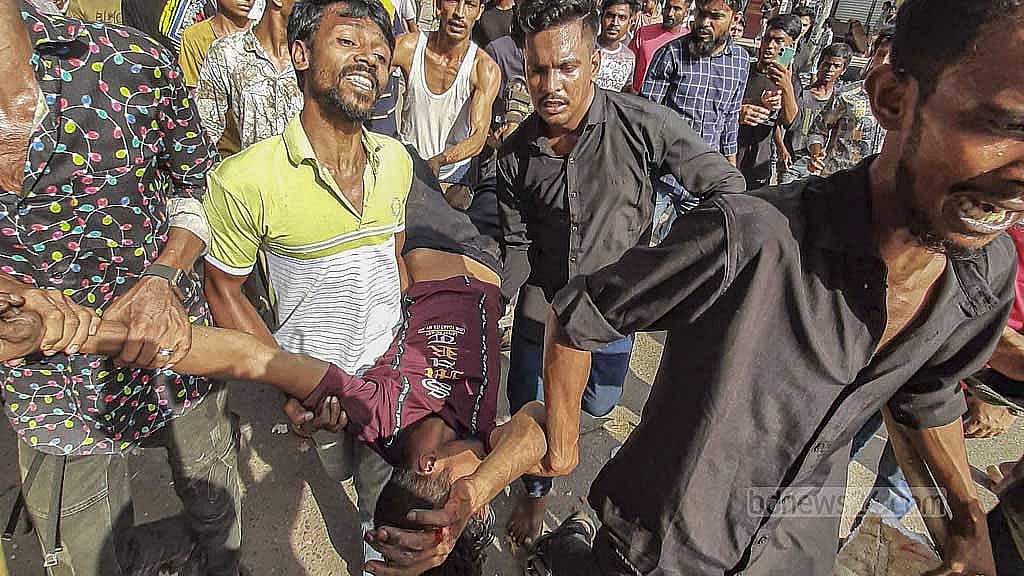
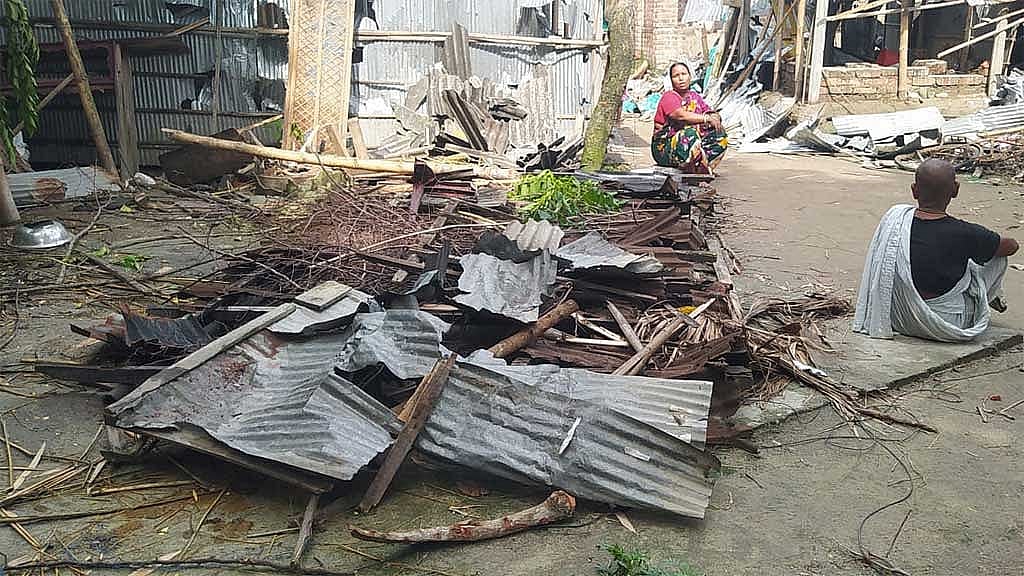
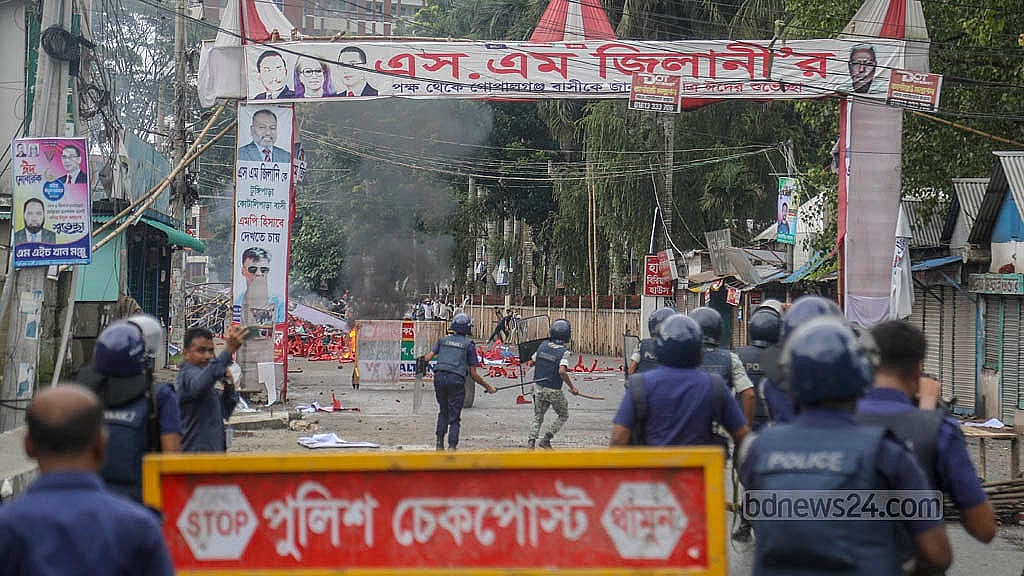
In the year since the Uprising, politically motivated “mob” violence has spread fear, particularly around attempts to suppress dissent. The public also witnessed the unprecedented destruction of Bangabandhu Sheikh Mujibur Rahman’s historic residence in Dhanmondi 32 -- an incident for which the government was not seen taking any firm action.
In July, a “mob” attacked Hindu homes in Gangachara, Rangpur. There were also cases where suspects were forcibly released from police custody, or police were prevented from making arrests. In some areas, so-called “moral policing” has led to the cancellation of girls’ football matches and cultural events.
According to the rights group Manabadhikar Shongskriti Foundation (MSF), 16 people were killed in mob violence and lynchings in July alone. Early that month, in Muradnagar, Cumilla, a woman and her two children were beaten to death by a mob.
MSF’s June report had documented 10 such killings. In July, a trader was bludgeoned to death outside Mitford Hospital in Dhaka, sparking nationwide protests.
That same month, MSF recorded 42 incidents of political violence -- 27 of them stemming from internal BNP conflicts.
One clash reportedly involved supporters of BNP leader Asif Mahmud Shojib Bhuyain. Nine people were killed in political violence in July: four from the BNP, and five during clashes in Gopalganj. Those clashes, on Jul 16, resulted in fatal shootings, and the banned Awami League and its affiliates were blamed. The rights group ASK described the incident as a “serious human rights violation.”
Among the BNP’s four dead, three were killed in internal conflicts and one in a clash with Jamaat-e-Islami.
MSF reported that political violence claimed eight lives each in May and June. According to ASK’s report -- based on news reports -- from January to June, mob and lynching-related deaths totaled 89, while political violence accounted for 65 deaths.
During this same period, 441 rape cases were reported, including 111 incidents of gang rape.
TIES WITH INDIA, PAKISTAN
The interim government’s year-long reform agenda received open support from Western countries, including the United States, United Kingdom, and the European Union.
As part of deeper engagement with multilateral institutions, a new United Nations Human Rights Commission office has been established in Dhaka.
Yet, major diplomatic breakthroughs have remained elusive.
While a thaw in relations with Pakistan was attempted, tensions with India persisted. Despite a meeting between the two prime ministers during the BIMSTEC summit in Thailand, no progress was achieved -- India instead imposed trade restrictions.
Talks of strengthening ties with China did not yield any major agreements either. Hopes of reviving SAARC or securing ASEAN membership also failed to materialise.
The government views a deal with the US -- reducing supplementary tariffs from 35 percent to 20 percent -- as a key diplomatic success.
Dhaka University international relations professor Imtiaz Ahmed said the deteriorating ties with India were not inevitable but stemmed from public frustration over India’s close alignment with the ruling party rather than the people.
This perception, he argued, triggered criticism from across the political spectrum and likely worsened bilateral ties. He noted that efforts to normalise relations with Pakistan were less crucial, as the two countries lack significant economic ties.
Reflecting on foreign relations overall, Imtiaz said expectations of major foreign investment, especially owing to the global profile of Yunus, did not come to pass.
Nonetheless, he acknowledged that the interim government managed to sustain diplomatic ties with key international players.
[Writing in English by Syed Mahmud Onindo]