Published : 09 Aug 2025, 10:13 AM
Updated : 28 Aug 2026, 01:24 AM


Two and a half centuries ago, the Rakhine people crossed the sea and settled along the stormy coastal stretches of what is now southern Bangladesh, transforming the untamed, disaster-prone coastal lands of Patuakhali and Barguna into arable terrain.
But today, the very descendants of those early settlers say they are being pushed to the margins: stripped not just of farmland, but of their homes, monasteries, and even cremation grounds.
Their plight, say local observers, is not incidental. “Land grabbers have a clear pattern,” says one development worker. “They target three things—Rakhine settlements, Buddhist monasteries, and cremation grounds. Those are the lands being taken.”
A field visit across Barguna and Patuakhali reveals a systematic pattern: lands long used by Rakhine communities, including government-owned plots, have been taken over by force, deceit, or under dubious legal claims. In many cases, encroachers have fenced off the land without resistance.
A SHRINKING COMMUNITY UNDER PRESSURE
According to community elders, the Rakhines first settled in Ranguabali, Kalapara (Patuakhali), and Taltali (Barguna) more than two centuries ago. Facing tigers and cyclones, they turned the coastal swamplands into fertile, habitable land.
In the early 1900s, the Rakhine population in the region numbered around 50,000. Many died in the devastating 1965 floods. Today, only about 2,500 remain in increasingly precarious conditions, with little land and few options for livelihood.
TWO CENTURIES AFTER SETTLEMENT, ENCROACHMENT TAKES HOLD
Mang Cho Thin Talukder, president of the Barishal region chapter of the Bangladesh Indigenous Peoples Forum, said the Rakhine first arrived in Ranguabali in 1784, travelling by sailboat.
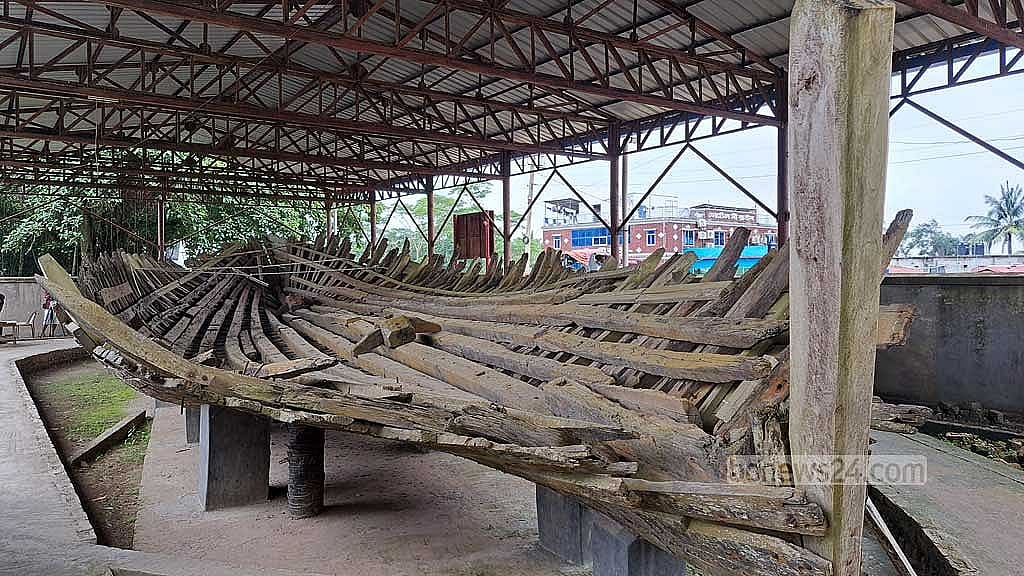
One such traditional boat was recently recovered in Kuakata’s Huichanpara area and preserved in 2012 near the Rakhine Women’s Market and Buddhist temple in Kuakata municipality.
Talukder notes the region’s original place names were in the Rakhine language; Kuakata was once called “Kanshai Chyuan”.
The wave of land seizures began more recently, according to Caritas officer Mang Mya. “Land-grabbing intensified in the 1990s when tourism potential in Kuakata and other coastal zones started booming,” he said. Caritas has worked since 2007 on Rakhine education, land rights, and cultural preservation through its Integrated Community Development Project (ICDPDC).
Caritas data shows there are now 40 Rakhine villages in Patuakhali and Barguna. Of 22 crematoriums once serving these villages, some are now completely or partially occupied. Twelve villages have no crematorium left at all, while 20 have temples only.
250-YEAR-OLD MONASTERY UNDER THREAT
Facing the Kuakata seafront, across from Hotel Sea Queen, stands the historic Kuakata Sreemangal Buddhist Monastery, which was established in 1784. Its land has shrunk drastically from 250 decimals to just 65.
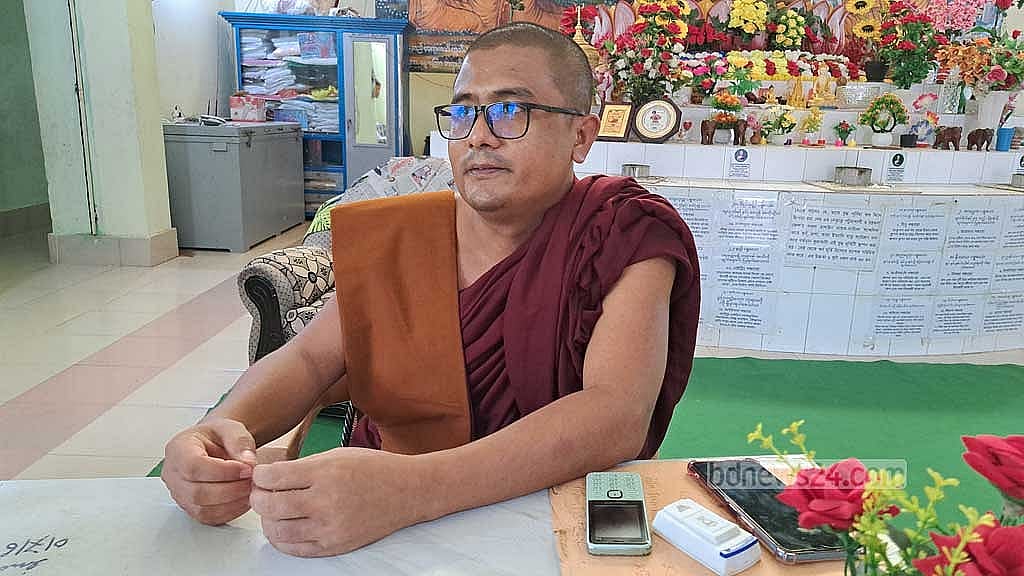
Venerable Indrabongsho Thera, head monk of the monastery, told bdnews24.com that the temple was first built with a thatched roof. Legal papers were issued in 1951, and concrete structures were added in 2003.
According to the RS survey records, the monastery owns 2 acres and 44 decimals, roughly 0.99 hectares. However, nearly an acre was taken for road construction. “We don’t contest that, it’s for public use,” said the monk. “But we demand the rest of the land be returned.”
He said 65 feet, or roughly 19.81 metres, of the remaining land is now being claimed by the Water Development Board (WDB), even though a High Court stay order is in place. “This case has been dragging on for 17 years,” he said.
Asked about the issue, Water Resources Advisor Syeda Rizwana Hasan told bdnews24.com, “I’ve informed the Water Development Board. I’ll take action once they report back.”
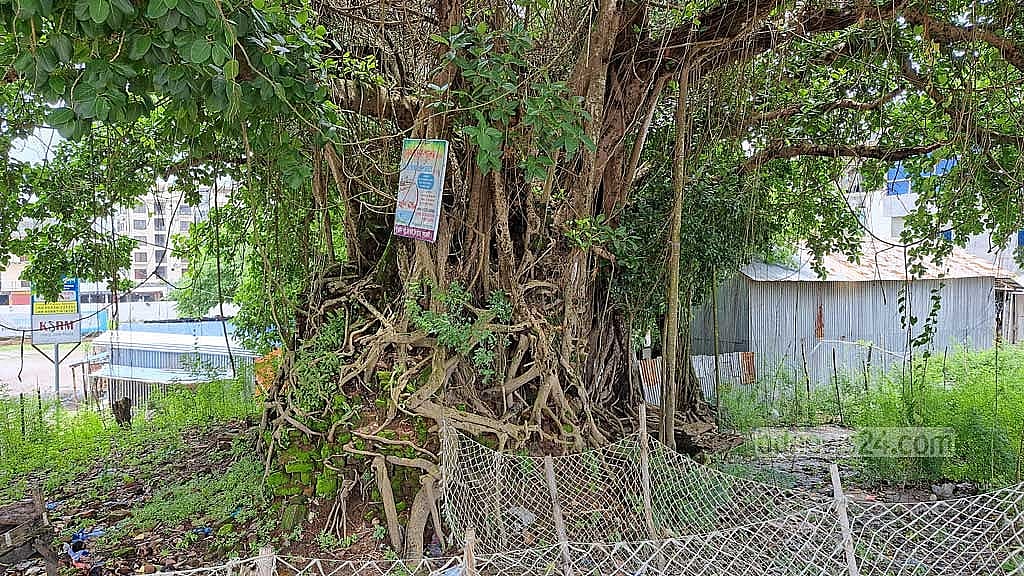
Indrabongsho Thera added, “There was a 'Jadi' shrine beside a large banyan tree right at the monastery entrance. That, too, has been destroyed. We weren’t even allowed to clean or renovate it.”
The Department of Archaeology has preserved a historic boat next to the monastery, a relic of the Rakhine migration to Bangladesh. The Rakhine Women’s Market, too, stands on monastery land.
CREMATION GROUNDS ARE DISAPPEARING
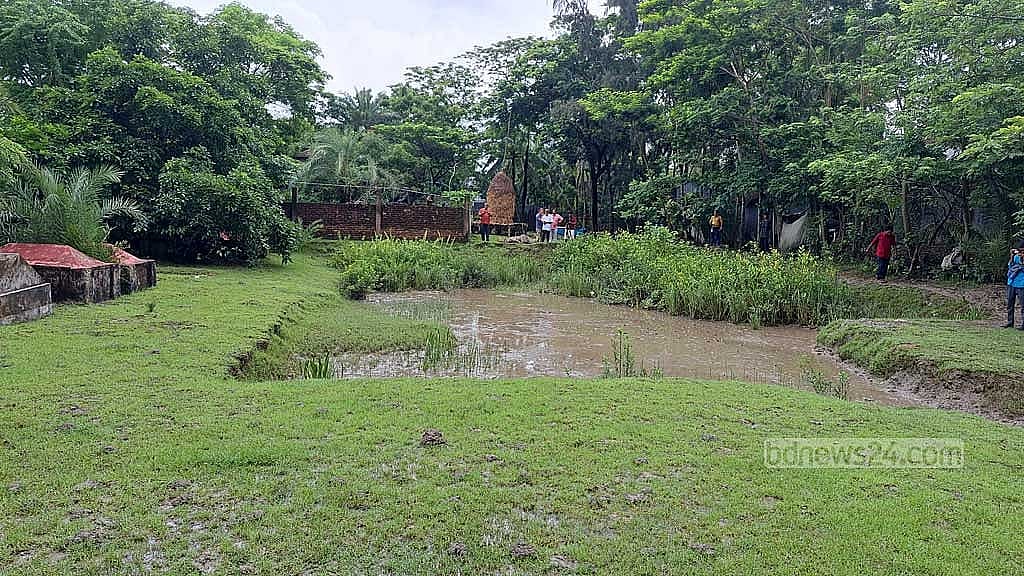
Across Barguna and Patuakhali, bdnews24.com visited several cremation grounds that have been partially or fully seized.
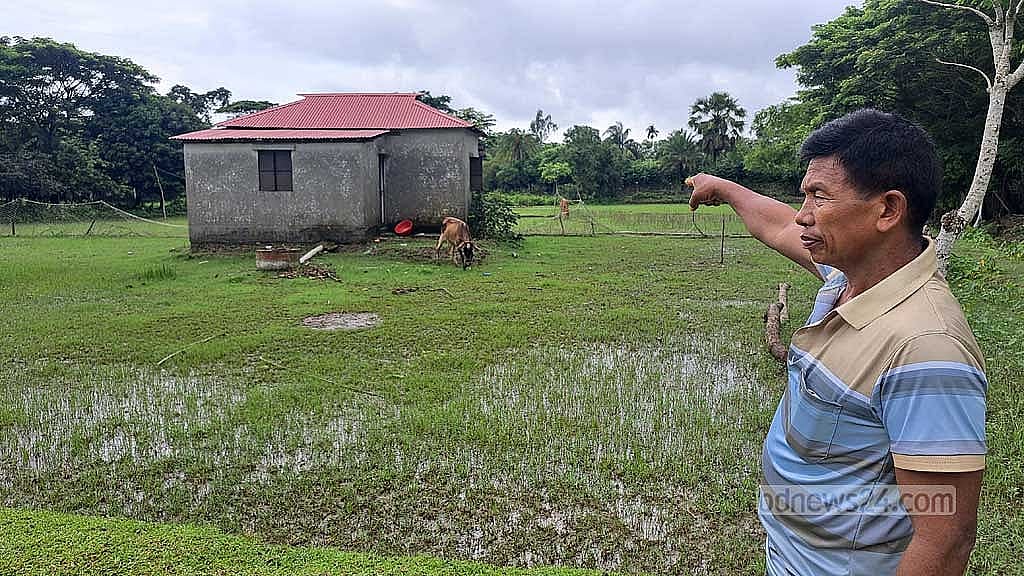
In Laupara village, nestled beside the Nidrar Canal in Taltali’s Sonakata union, a Rakhine community has lived for generations. For just as long, a cremation ground has existed alongside their homes.
In 2023, a house under the government’s Ashrayan (resettlement) project was built in the middle of that cremation site. Though the allocation was for just over two kathas, roughly 1.5 decimals, the recipient is now occupying more than six kathas.
Even though there is plenty of unused land nearby, the house was erected squarely on the cremation site. As a result, the original 150-decimal, approximately 1.5-acre, cremation ground has now been reduced to just 60 decimals.
Each Rakhine settlement has an elder or “matbor”. Laupara’s elder, Ching Ten Mong, told bdnews24.com: “Some residents couldn’t afford the legal fight over land and had to flee to Myanmar. Even our access path to the cremation ground has been taken.
“When digging for the house, bones from old cremation burials were found.”
Asked who allocated the land for the Ashrayan house, he said: “The then UNO (Upazila Nirbahi Officer).”
Records show that the UNO at the time was SM Sadik Tanvir, now serving as senior assistant chief in the Physical Planning, Water Supply and Housing Wing of the Planning Commission. Multiple attempts to contact him went unanswered; his phone remained switched off.
The house was allocated to a man named Abu Sulaiman, a former mosque imam who now works in Saudi Arabia. The house is currently occupied by a man named Naimur Rahman, who claims to be Sulaiman’s nephew.
Naimur told bdnews24.com that not only the house but also three decimals of adjacent land were allocated. Asked how he became the effective owner of his uncle’s government-allocated house, he deflected the question and blamed local authorities.
“I moved in a year ago. Before that, it was empty. I don’t know how my uncle got the allocation or who approved it.
“All I know is that it was for the imam. He was poor back then; now he’s abroad.”
When asked how he could occupy more than six kathas despite the two-katha allocation, he responded: “I can’t answer that. This is a government-allocated house. Why was it given without proper scrutiny? I don’t know.
“I’m poor and I need a place to live. That’s my claim. But verifying that was the administration’s job, not mine.”
Local Union Parishad Chairman Farazi Md Yunus said, “I don’t know anything about this. That house was allocated during Mujib Borsho (Mujib Year), under the previous chairman. No one has brought this to my attention.”
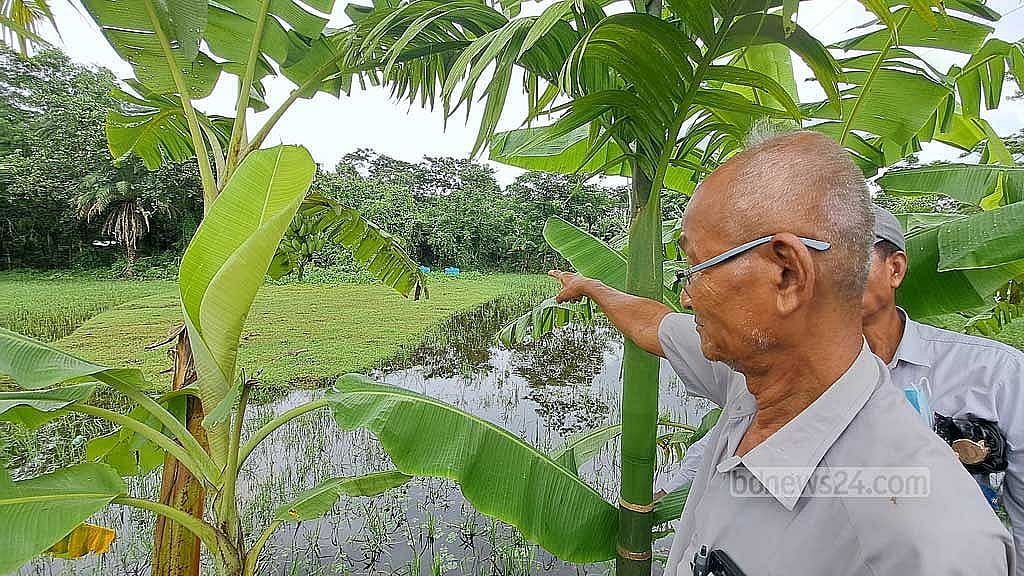
The oldest resident of the village, 91-year-old Mong Thong U, stood frail and stooped. He said quietly: “What’s gone is gone. At least declare this cremation site officially, so we don’t lose it all.”
SAME STORY IN OTHER VILLAGES
Across Taltali’s Thakurpara area in Chhoto Bogi Union, similar allegations of encroachment have surfaced. Another Rakhine cremation ground is gradually disappearing.
Resident Aung Ten Rakhine said: “According to documents, this cremation site was 74 decimals. Now it’s down to 15. Every year, they take one or two hands’ width more by cutting into the land.”
Investigations revealed that neighbouring houses and ponds belong to one Dulal Mridha. When asked, he said: “My grandfather bought this land in 1955. I built my house here in 2010.”
When asked why his family did not settle here earlier, he could not offer a clear answer, saying later he acquired the land in a swap.
Dulal added: “If it turns out the Rakhines own any of it, I’ll return it.”
Next door, Nurul Islam’s family is also accused of grabbing cremation land. His son Habibur Rahman blamed Dulal.
“We didn’t grab anything, Dulal Mridha did. He won’t be able to show any documents.”
Soon after, Dulal told a different story. “Actually, Habibur’s family grabbed the land. They don’t have documents.”
Thakurpara village elder Mong Cho Wen, 73, said: “For the past 10 to 15 years, this has been going on.”
When asked if he had filed any complaint, he replied, helplessly: “Who would we complain to? We’re a neglected people.”
Further inquiry revealed that Dulal and Nurul’s father had migrated from elsewhere. Though the Rakhines have little left, Dulal now owns houses, ponds, and rice fields.
Dulal said, “The whole area, including the pond and road, is mine. Only a part of the cremation ground belongs to the Rakhines. My grandfather bought this from the Burmese (Rakhines) in 1955.
“We used to live near the Thakurpara embankment. I built this house in 2010. Before that, someone else was occupying it. I have no desire to grab cremation land.”
Habibur added, “All this land once belonged to the Burmese. But later, might is right. We didn’t grab anything. Dulal did.
“My grandfather Sadem Ali Fakir bought it. We were from Gilatoli in Barguna.
“How we ended up here, I don’t know. My grandfather bought it—but how, I can’t say. A man named Gunjar Ali Hawlader used to occupy it. He never gave us a deed despite taking money three times. On his deathbed, he finally gave a deed for five katha.”
KALACHANPARA: GRAVES DUG UP FOR EARTH
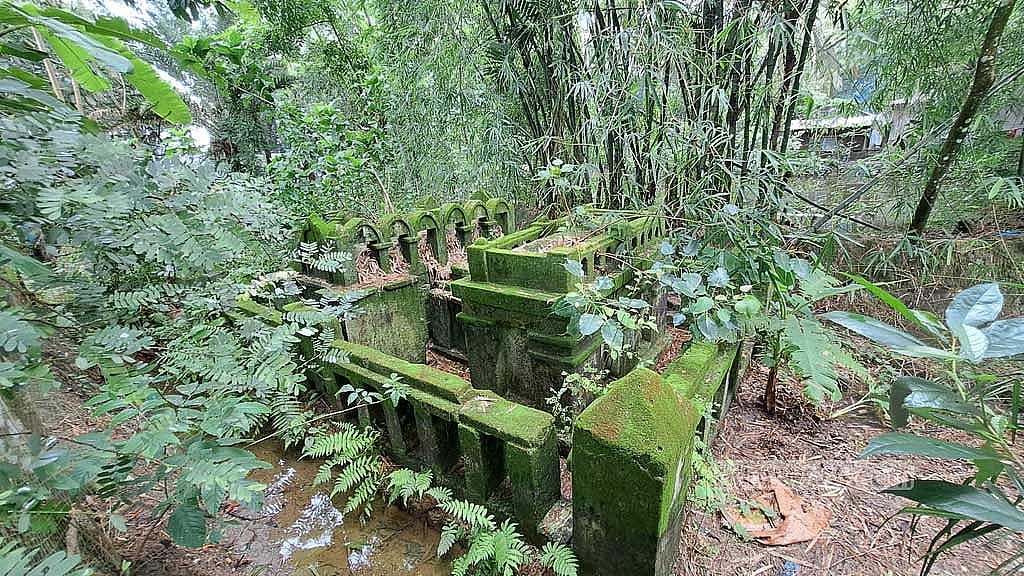
In Kalachanpara village, the cremation ground established in 1956 on government land has been partially seized by a man named Jalal Mistri.
Village elder Aung Cho Chan Talukder says, “He got official allocation through manipulation. We submitted a memorandum to the district administration when a fight broke out during a burial.”
The Development Committee’s secretary Mong Chya Chan adds: “My brother was buried here in 2002. That grave’s been taken too.”
Jalal Mistri denied digging out any soil: “But if there’s proof, I won’t argue.”
Kalapara UNO Rabiul Islam said, “We are actively working to grant official ownership of khas lands to Rakhine communities. We've already initiated the paperwork.”
He added, “We’ve urged the Rakhines to report any issues. We are committed to protecting their cremation grounds and villages.”
‘LAND GRABS WITH OFFICIAL BLESSING’
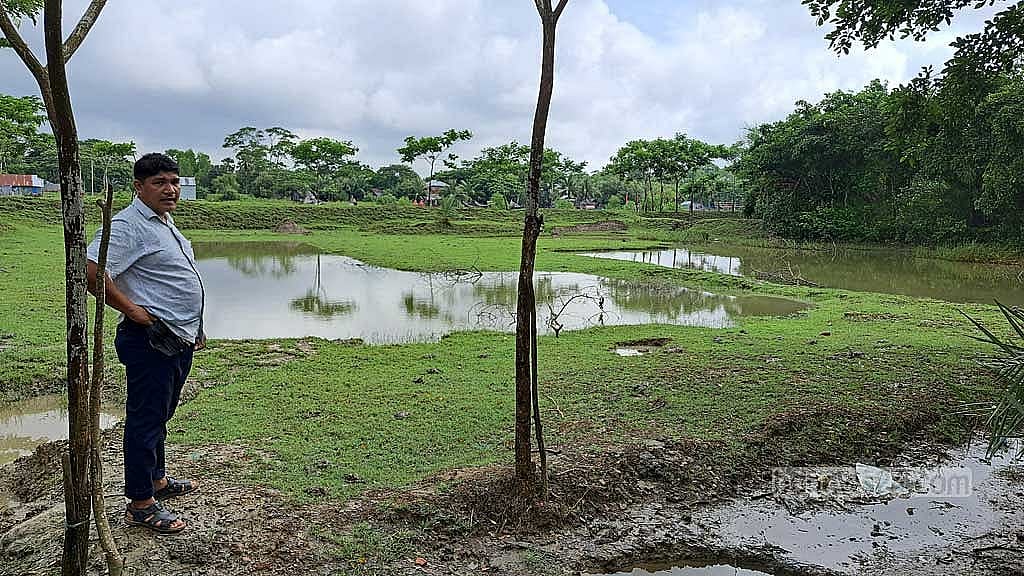
Mang Thing Jo, general secretary of the Barishal Indigenous Forum, explained that every Rakhine cremation ground -- known in their language as “Chansai” -- has two distinct sections. Although the Rakhine people are Buddhists, their funeral rites differ significantly from those of Bengali or other indigenous Buddhist communities.
According to Rakhine tradition, one part of the cremation ground is reserved for ‘guests’, those who die outside the village. The other part is for those who pass away within the community.
"Before the cremation, the deceased is brought to a staging area near the cremation ground, known as the shmoshanghat," said Thing Jo. "But in most cases, not just the guest section but the main cremation ground and even the staging areas have been seized by land grabbers."
He added, “We could face attacks at any time. That’s why we demand official documentation and registration of our ancestral lands. Without that, these conflicts will only escalate.”
Mong Mya, who is Caritas Land and Case Monitoring Officer for Taltali and Kolapara Upazilas, told bdnews24.com: “Rakhine cremation grounds have been designated on khas (state-owned) land since the British era. Under the 1950 State Acquisition and Tenancy Act, land used for cremation grounds or temples is non-transferable. Even if it's khas land, it must not be allocated without prior consultation with the Rakhine community.”
“Yet land grabbers continue to claim ownership of these sites, often with the implicit support of the administration.”
He added, “They are primarily targeting three types of land: Rakhine settlements, Buddhist monasteries, and cremation grounds. These are the areas being systematically seized.”
AUTHORITIES AWARE BUT SLOW TO ACT
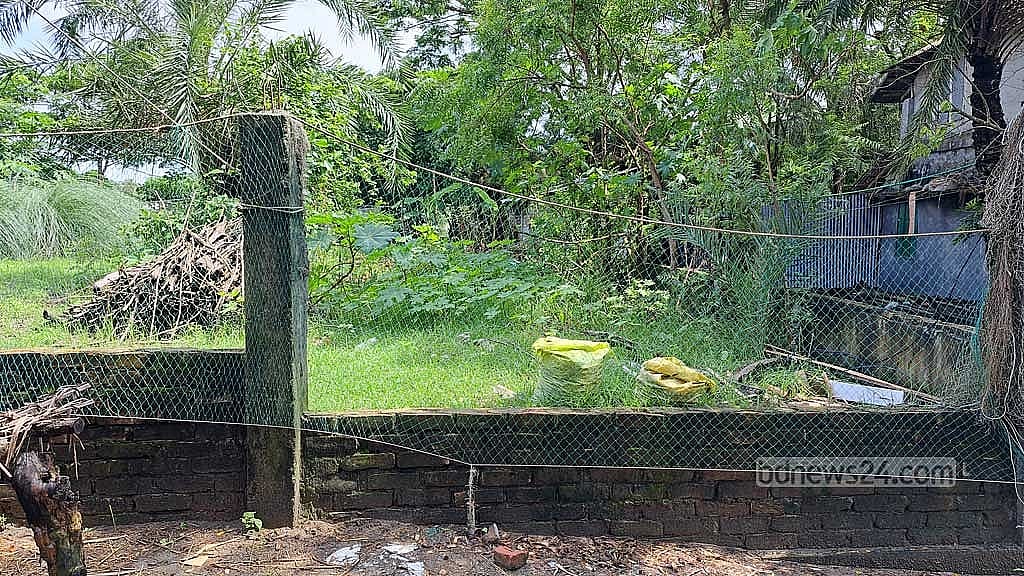
Local officials acknowledge the encroachment concerns but cite a lack of formal complaints as the reason for inaction.
Taltali’s current administrator or Upazila Nirbahi Officer (UNO) Umme Salma told bdnews24.com: “We recently took action regarding a cremation site in Taltalipara after complaints were made.
“I haven’t received any written or verbal complaint about Laupara or Thakurpara. But even if it’s not a formal complaint, if I’m informed, I’ll act immediately.”
Patuakhali Deputy Commissioner Abu Hasnat Mohammad Arifin echoed similar reasoning. He told bdnews24.com, “No one has submitted a formal complaint since I took office. Perhaps they were too afraid.
“But now that I’ve been informed, I will take action with the local administration.”