Published : 30 Aug 2026, 07:10 AM
Updated : 08 Sep 2026, 09:37 AM


Cash Flow, Cut Blow: The NGO Paradox
Aid up, jobs down: Foreign funding hits record highs, yet 30,000 skilled workers remain jobless
Salary chasm: Ex-USAID staff struggle to adapt to the lower pay scales of local NGOs
Funding hijacked: Surging aid is diverted to Rohingya relief, bypassing broader development
New funding routes: Smaller NGOs survive by tapping private foundations in West Asia and the US
The morning USAID’s announcement arrived, Aminul Islam Sohan was riding to a workshop when he joined a meeting from his motorcycle -- and learnt that his job was suddenly at risk.
Sohan, who worked on a USAID-funded project at NGO Abt Global, was among thousands of Bangladeshis who lost their jobs after the US Agency for International Development announced sweeping funding cuts in January 2025.
“On the day the USAID announcement came, we had a workshop. On my way there, I attended the meeting while I was on my bike.
“Our head office in the US told all staff during the meeting that USAID would assess its existing funds and decide which ones to retain and which ones to drop.”
Bangladesh lost around $700 million in development assistance. Sohan remained unemployed for seven months before finding another job.
“It was really a global impact. There were many US-based organisations operating in Bangladesh, such as Abt Global and RTI, and many others that ran on USAID projects. They had to shut down their operations. It was a very difficult time,” he said.
After Donald Trump returned to the White House for a second term, his administration moved to slash US foreign aid, triggering a wave of project closures in Bangladesh. Of 59 USAID-funded projects in Bangladesh, 55 were shut down.
Yet foreign funding to NGOs operating in Bangladesh has continued to grow. So why are the workers who lost their jobs still struggling to find work?
More Money, Fewer Projects
Hasin Jahan, country director of WaterAid Bangladesh and convenor of the INGO Forum Bangladesh, said many laid-off workers had previously held well-paid positions that were difficult for other NGOs to match.
“Those who lost their jobs had, at one point, held very good positions, and even those working at the field level were paid much better than in other NGOs.
“Accommodating them is actually very difficult. If, for example, someone works for a foreign company, they may not accept a position at a local company because the two simply don’t match. It’s the same here.
“USAID’s funding and working environment are both of a very high standard. International NGOs, or even national NGOs, are simply not compatible with them.”
NGO Affairs Bureau data shows foreign funding disbursed to NGOs in Bangladesh has risen steadily: from Tk 69.86 billion in 2021-22 to Tk 74.10 billion in 2022-23, Tk 76.02 billion in 2023-24 and Tk 92.20 billion in 2024-25. In 2025-26, through June, it reached Tk 101.43 billion.
Yet the number of approved projects has fallen. There were 2,007 projects in 2022-23, 1,658 in 2023-24, 1,836 in 2024-25 and 1,654 in 2025-26.
In 2025-26, health received the most funding at Tk 29.74 billion, followed by social development at Tk 12.61 billion. Rural development and tube-well projects received the least, at Tk 4.4 million each.
Where is the Money Going?
Coast Foundation Executive Director Rezaul Karim Chowdhury said his organisation’s funding rose nearly 25 percent in 2024-25 from the previous year.
“Although USAID provides funding in America, which is government funding and Donald Trump has stopped it, there are many private foundations in the US.
“They have sent emails to many organisations saying that if you have suffered because USAID funding has stopped, let us know and we will give you money. They have given money to us and many others. That is a fact.”
He said continued US funding for WFP’s food aid in the Rohingya response meant overall funding had not fallen as sharply as USAID’s withdrawal suggested.
“Donald Trump stopped USAID funding for NGOs and the government, but the US continues to provide WFP with a large chunk of funding for the Rohingya response, which is food aid. That is why funding has not actually decreased.”
Rezaul said the Rohingya response was a major reason for the rise.
“Funding is increasing for several reasons. One major reason is the Rohingya response. Donor funding in Bangladesh is increasing, but that does not mean others besides the Rohingyas are benefiting. They are not.
“We had two major events. One was the Cumilla-Feni floods. We did not receive much money for that because all the money is now going to the Rohingyas. So can you really say that the general people of Bangladesh have benefited?”
He said smaller NGOs were also securing funding directly from foundations in Europe and West Asia.
“The advantage for small NGOs is that they can contact different foundations on their own and bring in a lot of money, particularly from West Asian countries.
“For example, they are getting funding from Qatar Foundation, UAE foundations, Al Khair Foundation and many other countries in the Middle East. That is why funding has increased.
“Besides, Start Fund Bangladesh, a fund formed by several NGOs to coordinate disaster response, is bringing in large amounts of funding from different countries for disaster victims. That money has to be spent within 40 days. So funding is coming in, but the problem is that much of it is again going to UN agencies for the Rohingyas.”
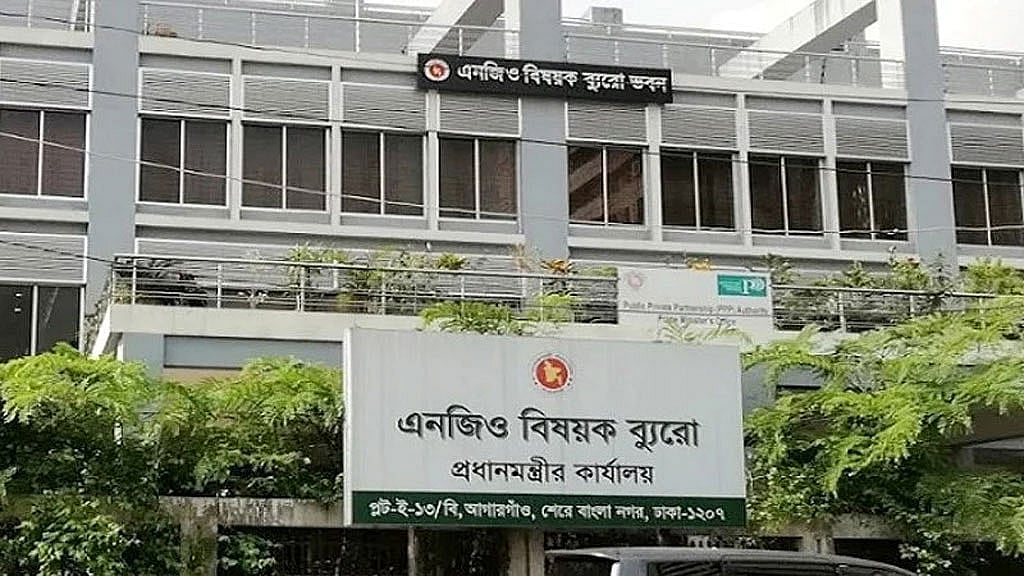
NGO Affairs Bureau Director General Mohammad Zakaria said the bureau was investigating why funding had increased.
“I came to the office in the morning and called everyone to look into the reason. We sat together with UNDP officials and our officers.
“I have assigned them to find out how much has come into which sectors. UNDP has now started working on this. We will get the information immediately.”
He added, “We know funding has come. Especially the smaller NGOs keep saying, ‘We have a funding crisis’. But we called them in to understand how and why the flow has increased.
“However, I think the big NGOs have received good funding. That may be why the flow has increased.”
AKM Jasim Uddin, director of the Association of Development Agencies in Bangladesh (ADAB), said the funding figures clearly showed an increase.
“The reality is that the list of NGOs contains the funding figures, so there is no doubt that it has increased. When USAID funding was cut, many people asked us whether this would become a huge hazard for us.
“Even then, we said that Bangladesh’s NGOs are fighters. They fight to raise money and try to keep their initiatives alive. And that is what happened. They have certainly opened other windows.”
He said some donors had held back funds during political uncertainty.
“If you critically analyse it, you will see that the total number of projects is lower than last year.
“That means some big chunks of funding have come. Several large consortium-type funds have arrived, which may explain why the funding is higher even though the number of projects is lower.”
Still out of Work
Rakib Hossain, a former water supply engineer at IDE, spent about two and a half months unemployed after his USAID-funded project ended. He eventually found another job.
“I was at IDE for about two years. We were notified of the layoffs in January 2025, and I stayed until March. My contract ran until December 2026, so I had to leave almost two years before it ended.
“It was a difficult period for us. When so many people lost their jobs within a week, the job market was also in crisis. Many people were applying for the same positions. I started applying in different places and found another job after being unemployed for about two and a half months.”
He added, “Many people had to struggle much more. Compared with them, I struggled very little -- almost not at all.”
Mamun Hossain, who worked in water, sanitation and hygiene (WASH) at a Rohingya refugee camp under a USAID-funded project, has not found work since losing his job in March 2025.
“I was working in WASH on this project. After losing my job, I tried many places but could not find anywhere to join.
“I have struggled for more than a year. I am deeply frustrated with my family. With no other option, I have been thinking about opening a small shop.”
Mamun said many laid-off workers were still unemployed.
“Many people who are either very low-skilled or highly skilled have not found jobs. The problem with highly skilled workers is the hiring budget, while low-skilled workers cannot compete in the market. That is my own experience.”
The Association of Unemployed Development Professionals (AUDP), formed by development workers who lost their jobs following the USAID cuts, estimates that around 50,000 development workers lost their jobs.
Convenor Jinat Ara Afroze said the group had submitted memorandums to several offices of the interim government seeking measures for the unemployed but received no response.
“One of our major demands at the time was to establish a system called the National Integrated Talent Detection System. If that had been done, the government could have recruited these people.
“That would have properly utilised what they had learned over so many years and the skills they had acquired. They could have been employed in the new funding and projects that are coming in. But the government did not take action.”
The organisation now estimates that around 30,000 remain unemployed.
For those still looking, the rising figures tell only half the story. Foreign money is returning to Bangladesh’s development sector, but it is not necessarily returning to the people whose livelihoods disappeared with the USAID cuts.
The funds have found new routes. The workers are still waiting for theirs.