Published : 26 Jul 2025, 07:39 AM
Updated : 28 Aug 2026, 01:23 AM


Ask anyone on the streets of Gopalganj town — be it a rickshaw-puller, a tea vendor, a fruit seller, or a restaurant hand — who opened fire on Jul 16, and the answer comes swift and certain: “The government forces.” Some say it was police, others the administration, but few hesitate.
Yet the official narrative tells a different story.
In four murder cases filed by police in the aftermath of the violence, the blame falls squarely on armed supporters of the Awami League, who allegedly opened fire on police and army personnel. Interestingly, the military has not corroborated any claim that its members were attacked.
What the locals do agree on is that the attackers, reportedly pro-Awami League supporters, unleashed chaos during a rally by the National Citizen Party (NCP).
More than 200 homemade explosives, or Molotov cocktails, were reportedly detonated that day. However, no firearms were seen in their hands, according to multiple witnesses.
The violence has left a deep scar on the town, and the grief still lingers. In the poor neighbourhoods where many of the victims lived, mothers continue to wail for lost sons, and fear hangs heavy over families bracing for more arrests.
At least four people were killed in the clashes, with more than 50 others injured, including nine with gunshot wounds. One of the injured later died in hospital, bringing the death toll to five.
Despite the scale of the tragedy, local residents claim that no political leader or state official has visited the bereaved families.
To make matters worse, police have filed cases against a staggering 9,846 unnamed individuals, accusing them of murder, arson, and attacks on police vehicles and even a prison facility.
So far, 312 people have been arrested, but many locals insist that those detained include the innocent and uninvolved. Gopalganj district Superintendent of Police Mizanur Rahman denies allegations of mass arrests, saying: “Each arrest is based on video evidence.”
The trouble began when a series of attacks targeted an NCP programme in Gopalganj, a stronghold of deposed prime minister Sheikh Hasina’s Awami League. Following these provocations, clashes erupted between Awami League activists and law-enforcing agencies, including police and the Army which have magistracy powers. The violence quickly spiralled, engulfing the entire town in running battles.
The dead have been identified as: Dipto Saha, 27, son of Santosh Saha, from Udayan Road in Gopalganj town; Ramzan Kazi, 17, son of Kamrul Kazi, from Harinhati village in Kotalipara; Sohel Rana, 30, from Shanapara in the town; Imon Talukdar, 17, from Bherar Bazar in the Sadar Upazila; and Ramzan Munshi, 32, son of the late Akbar Munshi from Thanapara.
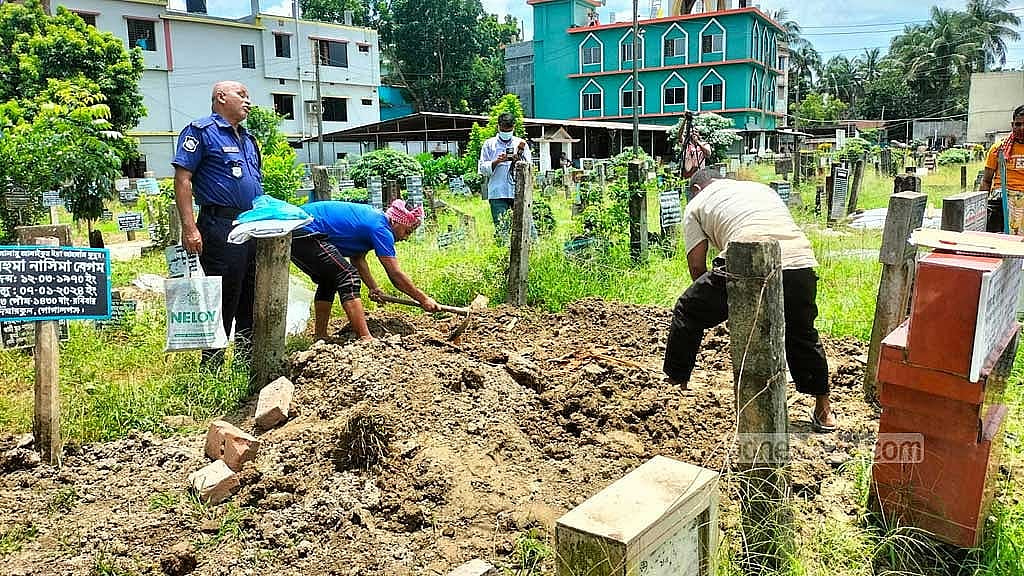
Controversy deepened when it was revealed that four victims were buried without post-mortems or formal inquest reports, a move that drew criticism and suspicion.
On court orders, three of the bodies were exhumed from their graves on Monday for post-mortem examinations amid growing demands for transparency and accountability.
WHO FIRED THEIR GUNS?
In all four murder cases filed by police, the narrative remains consistent: "The attackers opened fire" on the members of the law-enforcement agencies and security personnel.
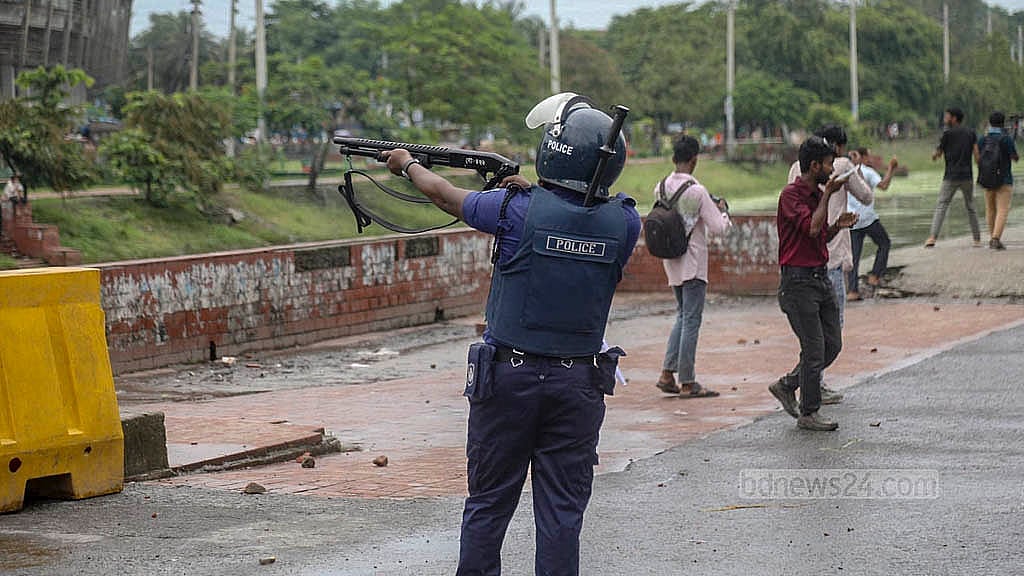
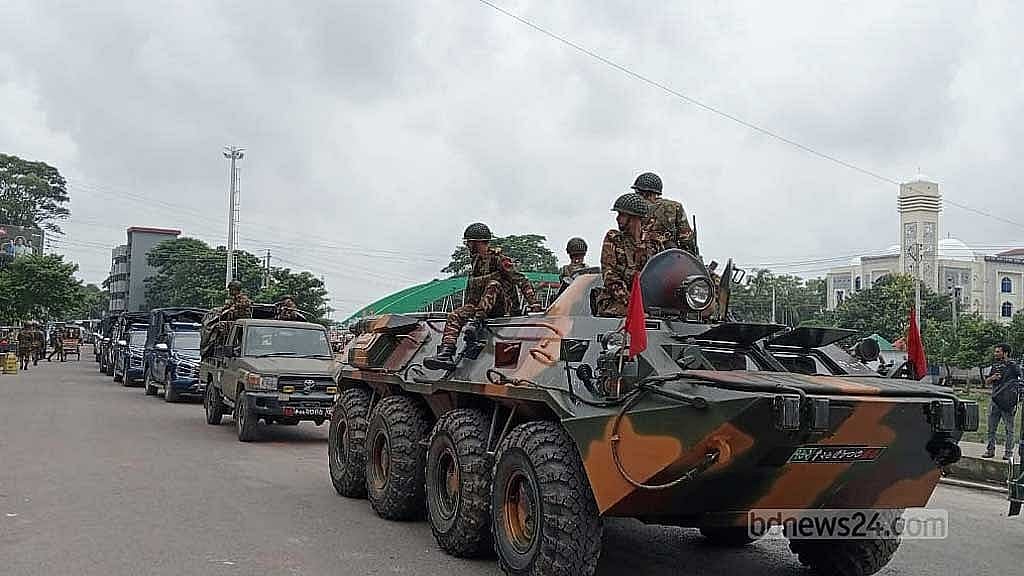
But multiple witness accounts contradict that story. Several people claim they saw shots fired from inside Armoured Personnel Carriers (APCs) and by uniformed police officers positioned at the scene.
Official case files note that two constables, Sohel and Rafiqul Islam, discharged 10 blank rounds each from shotguns. However, that detail does not align with the injuries sustained by victims.
A police sub-inspector, speaking anonymously due to the sensitivity of the matter, pointed to the inquest findings as evidence of live ammunition being used.
“It’s clear these people were killed by live bullets, not rubber pellets or shotgun pellets. Pellet wounds appear like small pockmarks, almost like chickenpox. These bodies had large-calibre entry wounds.”
The forensic contradictions and the consistency of local testimony are now raising critical questions about accountability, especially as police have arrested over 300 people while still insisting the shots did not come from their ranks.
CONSISTENT CASE FILES, CONTRADICTORY EVIDENCE
The four murder cases filed by police in connection with the Jul 16 violence all follow a near-identical narrative.
In one of them, filed by Sub-Inspector Shamim Hossain of Gopalganj Sadar Police Station over the killing of Dipto Saha, the complaint alleges that just after 2:15pm, as the NCP leaders were leaving for Madaripur following their rally, a mob of 4,500 to 5,000 armed attackers, allegedly members of the Bangladesh Chhatra League, Awami League, Jubo League, and Swechchhasebak League, ambushed them.
The assailants, according to the First Information Report (FIR), were armed with guns, machetes, spears, shields, metal rods and javelins, and shouted the Awami League’s slogan --“Joy Bangla” -- as they launched the assault.
Later, the complaint continues, as police moved from Launch Ghat Model Mosque to the Launch Ghat Police Box, they were confronted again, this time by 1,400 to 1,500 unidentified attackers wielding similar weapons. Constable Sohag, in “self-defence”, is said to have fired 10 blank rounds from his shotgun.
According to the FIR, when troops intervened, the attackers responded by opening fire at both police and military personnel, leading to Dipto being struck by a bullet on the road near Milon Pharmacy on College Mosque Road. He was rushed to the hospital, where doctors declared him dead.
Another case alleges that Sohel Rana was also killed by a bullet fired by the attackers.
Yet the proximity of the victims, all five of whom were shot within a one-square-kilometre radius, combined with witness accounts, paints a starkly different picture.
According to police records:
All five locations are interconnected alleyways, situated near Bangabandhu Road, a commercial artery hugging the Madhumati River. Residents of these alleyways say they saw law-enforcers open fire from armoured vehicles, with both police and army units stationed at the mouths of narrow lanes.
LOCALS DESCRIBE CHAOS
One fruit seller near the Chourangi area, who asked to remain anonymous, recalled the moment violence erupted.
“Everything was normal in the morning. Shops were open. Then we heard loud bangs, cocktails going off one after another. We started to shutter our stalls.”
Then came panic.
“I went out briefly to check the rain pooling on the tarp. That’s when I saw young men running with machetes and iron rods. They threw stones, then vanished. Police were posted at the alley mouth. Moments later, I heard someone had been shot near the madrasa. That’s when we ran.”
At least 10 separate witnesses told bdnews24.com they saw security forces fire shots, either from the streets or from within APCs. None of them agreed to go on record by name, citing fear of arrest or reprisal.
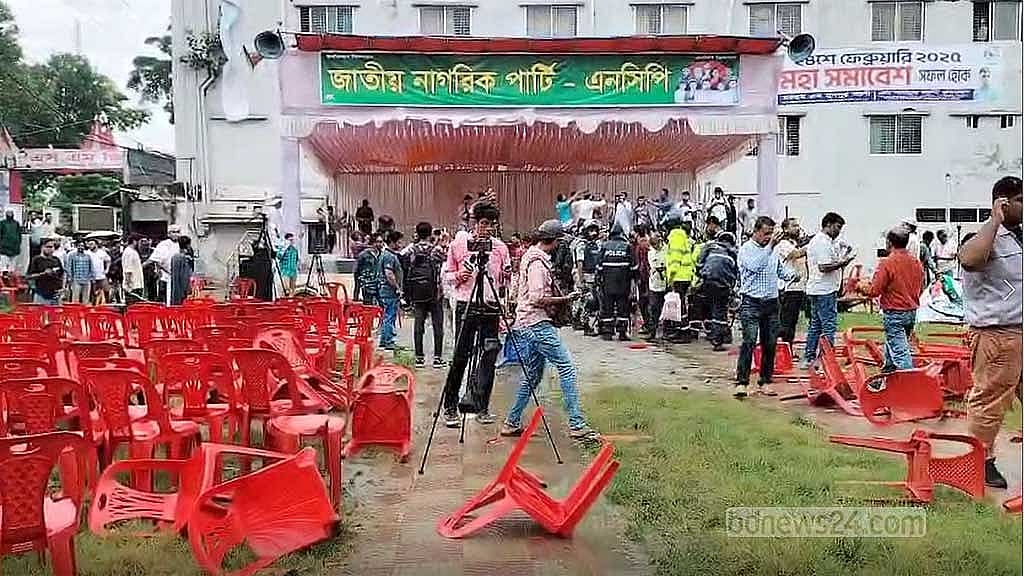
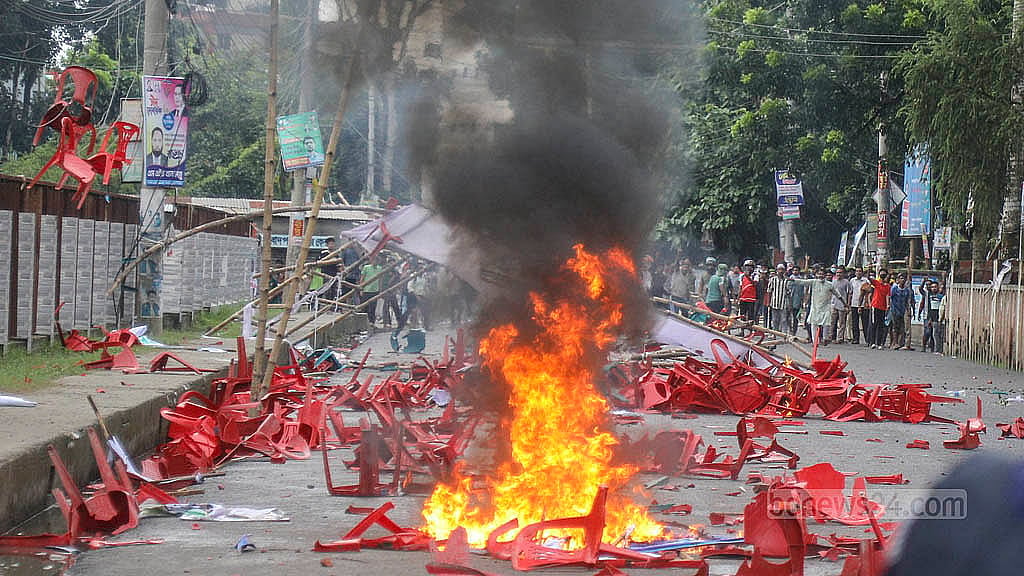
One image from that day shows smoke and debris strewn across Gopalganj’s main intersection; the town centre had become a battlefield.
HOME MINISTRY DOESN’T DENY ARMY FIRED SHOTS
The police cases blame thousands of attackers for the gunfire, but now even top officials are walking a fine rhetorical line.
Home Advisor Jahangir Alam Chowdhury, a retired lieutenant general of the Army, did not deny military involvement. At a press briefing on Jul 20 after a high-level meeting on law and order, he said: “Yes, what happened there, I’m not denying it. This is politics. These things happen. We saw it at Dhaka University too. The real question is: are we taking action afterwards? And we are.”
When a journalist interjected, “We saw the army fire shots there,” Jahanir responded before the question was finished: “You take measures based on the situation on the ground.”
Numerous news outlets subsequently reported, based on his comments, that army troops did open fire in Gopalganj.
Yet the military’s statement, issued by the Inter-Services Public Relations (ISPR) Directorate on Jul 17, made no mention of any soldiers being fired upon or responding with bullets.
It stated only: “Despite repeated warnings via loudspeaker, the attackers targeted the Army with a large number of homemade explosives and bricks. Eventually, the Army was forced to use force in self-defence.”
The phrase “use of force” also appears in the police case documents, but without specifying what kind of force was used.
SP SENDS “PROOF” THAT NO ONE CAN VERIFY
bdnews24.com asked Gopalganj SP Mizanur directly: “In all four police murder cases, it’s stated that attackers fired at police and soldiers. But the Army hasn’t confirmed this. What’s the real story?”
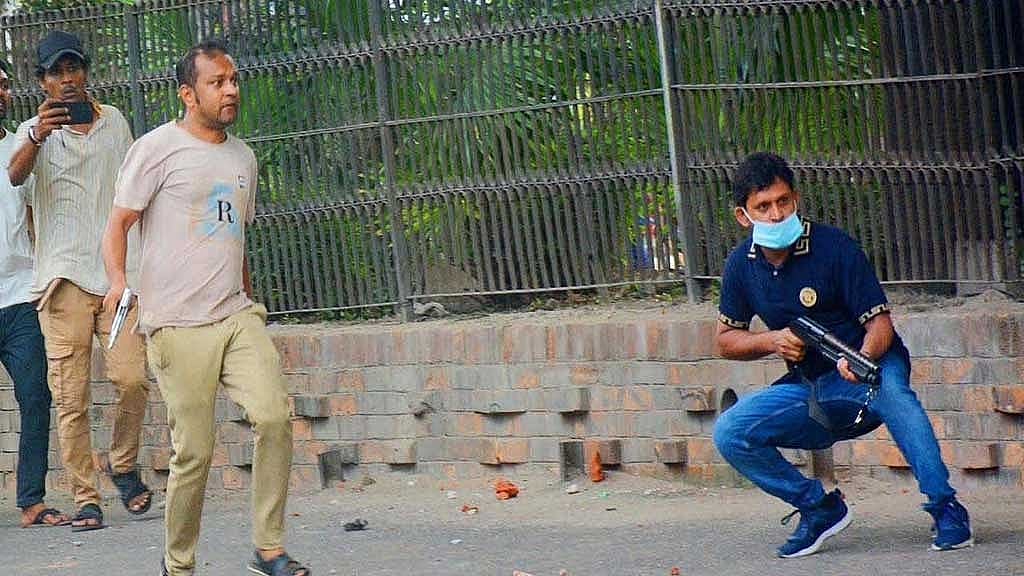
He responded: “I’ll send you pictures showing the attackers firing weapons. Check your number.”
Moments later, the SP forwarded four images via messaging app. But when those images were shown to 10 senior local journalists in Gopalganj, none could verify the identities of the armed individuals, nor identify the location or authenticity of the scenes depicted.
Two local journalists, after examining the photographs circulated as alleged evidence of the Gopalganj attackers, raised immediate doubts.
“It was raining that day,” one noted. “But these images show dry conditions. They clearly weren’t taken during the actual events.”
The discrepancy has further eroded confidence in the government’s account of what transpired during the Jul 16 clash.
Seeking clarity on whether the Bangladesh Army opened fire, bdnews24.com reached out to Lieutenant Colonel Sami-Ud-Dowla Chowdhury, director of the ISPR, the military’s media wing.
In a brief response, he said: “Please follow the ISPR website for official press releases.”
As of Friday evening, however, no such statement addressing the army’s role in the Gopalganj incident had been published on the ISPR website.
WHO WERE ARRESTED? THE DISABLED, THE ELDERLY, AND A 15-YEAR-OLD BOY
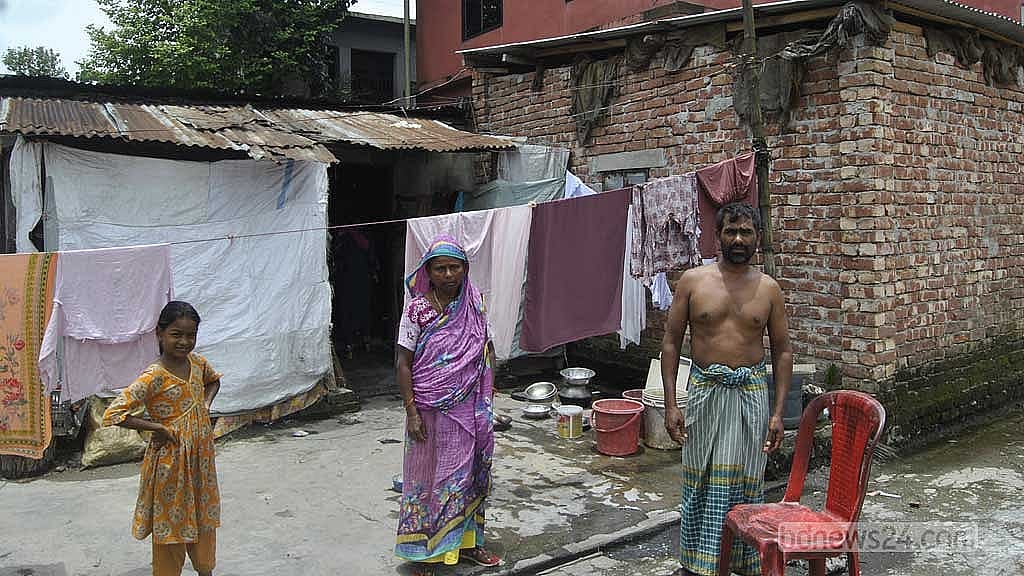
Among those detained is Kalu Sheikh, a 19-year-old who limps due to a childhood injury. He lived in a small tin shed near the BSCIC industrial estate in Gopalganj with his sister and brother-in-law. On Jul 17, police took him from outside his home, says his sister Sufia Begum.
“He fell into a drain as a child, and iron pierced his leg,” she explained. “The wound never fully healed, and he can barely walk. Last year, doctors at Dhaka's Pangu (orthopaedic) hospital said the leg needed amputation, but our mother was too scared.”
Kalu could not run, could not fight. He worked in a furniture workshop, doing light chores.
“Why would a disabled boy join a riot?” Sufia cried. “We begged police, but they didn’t listen. Now he’s in Pirojpur jail. The lawyers want a fortune we can’t afford. We don’t know what will happen.”
Also arrested are Bulbul Munshi, 40, a farmer from Muksudpur, accused of rioting, though his brother claims he was cutting jute all day.
Modak Halder, 70, was picked up by police while out for tea the following afternoon.
Sabuj, a 15-year-old identified with a single name, was detained after allegedly trying to help his injured friend Imon, who had been shot.
Sabuj’s grandmother Hajera Begum said he was later transferred to the Pulerhat Juvenile Development Centre in Jashore.
“We don’t even have the money to travel there,” she whispered.
FACEBOOK FILLS WITH OUTRAGE
Across local Facebook groups, including “Amader Gopalganj” (Our Gopalganj), residents are venting frustration over what they describe as mass arbitrary arrests.
One user, Md Elanur, wrote: “The real culprits were not arrested. The jails are full of ordinary people.”
Another, Mushfiqur Rahman, replied: “What do you mean by ‘real’ suspects? Even those named are fake. The nation knows who fired those bullets.”
Sayan Adhya Anku commented: “Now everything’s calm, but they’re still arresting people. Even those who never left their homes that day are being picked up.”
Eva Islam added: “People from the rural side didn’t even march, but they’re being detained without cause.”
In the same group, Sujon Shikder, joint convener of the district Swechhasebak Dal posted a video offering legal aid.
“Innocent citizens are being harassed,” he said. “Under the leadership of Selimuzzaman Selim and SM Zillani, we’ve formed a legal support team.”
However, Sazzad Hossain Hira, the main convenor, told bdnews24.com that no such party-sanctioned initiative exists, and Sujon’s move appears personal.
POLICE DENY MASS ARRESTS, BUT NUMBERS TELL ANOTHER STORY
SP Mizanur denied the allegation of mass detentions.
“We arrested seven people the day before yesterday, three yesterday, and two today. So how does that count as mass arrests?” "We’re using video footage to identify and apprehend suspects.”
In total, 317 people have been arrested in relation to 10 cases. Among them are multiple children, who have been sent to the Pulerhat Juvenile Centre.
Asked about this, SP Mizanur said: “There may be a few minors. But we’re only arresting those clearly involved, as identified in the videos.”
A JOURNALIST’S FIRST-HAND ACCOUNT
Abdullah Tuhin, a senior crime correspondent with Jamuna TV, has covered political unrest for over 15 years. What he witnessed in Gopalganj, he says, was utter unpreparedness.
“I left Dhaka early in the morning with a camera crew. Even before entering the town, I heard a police vehicle had been set on fire. Then came news that the local UNO’s (Upazila Nirbahi Officer’s) car was also attacked.”
“There were heated exchanges on social media the night before. Some talked of going to Tungipara (where independence architect Bangabandhu Sheikh Mujibur Rahman’s grave lies), while others vowed to stop them. Everyone knew something explosive could happen.”
“Yet when I reached Gopalganj town, I saw no significant police deployment, just two to four officers at alley entrances near the municipal office. Even at the rally site, police presence was minimal. Perhaps 6 to 8 officers led by a sub-inspector at one gate, 8 to 10 [Armed Police Battalion] officers at another.”
“It was raining. Around 12:30pm, a speaker was addressing a small crowd of 15–20 people under umbrellas. Suddenly, from the rear of the field, attackers rushed in and began smashing chairs. Multiple cocktail explosions followed. People fled in all directions.”
“I heard gunfire, but I couldn’t tell who was shooting. Later, NCP supporters regrouped and chased the attackers to the other side of the Madhumati River. The situation intensified near Chourangi intersection.”
By 1pm, the NCP’s central leaders arrived under military and police escort, delivered brief speeches, and attempted to leave. That was when the real assault began.
“It felt like an ambush,” Tuhin said. “Suddenly, more than a thousand people came out of the alleys and began hurling bricks and stones at the convoy. I heard more cocktails explode, and again, gunfire.”
“Army vehicles were pelted. Then the army began firing blanks. From there, the town plunged into chaos until well into the evening.”
A RUNNING BATTLE, A RAIN OF STONES
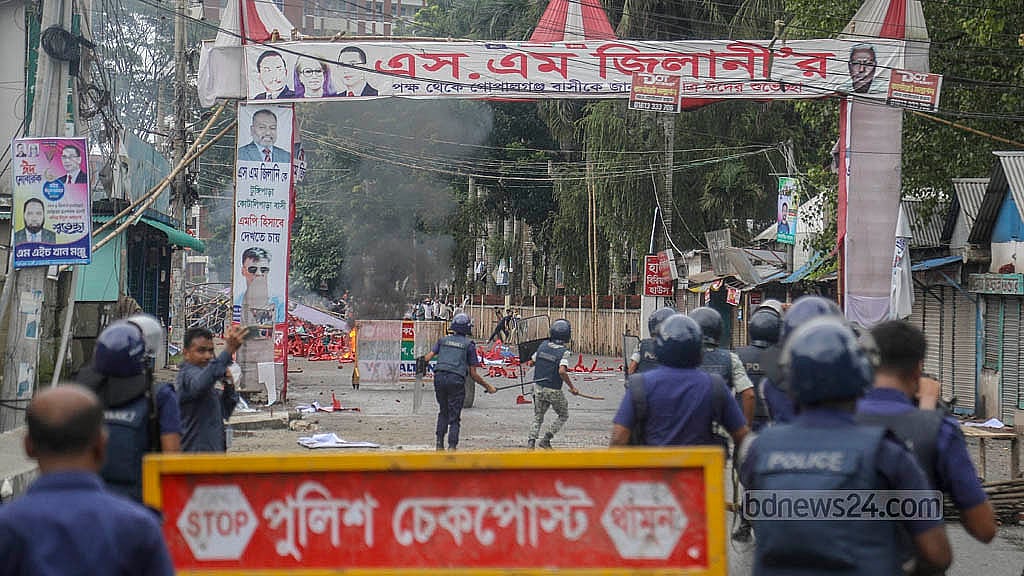
“The attackers didn’t leave,” Tuhin recounted. “Even after the APCs drove them off, they returned through alleyways. Around 5pm, we were surrounded -- police, reporters, and all.”
“Police had nearly exhausted their shotgun cartridges and tear shells. They fired back what little they had. The attackers came within 20–25 yards, throwing stones.”
“I lost my helmet. A police officer gave me a plastic mango crate to wear as a shield. We retreated with police.”
Inside the police lines, wounded officers collapsed on the ground, stripped of their bloodied uniforms. Others headed straight to the hospital. The attackers followed, vandalising parked vehicles, tearing down posters of NCP leaders, and pelting the gate of the police compound with stones.
Later that night, additional troops and police arrived from neighbouring districts, forcing the mob to retreat. A curfew was declared from 8pm.
HUMAN RIGHTS WATCHDOG: ‘GRAVE VIOLATIONS OCCURRED’
Following a two-day fact-finding mission, Ain o Salish Kendra (ASK), a leading human rights organisation, declared the Gopalganj events a serious violation of human rights.
In a formal statement, ASK said the right to peaceful assembly was undermined. The NCP leaders had just begun their speeches when tensions escalated following "provocative remarks about Sheikh Mujibur Rahman and the Awami League".
Protesters responded with bricks and stones. Some carried crude weapons, but no evidence was found that they had firearms. Security forces, however, fired live rounds indiscriminately, the watchdog concluded.
The family of Imon Talukdar, one of the deceased, told ASK that Gopalganj General Hospital officials forced them to bury the body without an autopsy.
Another survivor, who sustained gunshots to the abdomen and hand, said: “I was just cycling to work. I’m not involved in politics. Suddenly, I was shot. I lost a finger.”
ASK also confirmed that, as of Jul 21, at least 18 minors had been arrested, some charged under the Anti-Terrorism Act. Families insist the boys had no link to the clashes.
When ASK asked hospital Superintendent Dr Jibitesh Biswas how many patients had gunshot injuries, he replied: “That would need further examination.”
However, he confirmed that none of the wounded police officers or the UNO’s driver had been shot.
The bullets may have stopped, but for many families, the terror continues.