Published : 05 Aug 2025, 09:16 AM
Updated : 21 Aug 2026, 01:36 PM


On Aug 3, 2024, a single-point call to action reignited Bangladesh’s political landscape. Two days later, the nearly 16-year rule of the Awami League collapsed.
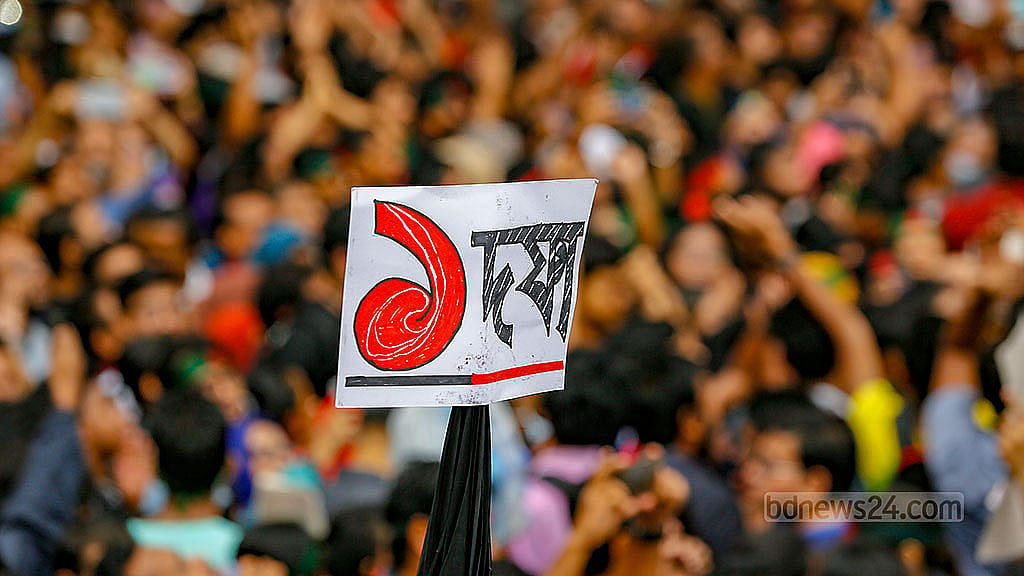
Led by the Students Against Discrimination, the 36-day July Uprising, sparked by protests over public service recruitment quotas, culminated in what many hailed as the dawn of a new Bangladesh.
But one year on, the question remains: how much has really changed?
From promises of a politics rooted in accountability and compassion, to institutional reform and democratic revival, expectations ran high. An interim government was formed. Reform commissions were launched. A roadmap was pledged. But today, citizens are asking: what has materialised?
For many, the clearest change is symbolic, not structural.
“I won’t say we’ve seen a major transformation,” said Dil Rowshan Zinnat Ara Nazneen of Dhaka University’s political science department.
“But there’s one big difference, and it’s huge. We can now express opinions without fear. That, to me, is the greatest achievement.”
Still, the new political compact remains fragile, according to Zobaida Nasreen of DU’s anthropology department.
“We’ve yet to see any visibly strong political realignment,” she said, noting a surge in what she called “performative politics” from groups across the spectrum -- including the BNP, the Jamaat-e-Islami, the National Citizen Party, and left-leaning alliances.
“The recent events -- ransom demands, the Milestone School aircraft crash -- have shown neither responsibility nor empathy,” she said.
“All we’ve seen is political exploitation.”
The passionate vigour that had birthed the NCP and revived dormant coalitions appears to be ebbing. The once-hopeful student movement has not been spared from accusations of extortion, echoing similar charges against the BNP, Jamaat, and new student outfits like the Bangladesh Ganatantrik Chhatra Sangsad.
On Aug 5, 2024, deposed prime minister Sheikh Hasina fled to India after security forces failed to suppress the swelling street protests. While some of her ministers and MPs have been arrested, most senior leaders of the Awami League remain either in hiding or abroad.
Trials have since begun. A single war crimes case has been filed against Hasina and her former home minister Asaduzzaman Khan. A judge has also ordered the start of a trial in a corruption case involving Hasina’s family. The party and its affiliates remain banned from all political activity.
Despite the collapse of Hasina's rule, real political reconstruction remains elusive. Reform efforts by the interim government have yet to bear visible fruit. Although 144 new parties have applied for registration with the Election Commission, no election date has yet been set.
Worse still, cracks have begun to emerge in the alliance that overthrew the old regime.
POLITICAL SHIFT
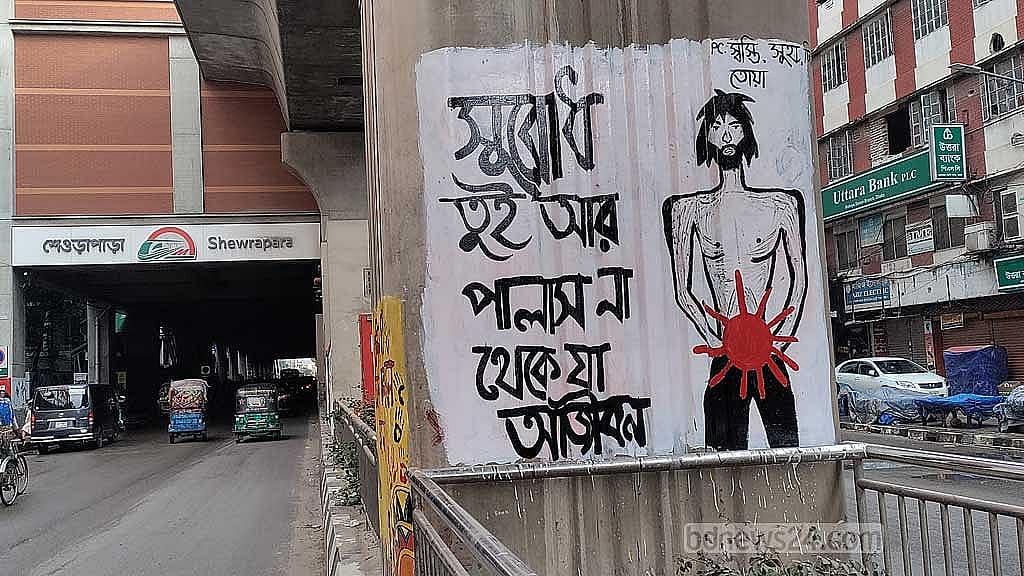
In the year since the interim government took over, some believe there has been a modest shift in political discourse -- one that favours the language of state repair and democratic accountability. Yet this perceived transformation remains tenuous and contested.
With the Awami League banned from political activity, its long-time coalition partners have come under increasing pressure.
The Jatiya Party, once the parliamentary opposition under the Awami League’s rule, has attempted to maintain a presence, but other allies have largely vanished from the scene.
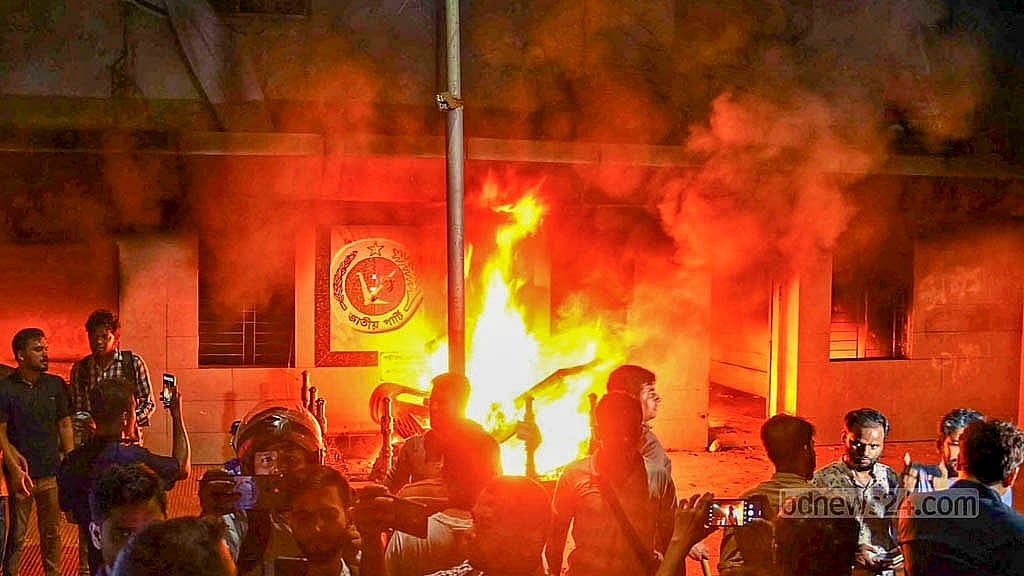
Last year, the Jatiya Party’s central office in Dhaka was subject to a “mob” attack. This year, its Barishal office and party chairman GM Quader’s home in Rangpur were in the crosshairs.
Echoing calls for action against the Awami League, intermittent demands to ban the Jatiya Party and suspend its registration have gained momentum.
The deadly clash during an NCP rally in Gopalganj -- which left five people dead -- was described by the rights group Ain o Salish Kendra as a “grave human rights violation” and a “failure of the state”.
In response, the BNP said it hoped the NCP would now strive to emerge as a genuine political party independent of the government’s shadow.
The NCP’s credibility has been questioned since its inception. Doubts persist over its political independence and proximity to the state. The party has faced BNP-led protests in Cox’s Bazar and Netrokona over controversial comments made during rallies.
NCP Joint Coordinator Arifur Rahaman Tuhin admitted there has been little change in political practices. He pointed to the BNP’s continued reliance on “muscle politics” as a reason for the movement’s unrealised aspirations.
“We had high hopes that the political parties involved in the Uprising -- long repressed and persecuted -- would be our greatest allies,” he said.
“But the oppressed are now turning into oppressors. We've seen the Sohag murder. More than 130 have been killed in intra-party conflicts alone. That was not supposed to be part of the new order. We envisioned a space for political debate, not force.”

Meanwhile, the question remains: how will the political and civil rights of non-partisan supporters of the Awami League and its longtime ally Jatiya Party -- many of whom have no formal affiliation -- be protected under the current arrangement?
Rowshan believes the Jatiya Party’s inactivity stems not from state obstruction but from internal leadership crises.
“Under the previous government, parties had to run in circles just to get permission for a rally. That’s no longer the case,” she told bdnews24.com.
“The Awami League is banned, so it’s understandable they can’t operate politically for now. But there’s no such restriction on the Jatiya Party. They’re paralysed by internal rifts, over who will lead and who gets to speak.”
Quader, however, alleged discrimination after being denied permission to hold a rally at the designated spot on the party’s founding anniversary. At a brief assembly in Segunbagicha on Jan 1, just before a planned march, he said the interim government’s treatment of the party reflects ongoing bias.
The Jatiya Party was part of the meeting at Bangabhaban on Aug 5, 2024, alongside President Md Shahabuddin and Chief of Army Staff General Gen Waker-Uz-Zaman.
Based on that involvement, Chief Advisor Muhammad Yunus had initially invited the party to participate in the first round of talks with political parties. But things changed when the Students Against Discrimination opposed their inclusion. Since then, the party has been excluded from all official dialogues.
A new polarisation appears to be taking shape ahead of the next general election and the reform process. Islamist parties, including the Jamaat, seem to be aligning on one side, and on several issues, the NCP’s positions are increasingly in sync with the Jamaat.
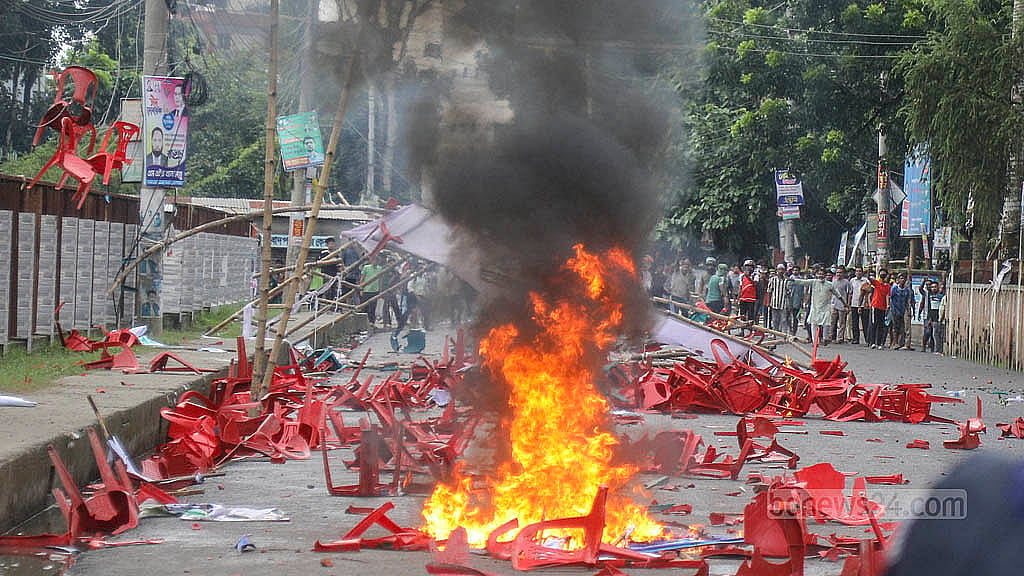
Over the past year, “mob” violence aimed at suppressing dissenting views has instilled fear across political spaces. The public witnessed the unprecedented demolition of Bangabandhu Sheikh Mujibur Rahman’s historic home at Dhanmondi 32.
Police were reportedly forced to release suspects or to arrest individuals under political pressure. A wave of “moral policing” also swept across the country.
“Mob” attacks are now posing a significant threat to law and order. The Manabadhikar Shongskriti Foundation (MSF) reported that 16 people were killed in mob violence and public lynchings in July alone, up from 10 in June.
While acknowledging the rise of “mob culture”, Rowshan argues that the space for open discourse has widened.
“As a teacher, I’ve noticed people speaking more freely than before. The fear that once silenced voices seems to have receded.”
However, political violence remains a persistent feature. According to MSF’s July report, 42 incidents of political violence occurred that month. Of those, 27 were linked to internal BNP disputes.
The rest included two BNP-Awami League clashes, two within the NCP, three BNP-NCP confrontations, one BNP-police clash, one NCP-police-Awami League incident, four BNP-Jamaat clashes, one Awami League-Jamaat clash, and one involving BNP activists and supporters of Advisor Asif Mahmud Shojib Bhuyain.
MSF said nine people were killed in political violence in July, four of them from the BNP and five during the Gopalganj violence. Of the BNP deaths, three resulted from internal conflict and one from clashes with Jamaat.
In both June and May, eight people died in political violence, MSF reported.

WHAT THE NEW ‘ORDER’ REVEALED?
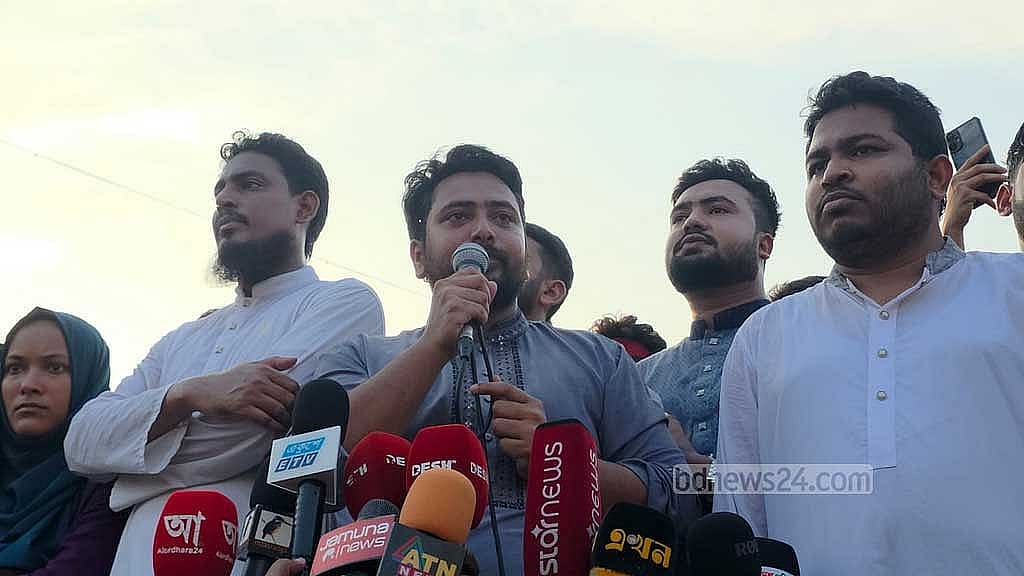
At the NCP meetings and rallies, there remains a clear message of persistence in establishing the new political “order”. The party’s convenor, Nahid Islam, has vowed to continue the struggle toward this goal.
However, after a year, there is growing assessment of how much this concept has been truly clarified to the public.
The intense debate over the new “order” began on the night of Dec 16, Victory Day, when interim government Advisor Mahfuj Alam posted a map on Facebook. The map showed Bangladesh linked with West Bengal, Assam, Tripura, Manipur, and several northeastern Indian states, describing Bangladesh’s territory, shaped by the 1947 partition of Bengal, as “fragmented”, and called for a “new territory and order”.
The post was removed within hours.
On Dec 20, the Indian government issued a sharp protest. At a weekly media briefing in New Delhi, Ministry of External Affairs spokesperson Randhir Jaiswal said: “We have protested to the government of Bangladesh on this matter. We have strong objections. The post you mentioned has been taken down.”
Subsequently, student leaders spoke at various times about the new “order”. Nahid warned that if the old system is not ended, preparations for another mass uprising will be made.
Nahid, one of the key coordinators of the Anti-discrimination Student Movement that led the July Uprising, was a frontline leader. After the formation of the interim government, he joined it but later resigned to take a top position in the youth-led NCP.
As part of NCP’s month-long July march, Nahid held a rally in Narayanganj on Jul 18, saying: “The new order we aspired to during the mass uprising is the order we must continue to fight for. This struggle will only end when we replace the old order with a democratic order that belongs to the people.”
When asked to explain what NCP means by “new order”, the party’s joint coordinator Tuhin told bdnews24.com: “It means the abolition of the fascist system. By that, we mean dismantling the provisions that allow fascism to flourish -- in particular, repealing Bangladesh’s ‘Mujibist’ Constitution of 1971.”
He claimed that over the past five decades, since independence, various governments have established forms of fascism.
“For so long, Bangladesh’s centre of power has been Delhi-centric and Rawalpindi-centric. We are talking about shifting the centre of power to the people, about elections that truly represent the people, that is democracy. That means a state that serves the people.
“And alongside that, ensuring the three core principles of the Liberation War -- equality, human dignity, and social justice. That is what we call the new order.”
Columnist and thinker Farhad Mazhar has similarly advocated scrapping the current Constitution and drafting a new charter. After the Uprising, he repeatedly urged holding a constituent assembly election to adopt this new charter.
He believes the failure to do so has created “political complexity” and “instability” in the country, pushing people into an “uncertain” space.
Mazhar said, “We didn’t rise to change the government. The Uprising means state formation.”
He explained some of the processes of how a democratic state is formed.
According to him, once the Uprising-led force assumes state power, the process of drafting a new constitution begins, followed by constituent assembly elections to approve it.
Mazhar said, “If the constituent assembly is elected and everyone approves the draft, it will go to the people. Then the people will debate and vote on it. Once adopted, the constituent assembly will be dissolved. Then a national government will be elected based on the new constitution.”
Zobaida said even a year after the Uprising, the students’ concept of the “new order” remains “unclear”. She said it is also unknown how the public will benefit from it.
She said, “The new order has not really been explained. I don’t know -- there has been no clear explanation. The NCP has repeatedly used these terms: the new order and the politics of responsibility and accountability. Now there is talk of an order of responsibility and accountability.
“But who this responsibility is for, through what processes, and how people will be involved, how much the people will benefit or participate, none of this has been clarified.”
WHAT HAPPENED TO CURBING BUREAUCRATIC CONTROL?
In its first year, the interim government faced perhaps its fiercest public scrutiny over bureaucracy. It is seen by many as a key source of discomfort for the administration and a frequent target of political criticism from forces active on the ground. To rein it in, a new law was enacted.
The Government Service (Amendment) Ordinance, 2025, criminalised disobedience, obstruction of duty, unauthorised absence -- whether individually or collectively -- as well as incitement to such acts.
But critics, including voices from within the administration, quickly labelled it a draconian measure, warning it could become a tool for power centralisation.
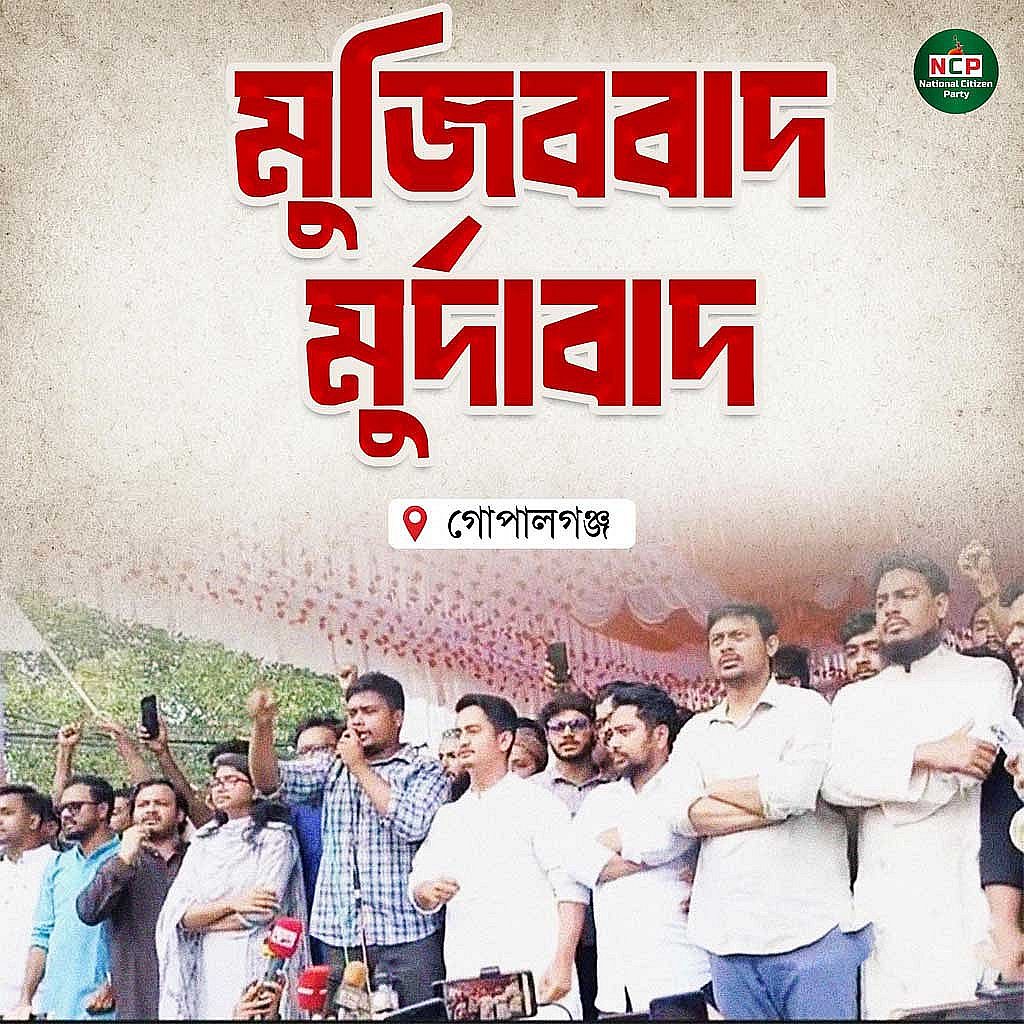
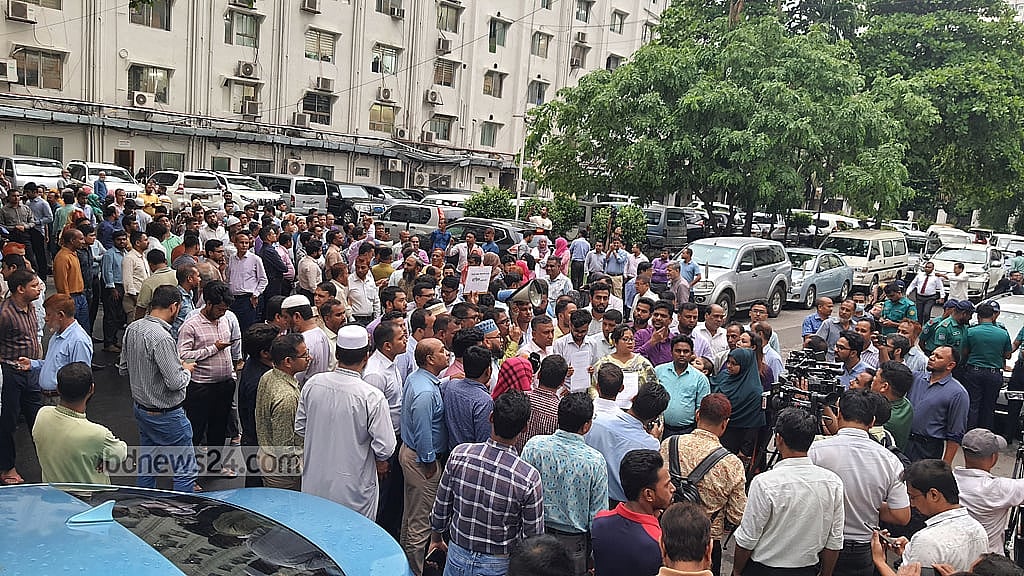
Protests erupted inside the Secretariat for several days, eventually compelling the government to amend the ordinance.
Responding to public outcry and sustained pressure, the government removed the word “disobedience” and republished the Government Service (Amendment) Ordinance, 2025, in gazette form.
The revised version, however, still includes the disobedience of “lawful government orders” as a punishable “misconduct disrupting public service”, reigniting concerns about its implications.
Former secretary Abu Alam Shahid Khan sees no major progress in curbing bureaucratic dominance.
“Nothing significant has changed,” he told bdnews24.com.
Referring to the July Uprising, he noted that many civil servants who openly expressed support for the movement on Facebook faced no consequences at the time. But under the new ordinance, they risk forced retirement or permanent dismissal -- provisions that, he argues, echo the emergency laws of 1969.
“The 2018 Public Service Act was carefully drafted,” he said. “But now they’ve revived elements from a 1969 martial ordinance on arbitrary dismissal, even when there’s no cause or adequate time. This is a return to emergency law.”
He added that a non-partisan interim government should have allowed civil servants greater freedom of expression as citizens.
Soon after the interim administration took charge, a reshuffle in deputy commissioner (DC) positions prompted frustration among mid-level officials. Deputy secretaries who had felt overlooked in previous terms gathered at the Secretariat, protesting until reassured by the Cabinet Secretary.
Though disciplinary action was announced against those involved, no meaningful measures followed.
In contrast, 15 customs and tax officials under the National Board of Revenue (NBR) were dismissed for refusing to comply with a transfer order. Many who were involved in the protests faced suspensions, Anti-Corruption Commission (ACC) investigations, and serial transfers.
Fouzul Kabir Khan, an advisor at the Ministry of Power, Energy and Mineral Resources, acknowledged that the ordinance was drafted with deliberate “cunning”.
“Those who framed the ordinance employed tactics to serve their own purposes,” he said.
Referring to the NBR protests, he claimed that what began as a benign movement later morphed into an anti-government agitation.
“Except for a few close to the chairman, nearly all officials and employees took part,” he added.
Shahid suggested that the government’s hardline stance stemmed from a deepening mistrust of the bureaucracy.
“In the July movement, many civil servants were visibly active. They had shown support for the protests through their Facebook profiles,” he said.
“I believe the government is gradually losing confidence in everyone. They now treat every issue as a threat, and are reacting from fear.”
ECONOMY ‘STAGNANT’?
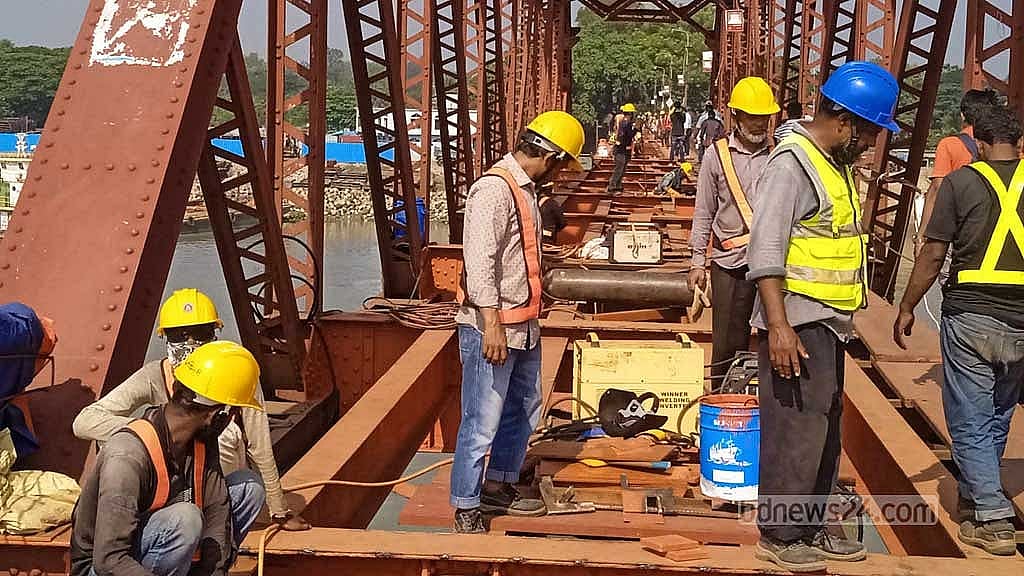
Across key trade and economic indicators, only a few positive signals emerged over the past year, mostly confined to the banking sector.
A strong inflow of remittances, buoyed by the high dollar exchange rate, contributed to a healthier balance of payments, with improvements in reserves, import capacity, and export earnings. Yet, despite some good news on exports, underlying concerns persisted.
Notably, many of those overseeing the interim government's economic and trade affairs are academics and researchers who had long been vocal critics of previous regimes.
Under their watch, however, sluggish revenue collection, stalled development initiatives, stagnant domestic investment, slow GDP growth, and unrest among civil servants left the economy struggling to inspire optimism.
Government data show that implementation of the Annual Development Programme (ADP) during the just-concluded fiscal year was the slowest in two decades. At the end of FY2025, only 67.85 percent of the revised ADP budget was utilised, down sharply from 80.63 percent in the previous year.
Speaking on the trade climate, AK Azad, managing director of the Ha-Meem Group, one of the country’s leading exporters, said: “Energy costs have risen sharply. Business operating costs have gone up. But product prices are falling at the retail end.”
Although he expressed concern over US tariffs, the supplementary duty was reduced from 35 to 20 percent. However, business leaders and analysts warned against complacency, pointing out that similar challenges could return in the future.
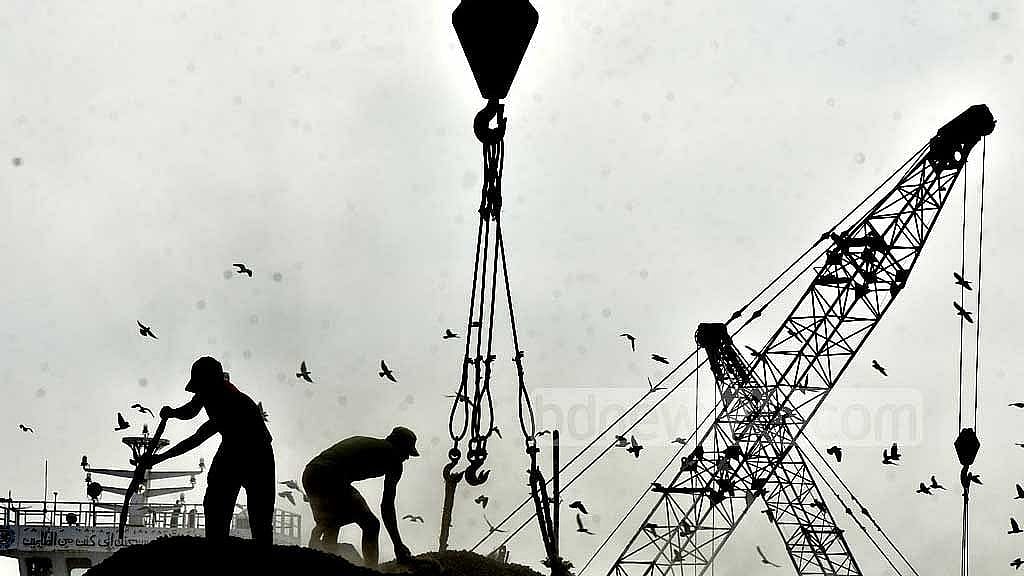
Former FBCCI president Mir Nasir Hossain said, “The energy crisis in business remains just as acute. Now you also have higher interest rates and worsening law and order, which are making things even more complicated.”
Speaking to bdnews24.com, he said: “We haven’t seen any real positive change, apart from some improvements in banking. Remittance inflows have increased, and exchange rate stability has made opening LCs possible.”
“But the higher interest rates are hurting us again. Business has slowed everywhere. So, the crisis hasn’t passed,” he added.
Mustafizur Rahman, distinguished fellow at the Centre for Policy Dialogue (CPD), acknowledged: “There have been some positive developments in the external sector, reserves, exchange rate stability, import capacity, debt servicing ability, remittances, and exports. These are encouraging.”
He continued, “But a major reason behind the movement was to create decent employment and revitalise investment, and to bring down inflation significantly. In those areas, not much has changed.”
He warned that high inflation has pushed many new people below the poverty line, while nutrition indicators have deteriorated.
“So the economic picture hasn’t turned out as expected,” he said.
Mustafizur also pointed out that the government failed to improve revenue mobilisation.
“Reforms needed to expand direct tax collection through the NBR haven’t seen much progress,” he said.
BALANCE OF POWER: HOW REALISTIC?
As part of the push for state reform, dialogue continued until the final day of July with three dozen political parties in pursuit of consensus.
Over five and a half months, the National Consensus Commission succeeded in reaching agreement on roughly 81 proposals.
Yet uncertainty remains -- will all of them be implemented? If so, to what extent would the structure of the state be reformed? And will those reforms truly address the root causes that necessitated change?
Although consensus was reportedly reached on 19 core areas of state reform, the commission has run into fresh complications over securing formal endorsement of the National Charter, also known as the July Charter, as a pledge of implementation.
Both the Jamaat and the NCP have demanded constitutional recognition of the National Charter. They have warned they will not sign the document without such recognition and have even threatened legal action against the government and the commission.
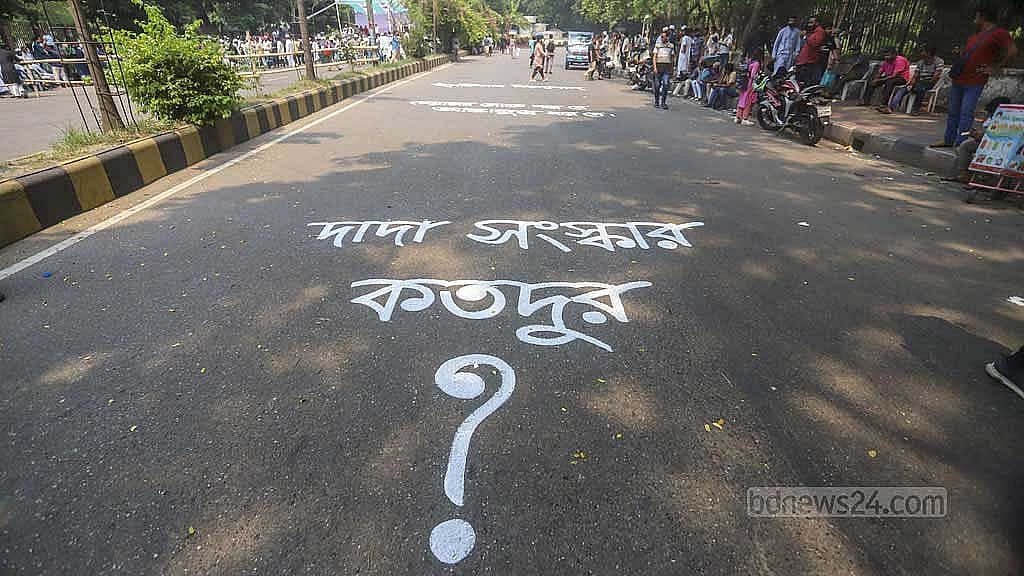
While the BNP supports official recognition of the Charter, it opposes elevating it to the level of constitutional status.
On the final day of talks, four left-leaning parties, including the CPB and Bangladesher Samajtantrik Dal (BaSaD), walked out over the exclusion of the four national principles from the draft, declaring there was now no possibility of them signing the Charter.
Prof SM Ali Reza of Dhaka University’s political science department viewed the establishment of consensus on several important issues as a success.
Zobaida, however, was more sceptical. She argued that many of the foundational questions associated with true state reform were never likely to yield consensus in such a large forum. While the talks were rich in ceremony, she said, they fell short in terms of actual outcomes.
[Writing in English by Syed Mahmud Onindo]