Published : 22 Jul 2025, 09:57 AM
Updated : 28 Aug 2026, 01:23 AM


Eight years ago, a plea scrawled on the walls of Dhaka shook the city’s conscience: “Subodh tui paliye ja” or "Subodh, run away”.
The cryptic call, etched in graffiti, echoed a rising wave of discontent and resistance, symbolising the silent scream of a generation suffocated under political weight.
But in July last year, following the student-led mass uprising that toppled the Sheikh Hasina government, the tone of the graffiti shifted.
Subodh, once urged to flee, was now called back -- not just to return, but to stay forever in the Bangladesh he once had to escape.
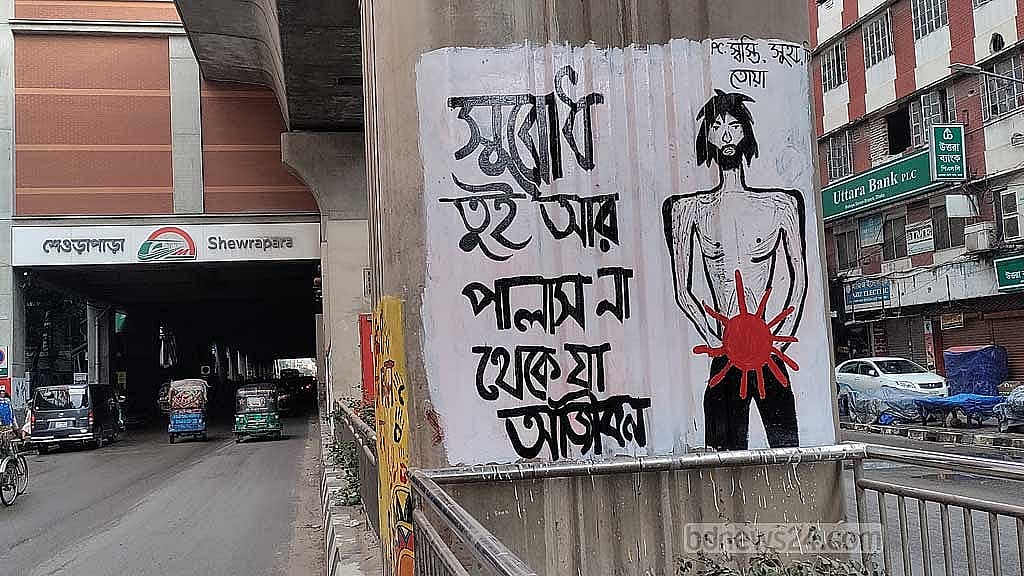
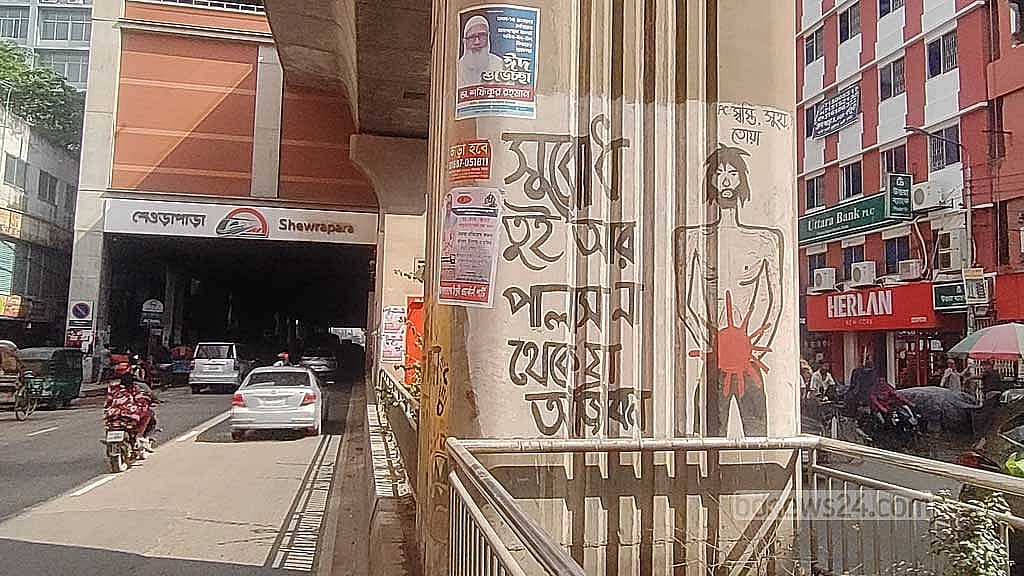
By August, a pillar beside Shewrapara metro rail station carried a bold new message: “Subodh tui ar palash na, theke ja ajibon” or "Subodh, don’t run anymore, stay here forever."
The graffiti still clings to the wall of the metro station. Its colours may have faded, but the message remains.
From Kazipara through Shewrapara to Agargaon, one can spot hundreds of such works -- paint peeling, edges worn, yet glowing with the quiet force of public hope.
Across the country, countless other walls still bear similar traces -- faded, but not forgotten.
Teachers, cultural workers, and researchers say these pieces are more than protest -- they are part of the country's social and political history. They call for both state and private efforts to preserve them.
But beyond preservation, they say the messages within -- the voices of the people -- must be understood by those who shape national policy.
That particular graffiti about Subodh still remains on the pillar at Shewrapara metro station.
The paint, however, has dulled, and posters have now been pasted beside it.
Gitiara Nasreen, professor of mass communication and journalism at Dhaka University said: “Although writing slogans on walls has been a longstanding practice, it was mostly confined within political parties.”
“But the events of the 24th of July created a new space -- one where everyone’s voice could find expression.”
She believes this widespread use of wall art is one of the “contributions of that July”, and that it may well evolve into a part of cultural identity.
Shortly after the July Uprising, the interim government published an art book showcasing vibrant and diverse graffiti images from across the country.
Chief Advisor Muhammad Yunus later presented copies of this book as gifts to prominent foreign dignitaries during official visits abroad.
Emphasising the historical significance of the graffiti, Yunus said: “These works portray the demands, emotions, hopes, and aspirations of the students and youth who stood up to a ruthless force resisting the oppressive power of autocratic Sheikh Hasina.”
Azad Abul Kalam, member of the Shilpakala Academy’s governing board, told bdnews24.com: “The graffiti painted on walls nationwide represent a unique chapter of history.
“People transformed the entire country into a canvas to express their hopes and expectations.”
Azad believes the dream of a secular, liberal, and discrimination-free Bangladesh, as depicted in the graffiti, remains “unfulfilled”.
DOES BANGLADESH ECHO THE WORDS ON ITS WALLS?
In some respects, he feels the country is moving in the “opposite direction”.
Anu Muhammad, former professor at Jahangirnagar University and editor of Sarbojonkotha, said: “The July mass uprising was driven by the aspiration for a Bangladesh free from all forms of discrimination.”
He identified those who espouse discriminatory ideologies -- based on class, gender, ethnicity, religion and seek to impose politics of oppression and dominance as the “enemies of the uprising”.
“In contrast, strengthening the people’s power to build a Bangladesh free from discrimination, oppression and domination is the urgent demand of our time,” he added.
WHAT THE GRAFFITI SAID
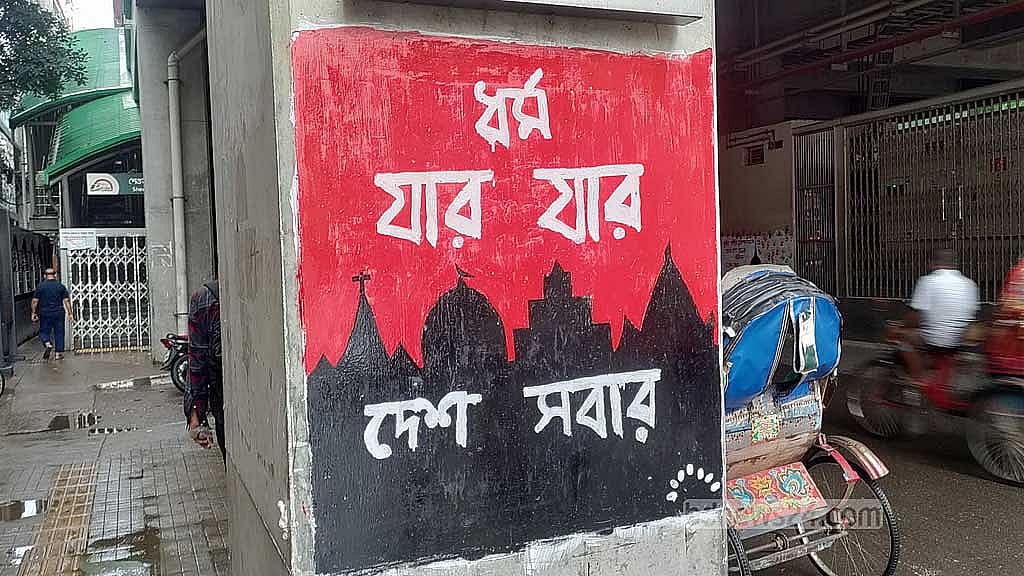
On a pillar of the Shewrapara metro line last August, four eighth-grade students from Manipur School -- Priyonti, Alvina, Tabassum and Nusaiba, all identified with single names -- painted the Bangladeshi flag.
Their story was featured in a report by bdnews24.com that same month. Alongside the artwork, these young students wrote a simple but powerful message: “Religion belongs to each, the country belongs to all”.
Portraits of students like Abu Sayed and Mir Mahfuzur Rahman Mugdho, who lost their lives during the movement, were painted across many city walls at the time.
Their memories were honoured not just in images, but in the enduring words of poems and songs.
The graffiti wave spread beyond the capital, reaching districts across the country.
These youthful expressions of protest didn’t remain confined to walls -- they were captured in photographs and shared widely online.
Some walls carried the words “A new Bangladesh”, while others bore the declaration: “We shall overcome".
The pillars of the metro rail turned into platforms for protest, inscribed with lines like “Paani Lagbe paani” and “Stop killing”.
Nearby walls were also covered with images of birds in flight, symbolising the joy of freedom, and of slogans breaking political silence.
These acts of defiance and longing sparked a deeper public interest in understanding this generation’s political imagination.
One wall in Dhanmondi carried the line: “Ei shohor hok shokol praner” or “Let this city belong to every living being.” The photo of that graffiti was widely shared on Facebook.
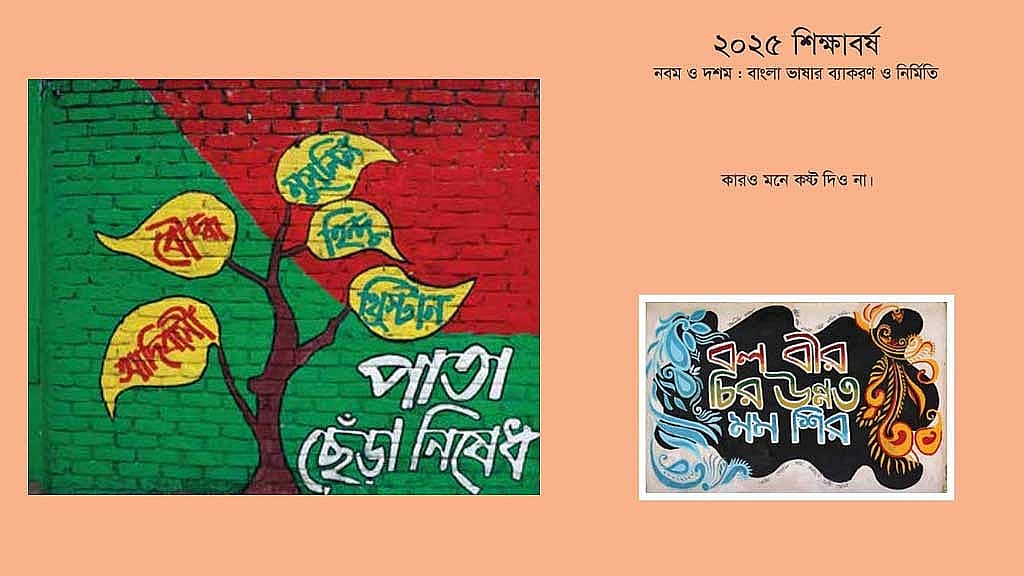
Rashid Amin, artist and teacher at Jagannath University’s Department of Fine Arts, said: “After the July Uprising, I travelled to a few districts outside Dhaka where I saw a graffiti that read: Tearing leaves is forbidden.
“That graffiti spoke of a secular Bangladesh, one that dreams of equality. The way young people expressed themselves on the walls during that time was unprecedented.”
The graffiti he referred to even made its way to schoolbook covers.
In January, a visual containing the word “Adivasi” (indigenous) appeared on the back cover of the Bengali grammar and composition textbook for grades nine and ten.
The image showed a tree with five leaves, each inscribed with a word: Muslim, Hindu, Christian, Buddhist, and Adivasi. Beside them, the words: “Tearing leaves is forbidden.”
But objections soon followed. A group calling itself Students for Sovereignty, which surfaced abruptly, protested the image.
In response to their demands, the artwork was removed from the textbook.
When Adivasi students protested this erasure, they were attacked.
Dipayan Khisa, information and publicity secretary of the Bangladesh Adivasi Forum, said: “What the graffiti once said no longer holds. Those wall paintings reflected the will of the people.
“But those messages have been devoured by a dark force -- just as our hopes, dreams, and aspirations are being devoured now.”
He pointed out that while the government has formed reform bodies and a National Consensus Commission, not a single indigenous representative has been included, highlighting, as he put it, the issue in plain sight.
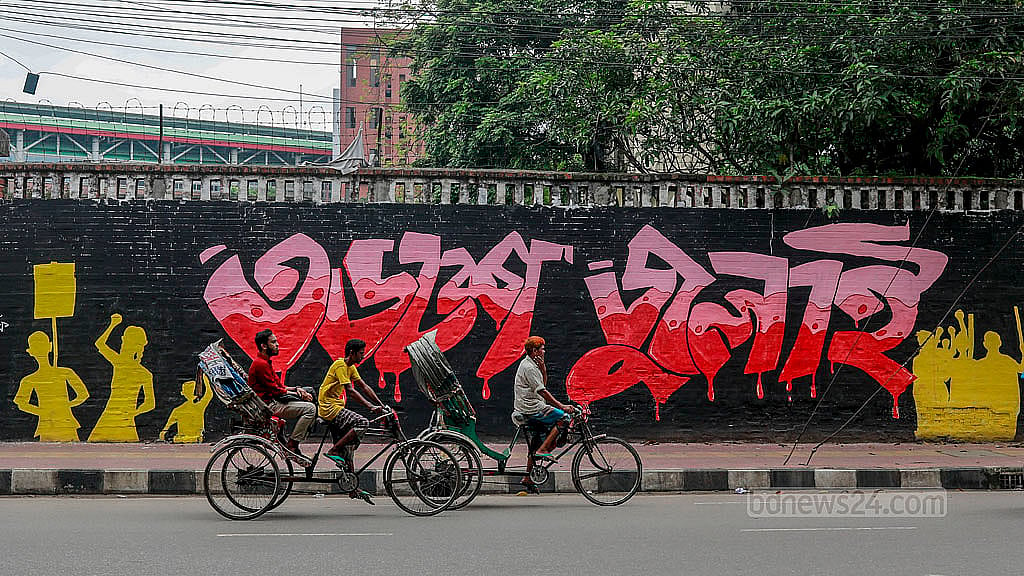
THE LANGUAGE MUST BE UNDERSTOOD
Prof Nasreen said that during the July Uprising, the walls became a canvas for the public to speak -- a living part of the protest.
“In the first phase of wall art, what emerged was anger, pain, and grief,” she said. “Much of it was spontaneous -- scribbled words and expletives expressing immediate rage. But students of fine arts and others who knew how to draw also joined in.
“The images and words spoke of murder, torture, police brutality, and arrests.”
She alleged that many of these works were erased after Aug 5. “To some, this raw expression of dissent was unseemly,” she said.
Nasreen, who was actively involved in the Uprising, said: “In the second phase, the artwork began again. This time, groups came together to paint without fear.
“As a result, the horror of July was reflected in those pieces -- but so were their dreams, expressed in vibrant colours.
“There were visions of a new country, rights for all, gender equality, representation of different communities and religions, quotes from thinkers, lines from songs -- all of it found space on those walls.
“The canvas became vast,” she added. “To realise even part of that dream would require a monumental effort and I don’t believe that’s been achieved in just one year. And always there was one line that returned: We want justice. Some steps toward justice are visible now.”
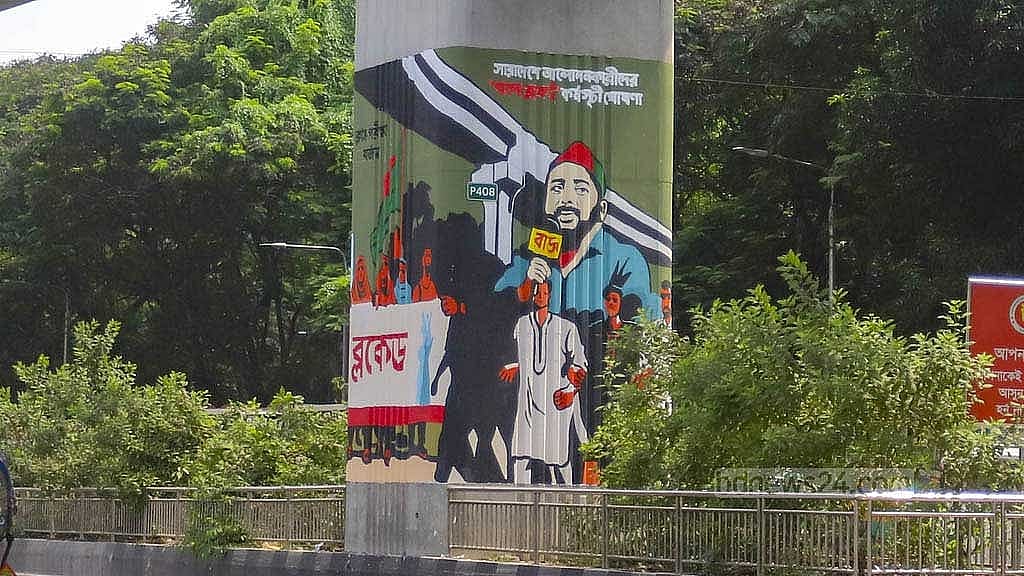
Dhaka University professor Samina Luthfa, who also played an active role in the July movement, sees the graffiti as “powerful documentation of public participation”.
But she believes there is now a tendency to “deny” many aspects of the Uprising and that this is happening with the government's “tacit approval”.
“You can understand the scale of public involvement in July just by looking at the graffiti,” she told bdnews24.com. “In some places, they were erased, and in others, new graffiti was imposed with force.
“An effort is underway to downplay the extent of women’s participation in July, but the responsibility lies with us to document history truthfully and without distortion.”
Writer and journalist Ehsan Mahmud, who was also active during the Uprising, said government efforts to archive the graffiti have been “inadequate”.
The hopes expressed in those wall paintings, he believes, remain largely “unmet”.
“We’ve seen graffiti deliberately defaced or destroyed in some places,” he said. “Yes, a few books have come out on graffiti, but no large-scale initiative is yet visible.”
Ehsan stressed the need to understand the politics behind the graffiti. “After the movement, people painted spontaneously. But in some places, those original works were removed and replaced with other images.
“That too is a form of politics and we must understand it.”
He called for impartial research on the July Uprising -- not only through state initiatives, but through independent efforts as well.
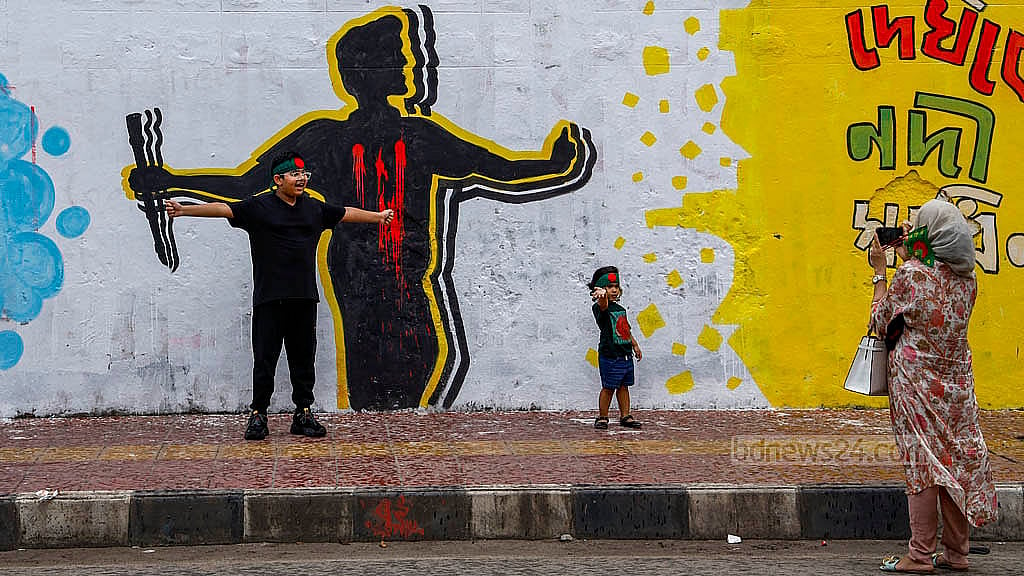
AL ERA PAINTED ON PILLARS
To mark the anniversary of the July Uprising, Dhaka metro rail pillars have been adorned with year-by-year depictions of the ousted Awami League government’s rule.
These artworks are titled “Phire Dekha Fascist Regime” or “A Look Back at the Fascist Regime” and “Jagroto July” or “Awakened July”.
Following new graffiti being commissioned, the artworks created by the public on the metro rail pillars after Aug 5, 2024, were removed after one year, and replaced with new graffiti under a government initiative.
The pillars now portray events such as the Pilkhana massacre, Khaleda Zia’s eviction from the cantonment residence, the stock market crash, the “enforced disappearance” of Ilias Ali, and the Shapla Chattar killings.
Other incidents depicted include the reserve fund theft, the Holy Artisan attack, exam paper leaks, Khaleda’s imprisonment, the Road Safety Movement, the black law, mismanagement during the COVID-19 pandemic, excessive spending during Mujib Year, the energy crisis, the murder of Abrar Farhad, the quota reform movement, communal violence, the Nasirnagar attack, the Sohagi Jahan Tonu rape case, the killings of Biswajit Das and Felani Khatun, and the arrests of opposition leaders.
From Farmgate through Manipuri Para to Agargaon, numerous scenes from the July movement are visible.
July movement leaders Nahid and Sarjis Alam are also featured in the metro rail graffiti.
Titled “Jagroto July er din” or “Days of awakened July”, the graffiti presents a detailed timeline of the movement.
Events like the widely discussed “Bangla Blockade” programme are also represented.
During the July uprising, former Prime Minister Sheikh Hasina’s remark, “If the grandchildren of freedom fighters should not get jobs, who should? The grandchildren of Razakars?”
Around the same time, the then home minister Asaduzzaman Khan’s comment: “Students are crossing the limit,” is also displayed.
Scenes of attacks on students by Bangladesh Chhatra League members are vividly illustrated as well.
WHO ERASED THE 'BLOGGER KILLINGS’ GRAFFITI?
Graffiti work on the metro rail pillars began about two weeks ago, starting from Kawran Bazar. One such graffiti titled “Blogger Killings” was painted on Pillar No. 464.
While graffiti on other pillars remained untouched, about a week ago, the one depicting the blogger killings was erased by unknown individuals.
In its place, someone wrote: “Towhidi jonotar Banglay nastik shatimer thai nai” or “There is no place for atheist blasphemers in the land of the Towhidi Janata.” Below that, it was signed: “Muslim Bongo.”
This act of erasing the graffiti has sparked widespread discussion on social media.
Blogger killings in Bangladesh began in 2013. Between Febr 14, 2013, and Aug 7, 2016, a total of 12 bloggers were murdered.
Militant groups like Ansarullah Bangla Team and Ansar al-Islam were linked to these killings.
The “Blogger Killings” graffiti was painted to remind the public of these events that took place during the Awami League government.
On Friday evening, an on-site visit showed that after the Towhidi Janata message was removed, no new graffiti had been painted in its place.
While multiple pieces of graffiti appear on other pillars, Pillar No. 464 now only features artwork titled “Terrorism” on both sides.
The original area where the “Blogger Killings” piece had been painted has been left blank and whitewashed.
Filmmaker and activist Aparajita Sangita wrote on Facebook: “Towhidi Janata erased the blogger graffiti and wrote: ‘There is no place for atheist blasphemers in their Bengal’. Does this mean the Towhidi Janata are admitting they were the ones who killed the bloggers?”
PRESERVATION
Sumon Rahman, a teacher at the University of Liberal Arts Bangladesh and a poet and short story writer, said: “Graffiti isn’t something permanent. It’s a language of its time.
“So I don’t think it must be preserved exactly as it appears on walls. It can be archived in different formats.”
Sumon, who is also a member of Bangla Academy’s executive council and reform committee, said several research initiatives on graffiti are already under way under the academy’s projects.
“Some of that may gradually become visible. Research takes time -- it’s not something that can be rushed. I’ve also heard that the July Museum has made some plans to preserve the graffiti.”
He believes that some of the aspirations expressed through wall art have been “fulfilled”.
“The reality during the time of the Uprising was one thing; the current reality is different,” he said. “It’s natural for realities to change. Some of the messages conveyed through images by the youth a year ago have perhaps been realised, while others have not yet been.”
Sumon added, “It’s not possible to implement everything at once. This is a continuous process. I believe the momentum of change is still ongoing.
“Time hasn’t run out. So I believe Bangladesh will continue to move in the direction of the aspirations reflected in the graffiti.”
Artist Rashid echoed the view, noting the temporary nature of these works.
“Graffiti and wall art are ephemeral by nature. They might not last more than a couple of years,” he said.
“So they should be photographed and published as a series in books. These works deserve research from multiple perspectives.”
In September, following the interim government’s assumption of power, it was announced that Hasina’s former official residence, Ganabhaban, would be converted into a July Uprising Memorial Museum.
Tanjim Wahab, chief curator of the July Museum, said the museum’s archive and collection team is gathering materials related to the uprising from across the country, including photographs, videos, artefacts, and letters from the movement.
When asked how many such items had been collected so far, Tanjim said: “This is an ongoing process. Even after the museum opens, collection will continue. Graffiti preservation is part of that effort.”
Asked how satisfied he was with the government’s efforts in preserving the memory and history of July, Nahid Islam, one of the leaders of the Uprising and now the convenor of the National Citizen Party (NCP), said: “I’ve heard that the government has made considerable progress in preparing the July Museum. There are also many private initiatives.”
“Once the government formally inaugurates the museum, we’ll get a clearer picture of how much of that history has been preserved,” he added. “I hope that will become visible this month, and I expect the process will continue in a sustained way.”
Nahid also stressed that preserving the history of July should not rest with the government alone -- researchers and others must also take responsibility.
[Writing in English by Sheikh Fariha Bristy]