Published : 06 Sep 2026, 10:23 PM
Updated : 16 Sep 2026, 11:48 AM


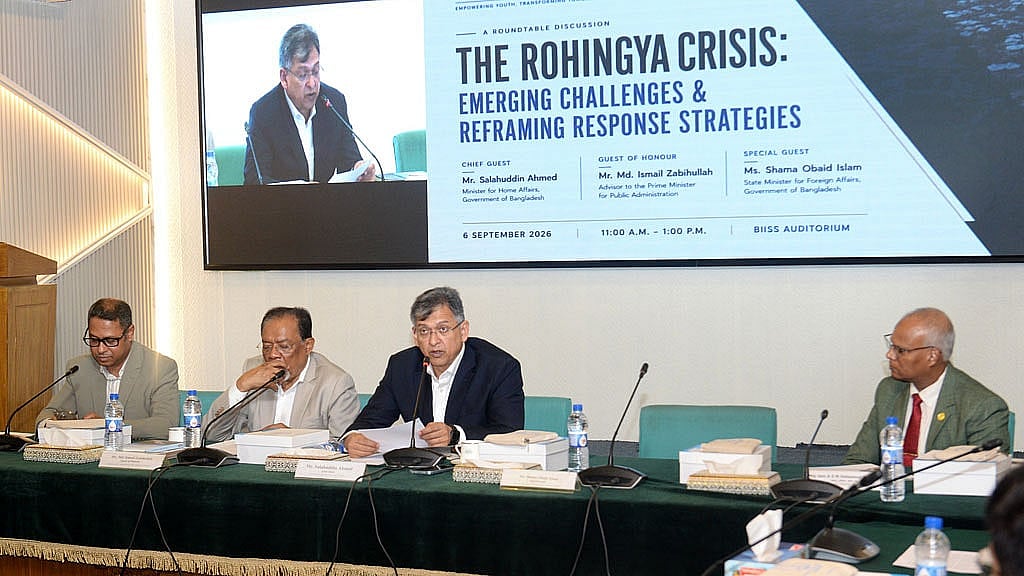
Home Minister Salahuddin Ahmed has stressed the need for strong cooperation from the international community and international organisations to resolve the Rohingya crisis.
At a roundtable discussion on Sunday, he called for a “swift, sustainable” political solution and urged the United Nations and the wider international community to act, the home ministry said.
The event, titled "The Rohingya Crisis: Emerging Challenges and Reframing Responsibilities”, was organised by the Institute for Global Cooperation Foundation (IGCF) at the Bangladesh Institute of International and Strategic Studies (BIISS) auditorium.
Salahuddin said, “The Rohingya issue must always remain active on the international radar of the United Nations and must not be overshadowed by any other global political conflict or crisis.
“Through joint efforts and effective diplomacy by the international community, the dignified and speedy repatriation of Rohingya refugees to their homeland in Myanmar must be ensured.”
Mohammad Ismail Zabiullah, advisor to the prime minister at the Ministry of Public Administration, who also spoke at the event, flagged the importance of administrative coordination in tackling the Rohingya issue.
The home minister said he believes that a permanent and sustainable solution to the Rohingya crisis is possible with the direct support of leading countries in world politics and the UN.
He called upon international human rights organisations, the United Nations High Commissioner for Refugees (UNHCR), and all other relevant stakeholders to play a “more effective” role in resolving the crisis.
He said, “Our sole objective is to ensure that the nearly 1.5 million—1.2 million according to UNHCR estimates—forcibly displaced Myanmar nationals (FDMNs) currently taking shelter in Bangladesh can be returned to their own country with full dignity and security.”
On the long-term impact of the crisis, the minister said, “For nearly nine years, Bangladesh has been providing shelter, food, land, healthcare and basic necessities for the survival and security of more than 1.5 million displaced Rohingya on humanitarian grounds.
“However, over time, criminal activities, arms and drug trafficking, human trafficking, gender-based violence and the activities of armed groups have increased in the camps, creating serious challenges to Bangladesh’s internal security.”
He also pointed to growing risks for communities living near the camps and the surrounding environment.
“Necessary security measures, such as fencing around the camps and a well-regulated movement system, have become essential to control crime and ensure the overall security of both the Rohingya population and local citizens,” he said.
The home minister said Bangladesh had successfully repatriated Rohingya to Myanmar in 1978 under the successful leadership of then-president Ziaur Rahman and in 1992 through the visionary diplomatic initiative of then-prime minister Begum Khaleda Zia.
"Drawing on those past successes, the current government is determined to once again achieve full repatriation under the leadership of Prime Minister Tarique Rahman," he said.
Referring to the formation of a “National Strategy Formulation Committee on Rohingya Affairs” under Tarique Rahman, Salahuddin said: “At the same time, another high-level national committee, led by the home minister, is actively working on law and order, border management and overall coordination.
“The government is pursuing a comprehensive ‘whole-of-government’ approach involving the civil administration, security agencies and defence organisations.”
The minister also expressed concern that humanitarian assistance provided indefinitely without a specific and credible repatriation plan could, in the long run, reduce the urgency for a political solution.
“We must move quickly beyond emergency relief assistance toward a ‘transitional strategy,’ whose primary objective will be to create a safe and suitable environment in Myanmar’s Rakhine State that is conducive to the return of the Rohingya,” he said.