Published : 26 Jul 2025, 09:03 AM
Updated : 28 Aug 2026, 01:23 AM


The Bangladesh Institute of Planners (BIP) has recommended the gradual removal of schools, colleges, hospitals, mosques, and Eidgah grounds from airport flying approach zones to avoid future tragedies like the Milestone School and College incident.
The organisation warned that such risks would “persist” unless action is taken.
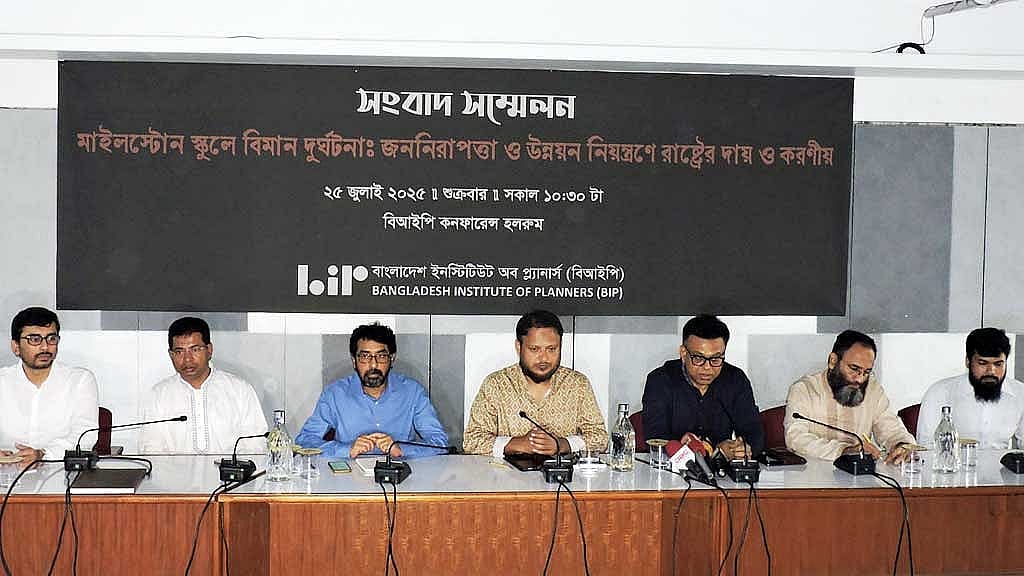
The call came in a fact-finding report titled “Plane Crash at Milestone School: State Responsibility and Actions on Public Safety and Development Control”, presented at a press conference at Planners Tower in Dhaka’s Banglamotor on Friday.
At the event’s outset, BIP Joint Secretary and urban planner Tamzidul Islam presented findings from the investigation.
He said the Milestone School’s permanent campus lies within the inner approach area of the Shahjalal International Airport runway -- a zone that compromises airport operations and public safety, while also posing long-term health hazards due to extreme noise pollution and high carbon emissions.
Structures are prohibited within 500 feet of a runway, while the next 13,000 feet (around 4km) forms the designated approach area for takeoff and landing.
Tamzidul noted that although the Civil Aviation Authority of Bangladesh (CAAB) sets building height limits to ensure aircraft safety, it does not specify what kind of structures or institutions should be permitted in those areas.
He also said the Dhaka Metropolitan Development Plan (DMDP) and Detailed Area Plan (DAP) lack any land use regulations to protect public safety and health in sensitive zones around the airport.
“Globally, residential buildings, schools, community centres, hospitals, and commercial properties are discouraged in inner approach zones -- something rarely enforced around Bangladesh’s airports.”
BIP Secretary General Sheikh Muhammad Mehedi Ahsan said the 1995 DMDP had recommended preserving the airport’s surrounding areas in their natural state, including as reservoir.
Satellite imagery confirms the land near Shahjalal Airport was previously water bodies, but this changed over time as establishments developed there.
“Any construction in such areas requires RAJUK’s approval, and RAJUK cannot disown this responsibility,” he said. “Also, no such approval can be granted without a no-objection certificate from CAAB.
“Yet, the Milestone School and College stands directly in the airport’s approach zone -- exposing a breakdown in coordination between CAAB and RAJUK.”
He said the CAAB should conduct thorough planning assessments before issuing any such clearance.
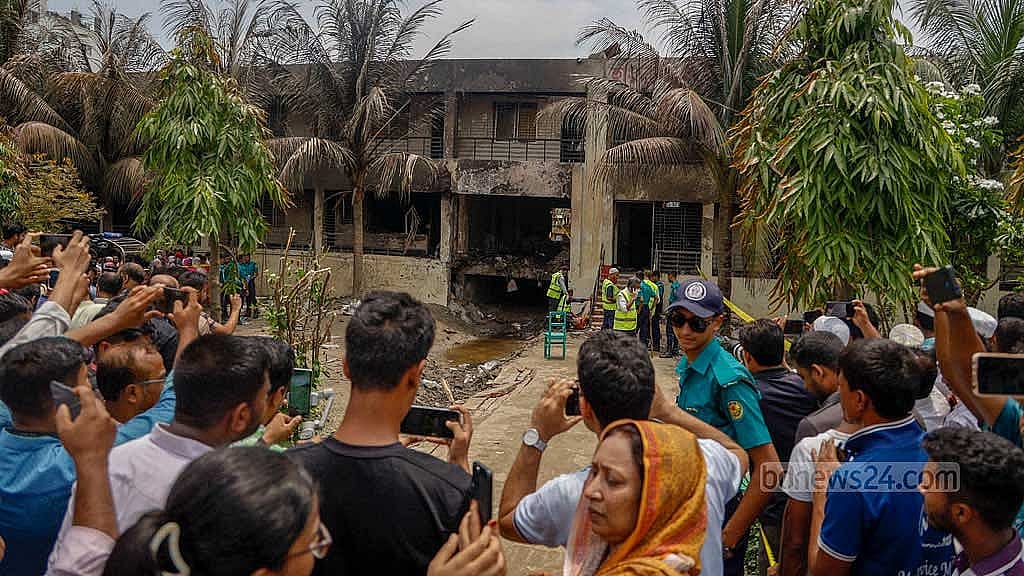
On Monday afternoon, a Bangladesh Air Force jet crashed onto a building on the Milestone School campus in Diabari.
The country’s deadliest military aviation disaster has claimed 33 lives, most of them children.
The crash triggered widespread concern over how a school was operating within a kilometre of an airport's approach path and whether training flights should be allowed in such densely populated areas.
At the briefing, BIP President Adil Muhammad Khan said no training aircraft should operate over high-density zones.
Urban planning must ensure safe air corridors, which is why major airports in developed nations are located at a distance from city centres, separated by buffer zones.
“The city’s growth should have avoided the flying approach zones,” he added. “According to the 1995 DMDP, the Milestone School area was designated as wetlands, which also played a role in airport safety.
“So the question is, on whose interest or under what motive did RAJUK permit urban development in these restricted zones, bypassing the DMDP?”
On the Milestone incident, Adil said: “It is essential to investigate whether all the school’s buildings were approved by the RAJUK and CAAB. The building that was struck had its balconies sealed with grills and only one entry and exit point -- severely hindering rescue efforts and causing the deaths of many children.”
During the event, BIP also presented a set of proposals and action plans:
• The government must identify all crowd-heavy structures located within the flying approach and funnel zones through technical assessments, and determine which buildings lack proper approvals. The BIP expressed willingness to voluntarily assist in this process.
• A white paper should be published detailing all planning violations across Dhaka city, followed by necessary steps.
• Legal action should be taken against individuals running schools on land that violates DAP and DMDP land-use classifications. The roles of the education ministry, RAJUK, and other responsible agencies should also be reviewed.
• Unlawful influence from interest groups must be removed from the planning and decision-making processes. Legal steps must be taken against coercive actors.
• Urban planning and development-related government bodies must ensure inclusion of qualified urban planners.
• Corrupt officials and employees within ministries, industrial owners, political figures, bureaucrats, professionals, development authorities, and relevant public agencies involved in violating planning laws should be identified and held accountable.