Published : 10 Dec 2025, 04:20 AM
Updated : 21 Aug 2026, 02:51 PM


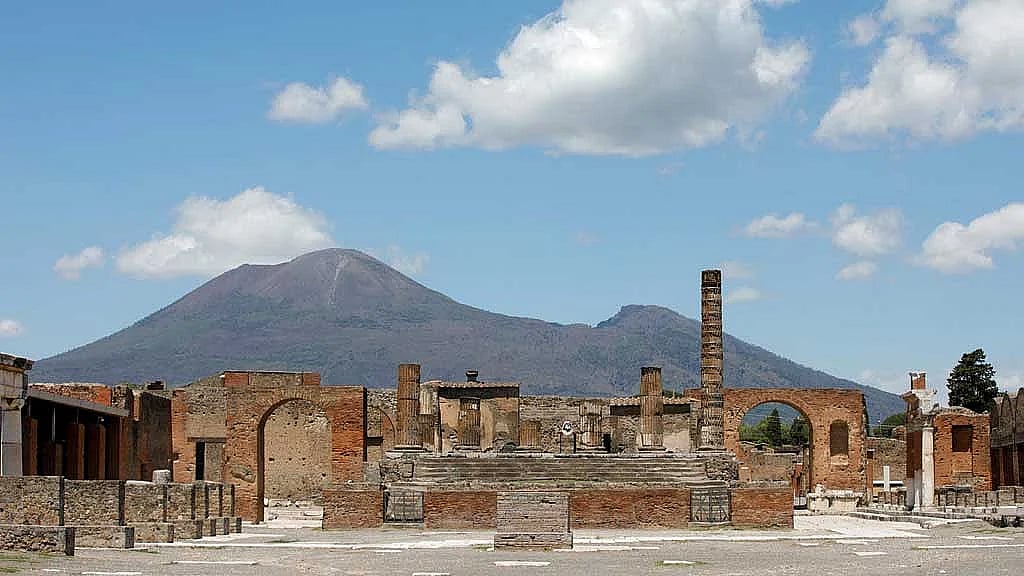
Scientists excavating the ruins of Pompeii have discovered a construction site left frozen in time by the eruption of Italy's Mount Vesuvius volcano in 79 AD, clarifying the ingredients and methods behind the durable self-healing concrete the ancient Romans used to revolutionize architecture.
The site represents a building project that was underway when the eruption buried Pompeii under volcanic ash and rock. The researchers came across rooms where the walls were unfinished and piles of premixed dry material and tools for weighing and measuring were in place for preparing concrete.
"Studying it truly felt as if I had traveled back in time and was standing beside the workers as they mixed and placed their concrete," said Admir Masic, a Massachusetts Institute of Technology professor of civil and environmental engineering and leader of the study published on Tuesday in the journal Nature Communications.
An indispensable building material, concrete helped the Romans erect structures including stadiums like the Colosseum, domed temples like the Pantheon, public baths and other big buildings, aqueducts and bridges unlike any fashioned to that point in history. Because the concrete could harden underwater, it also was vital for constructing harbors and breakwaters.
The precise method they used to make their concrete has been a matter of debate, with recent archaeological discoveries appearing to contradict accounts given in a 1st century BC treatise by Roman architect and engineer Vitruvius.
The Pompeii discovery showed the Romans used a technique called "hot mixing" in which a material called quicklime - dry limestone that was previously heated - is combined directly with water and a blend of volcanic rock and ash, producing a chemical reaction that naturally heats the mixture. That differs from the method described by Vitruvius, who wrote about a century earlier.
"Pompeii preserves buildings, materials and even work in progress in the precise state they were in when the eruption occurred. Unlike finished structures that have undergone centuries of repair or weathering, this site captures construction processes as they happened," Masic said.
"For studying ancient technologies, there is simply no parallel," Masic said. "Its exceptional preservation offers a true 'snapshot' of Roman building practice in action."
The building under construction combined domestic rooms with a working bakery with ovens, grain-washing basins and storage. The evidence there indicated that the technique outlined by Vitruvius, known as slaked lime, was not used for building walls.
That method may have been outdated by the time of the project in Pompeii.
"Imagine what 100 years of difference could mean for the building technology. A good analogy could be the early telephones. In the 1920s-30s: rotary dialing, long-distance copper lines. In the 2020s: smartphones using packet-switched digital signals and wireless networks," Masic said.
The hot-mixing technique contributed to the self-healing properties of the concrete, chemically repairing cracks. The concrete contains white remnants of the lime used to make it, called "lime clasts," which can dissolve and recrystallize, healing cracks that may form with the infiltration of water.
The Romans industrialized concrete, beginning in the 1st centuries BC and AD.
"This allowed builders to construct massive monolithic structures, complex vaults and domes, and harbors with concrete that cured underwater. Concrete fundamentally expanded what could be built and how cities and infrastructures were conceived," Masic said.
The new understanding of Roman concrete may have relevance for modern architects.
"Modern concretes generally lack intrinsic self-healing capability, which is increasingly important as we seek longer-lasting, lower-maintenance infrastructure," Masic said. "So while the ancient process itself is not a direct replacement for modern standards, the principles revealed can inform the design of next-generation durable, low-carbon concretes."