Home
+
Published : 12 Nov 2025, 02:08 AM
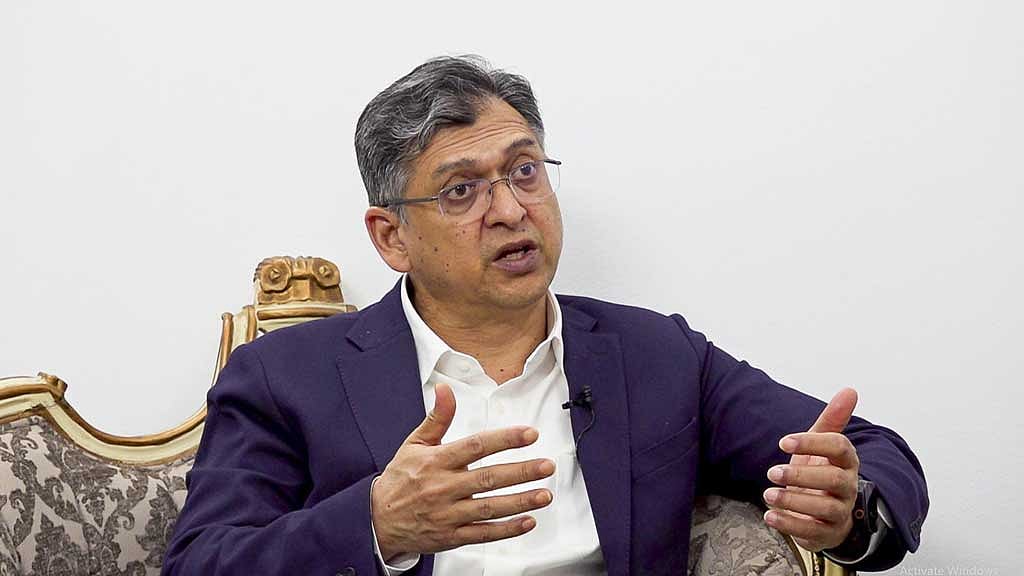
Salahuddin Ahmed believes a “conflict of interest” has emerged in Muhammad Yunus’s dual role as both the head of government and chief of the National Consensus Commission.
He argued that the government’s proposed steps for implementing the July National Charter diverge sharply from how it was signed, raising questions about constitutional authority, referendum timing, and parliamentary supremacy.
“There’s clearly a clash of interest here,” he said. “This government is responsible for implementing the July National Charter. As a political party, we are cooperating, participating in the election, and encouraging the public.
“But as the head of government and the chairman of the National Consensus Commission, the recommendations he provided to the government have gone far, I would say, from the way the July National Charter was originally signed.”
Salahuddin, who led the party's engagements in the consensus talks, claimed that the issue of holding a referendum without a note of dissent had never been discussed within the commission.
He insisted that the Charter must be based on the consensus reached by political parties, to be implemented by the next elected parliament -- a principle, he argued, from which the chief advisor “cannot deviate”.
Urging the interim government to act impartially, he said: “We hope the government will refrain from any steps that could sow division or disunity within the nation.”
Appearing on bdnews24.com’s flagship discussion programme Inside Out, Salahuddin spoke openly about the July Charter, the process of its implementation, the controversies surrounding the proposed referendum, and the current political situation, including the next parliamentary election and the BNP’s coalition strategy.
The programme was aired on bdnews24.com’s Facebook page and YouTube channel on Tuesday.
DRIFTED FAR AWAY
Representing the BNP in the National Consensus Commission dialogues, Salahuddin was asked how successful the year-long discussions had been.
Recalling his experience across three rounds of talks with the Reform Commission and the National Consensus Commission, he said:
“Towards the final stage of the discussions, a day or two before the July National Charter was signed, the chief advisor met with all political parties. We proposed that the Charter be signed through a historic ceremony, and that all parties pledge to implement it in full.
“The Charter was accordingly drafted, containing around 84 points. In several of those points -- not all -- we and other political parties added notes of dissent. These were not traditional notes of dissent.
“They explicitly stated that if the party or alliance securing the mandate of the people wished to implement their dissenting points, they could do so according to their election manifesto.”
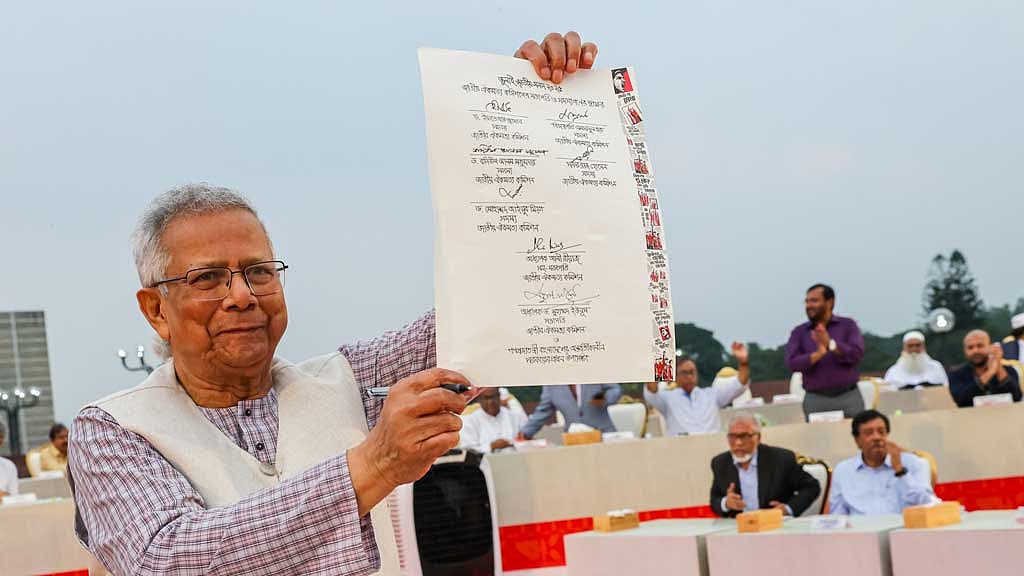
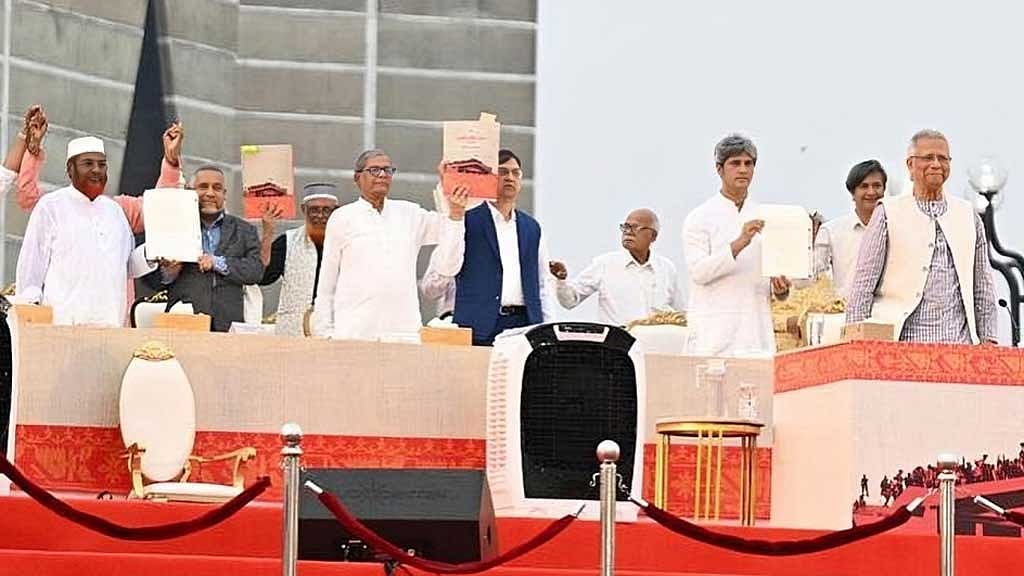
Reminding that the Charter was signed on Oct 17, Salahuddin said: “A couple of political parties did not sign, but out of 29 or 30 parties, 24 to 25 did. Following the signing, it was agreed that the National Consensus Commission would prepare recommendations for the government on the implementation process of the Charter.
“A few days later, within its term ending on Oct 31, the commission submitted those recommendations to the government. The chief advisor also signed them -- as chairman of the commission. So, he would both implement them as head of government and recommend them as head of the commission.”
Raising the question of whether this dual role created a clash of interest, Salahuddin said, “We could have overlooked it had the recommendations proposed measures that truly reflected the spirit and contents of the July Charter as signed. But instead, in the recommendation document, they proposed several steps, the first of which was the issuance of an order -- without specifying who would issue it.”
He continued, “For implementation, they presented two alternative proposals. The first option was to issue an order containing a schedule listing 48 points related to constitutional amendments.”
Salahuddin clarified that the BNP had “no disagreement” about implementing other matters through ordinances or executive orders.
“But the 48 points that involved constitutional amendments -- the ones where notes of dissent were added to the July National Charter -- were completely omitted. Instead, it was stated that these 48 points would be put to a referendum. The exact question to be asked in the referendum was not even specified.”
Explaining why the BNP had agreed to a referendum, Salahuddin said that when questions arose over the legal foundation for implementing the July Charter, he had proposed “in the interest of national unity” to seek the people’s consent.
“The people could indicate through a simple ballot, held on the same day as the parliamentary election, whether they support or oppose the July Charter. If the public says ‘yes’ to its implementation, that would create a moral obligation upon the members of parliament, binding them to honour that mandate,” he said.
However, he made clear that the referendum itself would not enact constitutional reforms: “The parliament must still perform its legislative role in amending the Constitution.”
On the timing of the referendum, Salahuddin highlighted a difference of opinion with the Jamaat-e-Islami: “There’s no logic in holding it before the national election. There’s no time, nor any need.
“The most logical, relevant, and acceptable way would be to hold it on the same day as the parliamentary election, using a small additional ballot. It would also save costs.”
Referring to the movement led by Jamaat and seven other religion-based parties demanding the referendum be held in November -- ahead of the parliamentary elections scheduled for February -- Salahuddin said:
“They have the right to campaign. But the extent to which the public will accept their demand has already become evident.
“We have fought for democratic rights. They have every right to express their position within that framework. But our position is that neither the Consensus Commission, nor the government, nor any political party can deviate from the principles upon which the Charter was drafted and signed.
“So, this is our current and rational stance,” he said.
Salahuddin had recently remarked that the interim government “acted like a referee, handing over a goal”.
When asked whether this meant BNP had lost confidence in the government, he replied: “They have moved far from how the July Charter was signed.”
He elaborated that the proposal for implementing the Charter included parliament members taking oath as members of a constitutional reform council -- an issue “never discussed” in the Consensus Commission meetings.
“It has been suggested that as members of the constitutional reform council, they would ensure implementation within 270 days, otherwise the reforms would automatically be incorporated into the Constitution,” he said. “This effectively denies the sovereign authority of parliament and the people.”
Salahuddin stressed that the primary forum for implementing the July Charter is parliament.
“Nothing can be imposed above it, neither by the Reform Commission, the Consensus Commission, nor the government. Then why did we spend so long in discussions?”
‘NEUTRAL’ CONDUCT
Asked what the BNP would do if the government decided to hold a referendum before the national election or without a note of dissent, Salahuddin said such discussions had not yet taken place.
He reminded that before the formulation of the July Charter, the chief advisor had repeatedly assured the nation that issues agreed upon by all political parties would be compiled into the Charter and later implemented by the next elected parliament.
When asked if the BNP would boycott a referendum if the government withdraws, Salauddin replied: “I believe the current interim government will act as a caretaker, behave neutrally, and we hope it will not take any steps that create division or discord within the nation.
“Our aim is to conduct a historic parliamentary election that will be internationally recognised, credible, and beyond question.”
CHARTER IMPLEMENTATION
The issue of who will issue the implementation order of the July Charter remains unsettled.
When asked, Salahuddin said no one currently has the authority to issue a “constitutional order”.
“We are currently under a constitutional government, operating within a constitutional framework. This government has taken oath constitutionally. Therefore, we are following the law and constitutionality. Proposals for constitutional or extra-constitutional orders were rejected long ago -- they are unacceptable and unconstitutional. There is no question of doing so.”
He explained that presidential orders were historically issued during the period after the declaration of independence, when elected representatives drafted the Constitution and managed state affairs.
“Once the authority to issue presidential orders is granted, there is no room for issuing such orders now. Any question about issuing a presidential order is a matter of history; there is no opportunity for it today,” he added.
BNP’S POSITION
Salahuddin explained that while the government is issuing ordinances regularly, the July Charter could be implemented through a gazette notification if the government so wished.
He said the Charter is a political consensus document -- not a legal one -- but all parties are bound by its principles.
“Since it is a product of political consensus and will be subject to a referendum for public approval, it will carry a moral obligation for the next parliament,” he said.
When lawyer Shahdeen Malik suggested that the July Charter might lose importance once election momentum builds, Salahuddin disagreed.
He said the BNP remains committed to the reforms, which he described as long-standing national demands.
“Any proposal that benefits the nation and the people will be welcomed. We believe in moving forward through reform, not away from it,” he said.
ALLIANCE WITH NCP?
The BNP has already released its preliminary candidate list for 236 constituencies.
Secretary General Mirza Fakhrul Islam Alamgir said, “For those constituencies where our allies have been active, we have not nominated candidates. We expect them to announce their names, then we will finalise our list.”
Media reports suggest that the new party NCP, formed by student leaders from the Uprising, is discussing seat-sharing with the BNP, though NCP has denied this.
When asked about an electoral understanding with the NCP, Salauddin said: “In politics, one cannot make a final statement. So far, the BNP has cooperated with other parties that were involved in joint movements, including some Islamic parties, and we aim to contest elections in alliance with them.”
Although denying current talks with the NCP, he did not rule out future cooperation: “Whether we will form an alliance with the NCP or contest elections together has not been proposed by either side yet. But it is too early to dismiss the possibility altogether.”
The BNP has historically boycotted the 10th and 12th elections, claiming they were not inclusive.
When asked whether the absence of the Awami League would affect the legitimacy of the 13th parliamentary polls, Salauddin said: “During those three questionable elections under the Awami League, the boycotting parties were not banned, nor were they accused of crimes against humanity.
“Therefore, Awami League’s absence now does not make the election illegitimate or non-participatory, and we do not agree with that view,” he added.