Home
+
Published : 03 Sep 2025, 02:05 AM
When Dhaka University last held a full Central Students’ Union (DUCSU) election in June 1990, Jatiyatabadi Chhatra Dal (JCD) stunned the political establishment with a clean sweep, riding the wave of a nationwide movement that ultimately toppled military ruler HM Ershad.
Now, more than 30 years later, the echoes of 1990 have returned, but under dramatically different conditions.
In the wake of the July Uprising that pushed Sheikh Hasina from power, JCD is once again hoping to ride a wave of popular momentum. But whether it can replicate the tide of 1990 remains to be seen, given its shaky organisational base in the halls.
In a twist of political fate, those who stood united with JCD on the frontlines of the July protests are now its rivals in the race for DUCSU.
In the aftermath of the movement, general students consolidated their position on the campus, forcing JCD to sideline its senior leadership and nominate comparatively younger candidates. The panel features fresh faces who played active roles in the July Uprising.
JCD’s VP candidate is Abidul Islam Khan, the joint general secretary of its DU unit and an MPhil student in Islamic Studies (2015-16 session). Its GS candidate is Sheikh Tanvir Bari Hamim, convener of the Jasimuddin Hall committee from the 2018-19 batch in Women and Gender Studies, while the AGS candidate is Tanvir Al Hadi Mayed, convener of Bijoy Ekattor Hall, also from the 2018–19 batch in Mass Communication and Journalism.
In 1990, JCD’s victorious VP Amanullah Aman went on to become an advisor to the BNP chief, GS Khairul Kabir Khokon became joint secretary general, and AGS Nazimuddin Alam rose to the party’s executive committee.
Speaking to bdnews24.com, former AGS Nazimuddin Alam drew parallels between the two moments.
“The wave we saw in 1990 is here again. Our VP candidate Abidul, GS candidate Hamim and AGS candidate Mayed fought bravely in July-August (of 2024) without compromise. Abid has been tortured, injured, and oppressed, but he never gave up,” he said.
Nazimuddin acknowledged that other groups also played roles in the anti-Hasina protests, but argued that JCD’s contribution was the largest as the biggest student organisation.
Notably absent this time are the Bangladesh Chhatra League, JCD’s main rival in 1990, and other groups from the old Chhatra Sangram Parishad, all banned after the ouster of the Awami League government.
Instead, JCD faces Islami Chhatra Shibir, which finished fifth in 1990, along with three left-aligned panels and the newly formed Bangladesh Ganatantrik Chhatra Sangshad (BGCS), born out of the July movement last year.
Umama Fatema, a former coordinator of the Anti-discrimination Student Movement, has also entered the fray with an independent alliance.
The fall of the Awami League has opened space for campus politics after more than a decade of dominance by the Chhatra League.
Yet, in recent months, JCD faced resistance after announcing new hall committees, prompting the university authorities to ban hall-based student politics altogether.
Before the Uprising, the organisation had been largely absent from campus and hall politics under the dominance of the Chhatra League, with its activists confined to activities outside the university. Many senior leaders were also forced to leave the halls after completing their studies.
On these grounds, students say the July Uprising has created a new reality, and JCD’s decision to drop older leaders in favour of younger candidates signals a positive shift, though concerns remain over whether the old “guest-room” and “mass-room” culture might return if JCD gains control.
Its GS hopeful Hamim told bdnews24.com, “The 1990 DUCSU was the last truly participatory, fair election. Chatra Dal won a landslide then. This time, too, we want a healthy, democratic process where we will win a full panel.”
VP candidate Abidul Islam was more ambitious. “I don’t want a repeat of 1990," he said. "I believe this time will be even bigger, a repeat of 2024. The response on the ground has been unprecedented.”
WHAT STUDENTS SAY
Some students view JCD’s decision to field “regular students” as an “encouraging change”.
Shahriar Alam, who studies Sociology, told bdnews24.com: “When people heard Chhatra Dal, they used to joke 'Chacha Dal' [the ‘uncles’ party]. That's changing now, they've nominated people from our time.
"I think that's a big shift for Chhatra Dal. If they can read the students' mood and work accordingly, they'll do well."
Asked whether JCD's return could revive the old “mass-room/guest-room” culture in the halls, he said: "Given the positivity Chhatra Dal is showing now, I don't think it will return. But if they slip back into the old 'maar-maar' (‘beat-them-up’) mode, then yes it would come back through them."
Mudassir Rahman, a resident student at Dr Muhammad Shahidullah Hall, largely agreed.
"The way Chhatra Dal is working is positive," he said. "But some leaders still carry themselves as if they’re 'special'. If they can avoid that, I think they'll do better.
"If they can keep up this positive tone in the coming days, Chhatra Dal's politics will become student-friendly. Over the last year I've seen them in a positive light. The question is whether they can sustain it. If they do, their popularity will grow on campus. If not, they'll rule by fear, and then mass-rooms and guest-rooms will be the 'normal' again."
THE 1990 VOTE
Amid the anti-Ershad movement, DUCSU elections were held on Jun 6, 1990. JCD won all 20 central posts and swept full panels in 9 halls.
Out of 28,230 registered voters, 17,938 cast their ballots. In that election, Amanullah Aman took 7,389 votes for VP, Khokon won 7,191 for GS, and Nazimuddin secured 7,081 for AGS.
Contenders included the Chhatra League, which finished second, and a nine-party alliance that came third, according to newspapers at the time.
Chhatra League’s VP candidate Shahe Alam polled 3,619 and GS candidate Syed Kamrul Ahsan 3,418; the nine-party alliance’s VP Mushtuq Husain received 2,612 and GS Zahiruddin Swapan 2,752.
From Chhatra Union, VP prospect Mostafizur Rahman Babul got 1,071 and GS runner Nasir Ud Doza 2,030. Islami Chhatra Shibir’s VP candidate Aminul Islam polled 1,149 and its GS hopeful Mujibur Rahman 1,084.
Mushtaq Hossain had served as DUCSU GS in 1989, and Chhatra Union’s GS candidate Nasir ud Duza was AGS in that union.
A former JCD leader told bdnews24.com that, due to infighting, the JCD committee was dissolved shortly before the 1990 polls. BNP Chairperson Khaleda Zia then appointed a new committee with Aman as convener.
In that context, a rebel JCD panel led by former president Shamsuzzaman Dudu and Asaduzzaman Ripon entered the race but withdrew late on. Dudu still received 50 votes for VP and Ripon 107 for GS.
1990 VS 2025
bdnews24.com asked current JCD leaders and Nazimuddin Alam, the former AGS, where the two moments converge -- and where they don't.
"Our election took place before the Uprising," Nazimuddin said. “This one is after it. They are two different things. Our vote was on the 6th of June in 1990; Ershad fell about six months later, on the 6th of December.”
Recalling "strong competition" in 1990, he added: "There was co-existence among student organisations, and an 'environment committee' of sorts. The university authorities consulted all groups and, taking a risk, held the election. We had votes in 1989 and then 1990 -- two elections back-to-back."
Nazimuddin noted that while JCD has brought in entirely new faces this time, candidates in 1990 tended to be organisational office-holders.
"Back then, some of us even enrolled in another department after finishing our Master’s to retain student status and keep the movement going. We were somewhat senior. These candidates are very young and energetic -- you can see it."
In 1990, Aman was JCD’s central convener, Nazimuddin a joint convener, and Khokon president of the DU unit.
Nazimuddin said the campaign then highlighted Khaleda’s uncompromising leadership against dictatorship and JCD's role in that movement.
“Today, JCD is the largest student organisation with a proud history. In the 1990 people's uprising we succeeded, not just in DUCSU but in BUET’s UCSU, Chittagong University’s CUCSU, and elsewhere.
“We hope students can vote fairly, according to their needs, and do so properly. We fought for 17 years for their voting rights. DUCSU is a mini-parliament, and students must be able to vote freely.”
PANEL AND POSTS
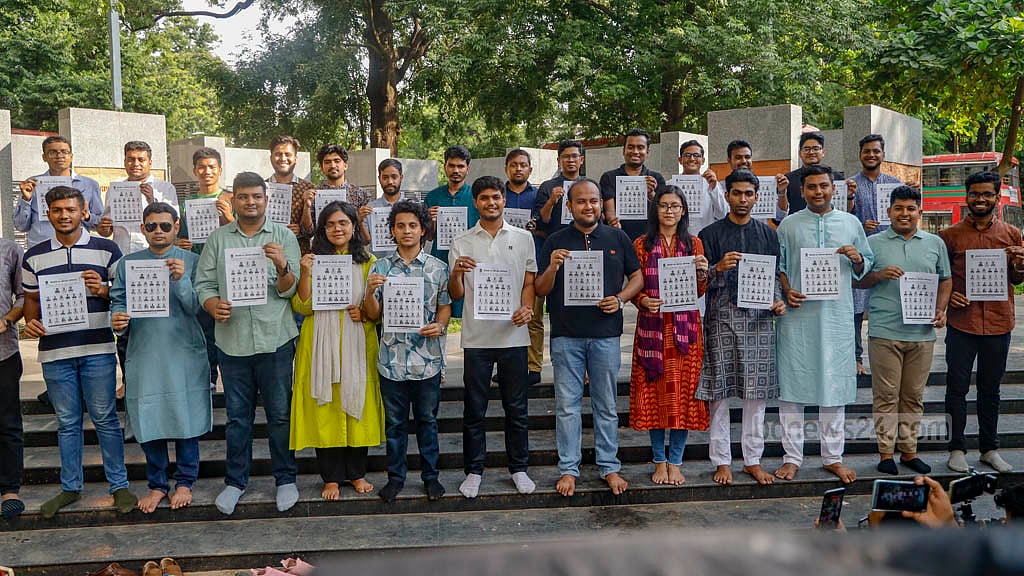
JCD named the following candidates for the 12 secretary posts in DUCSU:
Ariful Islam — Liberation War and Democratic Movements
Ehsanul Islam — Science and Technology
Chemon Faria Islam Meghla — Common Room, Reading Rooms and Cafeteria
Md Mehedi Hasan — International Affairs
Abu Hayat Md Zulfiqar Zisan — Literature and Culture
Chim Chimmya Chakma — Sports
Md Saif Ullah (Saif) — Student Transport
Syed Imam Hasan Anik — Social Service
Md Arkanul Islam Rupok — Career Development
Anwar Hossain — Health and Environment
Md Mehedi Hasan Munna — Human Rights and Law
JCD said the Research and Publications secretary post would be left vacant in honour of Sanjida Ahmed Tonvi, who was injured in the July movement.
For DUCSU member posts, it nominated Md Zarif Rahman, Mahmudul Hasan, Nahid Hasan, Md Hasibur Rahman Sakib, Md Shamim Rana, Yasin Arafat Alif, Munim Hasan Arup, Ranjan Roy, Sowaib Islam Omi, Mehrunnesa Keya, Ibnu Ahmed, Shamsul Haque Anan and Nityananda Pal.