Published : 09 Apr 2026, 07:53 AM
Updated : 21 Aug 2026, 03:34 PM


Abdul Khalek, a resident of Mohammadpur in Dhaka, relies on liquefied petroleum gas (LPG) for cooking.
Long frustrated by persistent supply issues, he now faces further distress as prices continue to exceed government-fixed rates.
Even after a steep hike of Tk 387 in the price of a 12kg LPG cylinder, Khalek said he is unable to purchase gas at the official rate.
The sharp increase has already angered consumers, but the situation is worsened by what he described as ongoing “hide-and-seek” by retailers over availability.
“Now they cite war as the reason for the crisis. But even before that, gas was scarce. Shopkeepers charged whatever they wanted,” Khalek said.
“Even after the government increased prices, we are not getting gas at that rate. A 12kg cylinder costs no less than Tk 2,100 to Tk 2,200 anywhere.”
In December, when prices began rising on the pretext of supply shortages, the government launched enforcement drives.
In response, LPG cylinders disappeared from the market and traders went on strike.
The interim government eventually withdrew the drives, after which prices surged beyond double and the crisis deepened.
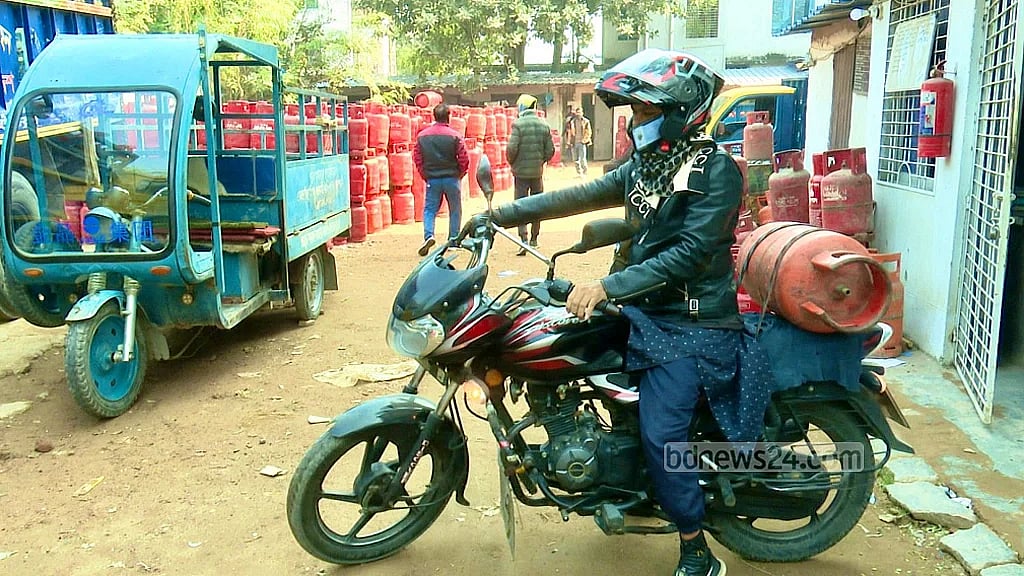
Despite subsequent measures -- including allowing imports on credit, increasing import quotas, and offering incentives -- the supply situation did not normalise.
Consumers continued to report paying above official rates.
In January and February, prices were increased again.
Although supply of the widely used 12kg cylinders to households and restaurants gradually improved, complaints of overpricing persisted.
On Thursday, the Bangladesh Energy Regulatory Commission (BERC) raised the price of a 12kg LPG cylinder from Tk 1,341 to Tk 1,728 -- an increase of Tk 387.
The adjustment reflects a per kilogram rise of Tk 32.30 across all cylinder sizes.
Yet consumers say the burden has not eased.
They are still paying an additional Tk 400-500 per cylinder above the official rate.
There appears to be a stark disconnect among retailers, distributors, dealers and companies, each blaming the other for the price discrepancy.
Meanwhile, BERC, despite being aware of consumer complaints, has remained largely inactive.
BERC Chairman Jalal Ahmed said the commission is already struggling to regulate petrol pumps, making LPG market monitoring “challenging”.
However, he said they would engage with importers and suppliers to try to “coordinate the situation” in the coming days.
Khalek expressed frustration that a cylinder previously available at Tk 1,700 now costs Tk 2,100-2,200, despite the new official price being set at Tk 1,728.
“The government says there is no shortage, but when we go to buy, we pay much more than the set price. Does the government not see this? Who is actually running the country?” he said.
He questioned the purpose of fixing prices if authorities cannot prevent what he described as “anarchy” in the market.
Retailers claim they are helpless.
"We cannot get gas from suppliers at the government rate. We are forced to buy at higher prices, so we must sell higher," a local shopkeeper said.
In response, the LPG Operators Association insists that no company is selling above the official rate, blaming intermediaries -- particularly dealers -- for manipulating the market.
While some dealers deny charging extra, others admit there is “some gap” in pricing.
‘Pay What They Ask’
Monirul Islam, a resident of West Shewrapara, said while gas was unavailable even at high prices during December and January, it is now available -- but only at an exorbitant cost.
"Those of us without piped gas connections have no choice in this city. We have to pay whatever is asked; you can’t go days without cooking," he said.
"We are essentially hostages. Last month, I bought a 12kg cylinder for Tk 1,500–1,600. Now it’s Tk 2,100–2,200. The moment the government raised the official rate, the ‘extra’ black-market premium jumped as well."
Saiful Alam, proprietor of Alif Lam Traders in the same area, confirmed he is charging Tk 2,100 for a Petromax 12kg refill.
When questioned about the discrepancy with the official rate, he argued: "We are buying it ourselves for Tk 1,775. After adding transport costs, we cannot break even without selling at this price."
Similar stories echo across the city.
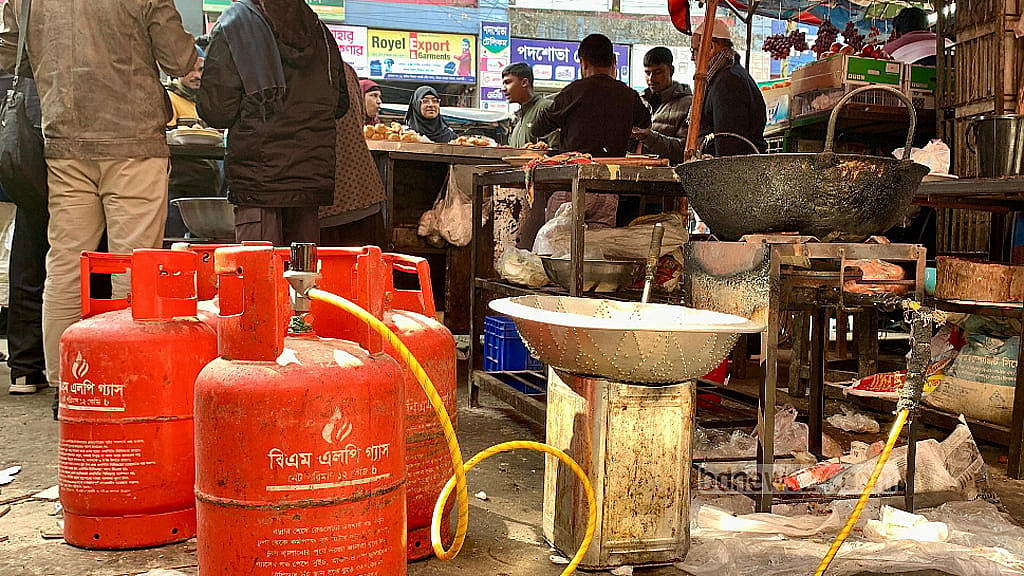
Mumtaz Begum, a tea-stall owner on Tajmahal Road, paid Tk 2,100 in cash, noting that vendors no longer offer credit.
In the Krishi Market area, Enamul Huq of Enam Enterprise sells Bashundhara cylinders for Tk 2,200.
"I sell based on what I pay. If I can't buy at the government rate, how can I sell at it?" he asked.
In Shyamali, Jahirul Islam of Messrs Bismillah Enterprise reacted with anger toward the authorities.
"The government says many things. Tell them to give it to me cheaper first. I challenge them to check my vouchers and see what I pay versus what I charge."
He delivers TotalGas cylinders to doorsteps for Tk 2,100.
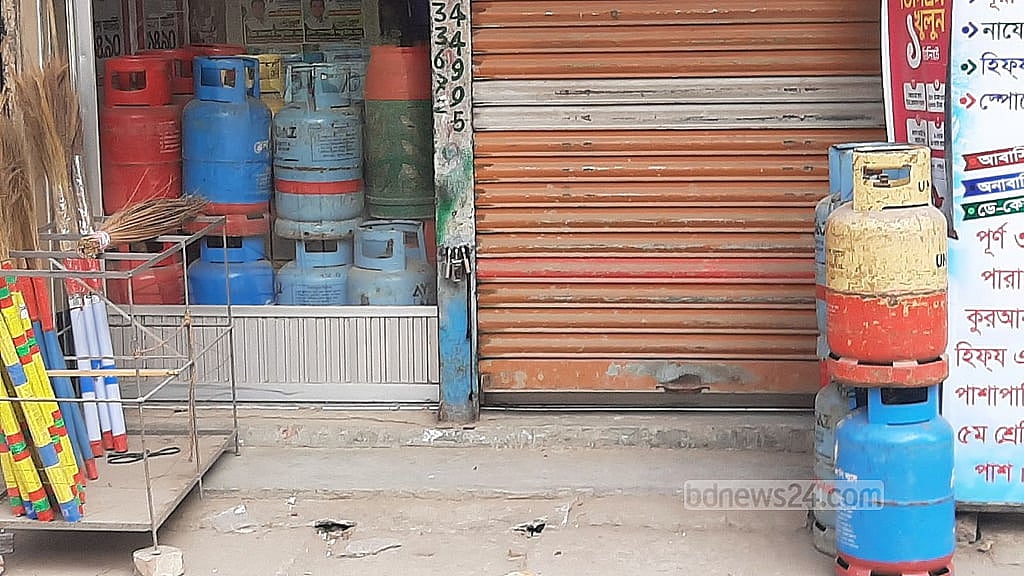
Dealer-Operator Deadlock
The finger-pointing extends to the supply chain.
A dealer in Demra admitted the situation was "bad" but refused to disclose specific figures.
Meanwhile, Ashim Roy, a representative for BM LPG in Munshiganj, claimed they sell at the official rate, but transport costs inflate the final retail price.
"There is a gap," he admitted. "Distributors add costs that eventually fall on the consumer."
However, Mohammad Amirul Huq, president of the LPG Operators Association of Bangladesh, categorically denied that companies are overcharging.
"Go check any of the 17 plants. Not a single company is taking an extra taka," he insisted.
He claimed companies even provide an "inbuilt commission" so dealers can profit while selling at the official rate.
Amirul Huq, also the managing director of Delta LPG Ltd, blamed a lack of field-level monitoring.
"Where are the Directorate of National Consumer Rights Protection and the local administrations? If a dealer claims they are buying at high prices, check their invoices.
Punish five people, and the rest will fall in line."
He noted that with 15,000 retailers and 200 dealers nationwide, the market remains at the mercy of middlemen.
A 'Criminal' Lack of Enforcement
According to BERC data, Bangladesh is almost entirely import-dependent, requiring 120,000–130,000 tonnes of LPG monthly.
Despite this, consumers are left unprotected.
A Bashundhara LPG representative said they charge Tk 1,820 -- above the official rate -- citing "delivery charges" applicable to Bashundhara Residential Area.
Jasim Uddin Bahar, head of sales at Universal LPG, also deflected blame, suggesting "groundwork" is needed to understand why retailers hike prices.
Energy expert Prof M Shamsul Alam labelled the entire pricing process "illegal".
He pointed out that BERC is violating its own mandate by skipping the legally required public hearings for price adjustments -- a practice a court ordered them to follow in 2021.
"BERC is committing an offence by bypassing public hearings, and its licensees are committing offences due to BERC’s inaction," Shamsul said.
He cited Sections 42 and 43 of the BERC Act, which prescribe jail time and fines for defying the commission's orders or laws.
"By failing to cancel licences or impose penalties, BERC is effectively sheltering dishonest businesses and turning LPG into a corrupt trade."
BERC Chairman Jalal Ahmed admitted the market is currently "uncontrolled".
While acknowledging that importers and dealers claim rising trade and transport costs, he said April would remain "critical".
He promised to sit with all stakeholders soon to "attempt to coordinate" the situation.