Published : 17 Nov 2025, 06:42 AM
Updated : 21 Aug 2026, 02:44 PM


The prosecution has produced a total of 54 witnesses in court to prove charges against ousted prime minister Sheikh Hasina and two others in the case filed over crimes against humanity committed during the July Uprising last year.
The witnesses included former police chief Chowdhury Abdullah Al-Mamun, who appeared before the International Crimes Tribunal as a state witness.
Late author, researcher, and Marxist theorist Badruddin Umar had also submitted a written deposition to the International Crimes Tribunal before his death last September.
The charge sheet in the case brought five allegations and incorporated 81 witnesses, including two advisors to the interim government. The tribunal heard the testimonies of 54 witnesses.
Alongside the witness depositions, the prosecution also played in court several conversations in which Hasina allegedly gave “direct instructions” to suppress the July Uprising and open fire on protesters. A forensic expert also testified before the court.
The list of witnesses also included Mokbul Hossain, the father of Abu Sayed, who was killed in Rangpur in a daring one-man confrontation with police; several injured protesters, including Khokon Chandra Barman and Abdullah Al Imran; Nahid Islam, convener of the National Citizen Party (NCP) and a frontline leader of the July movement; and Mahmudur Rahman, editor of the Bangla daily Amar Desh.
The ICT-1 framed charges against Hasina and two others on July 10, opening the trial proceedings.
The allegations levelled in the charge sheet against the suspects include instigating, provoking, and directing the killing of 1,400 people. The allegations also concern charges such as “superior command responsibility” and “joint criminal enterprise”.
Alongside Hasina, former home minister Asaduzzaman Khan Kamal and former IGP Mamun stand accused in the case. Mamun has confessed to the crime and turned state witness.
On Aug 3, Khokon Chandra Barman, who was shot in Dhaka’s Jatrabari during the July movement, appeared before the tribunal and demanded the maximum punishment for Sheikh Hasina, baring his disfigured face to all present during the hearing.
The 23-year-old youth has lost his left eye, and his nose and facial structure were severely damaged. His complicated injuries required him to travel to Russia for treatment.
Khokon was shot on Aug 5, the day Hasina was ousted from power.
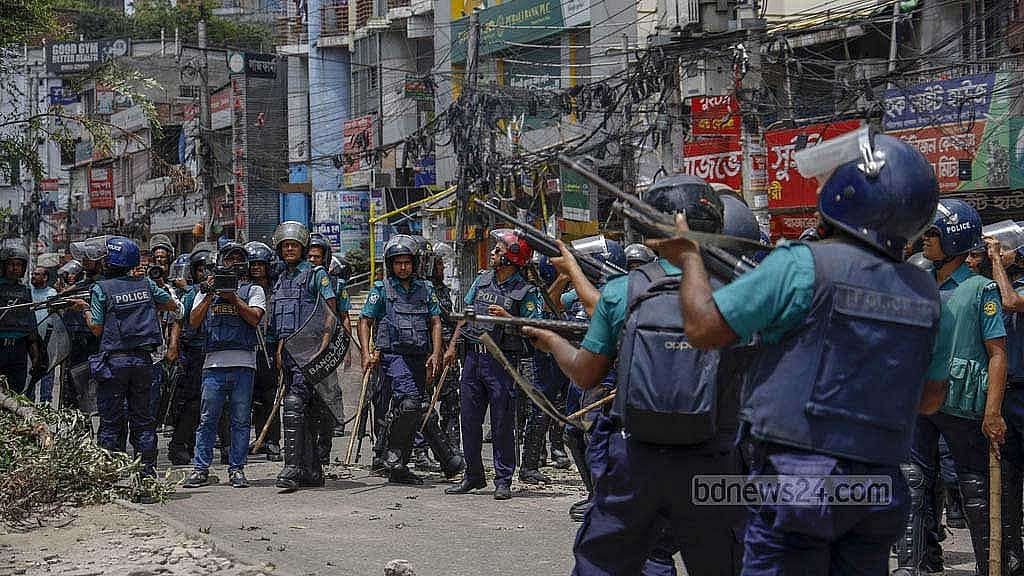
Khokon recalled before the court, after the Army withdrew, police emerged and started firing indiscriminately at them as if they were “shooting at birds”. The crowd of protesters scrambled to take cover when Khokon tried to hide behind a pillar under the Jatrabari Flyover.
At one point, police approached and “targeted” them with gunfire, Khokon told the court. Most of those hiding were shot. Khokon took shelter behind a drum under the flyover. An officer saw him and aimed the gun at his head; the bullet hit him in the face.
Khokon said he screamed in agony and never thought he would survive.
He then removed his mask in the court, baring his disfigured face.
Some students had rushed to help Khokon, taken his phone from his pocket, and informed his family. Khokon was taken to Mugda Hospital, from where he was referred to Dhaka Medical College Hospital for advanced treatment. Khokon was later sent to Mirpur Dental Hospital, where he began his long recovery.
Mokbul, the father of Abu Sayed, silently wept as the video footage showing his son’s final moments as he was being shot by the police played before the court during his deposition. Sayed was killed on Aug 28, 2024.
He told the tribunal he wished to see justice for his son before he died.
Mahfuzur Rahman, a physician at the National Institute of Neurosciences and Hospital, testified on Aug 20, saying the “detective police pressured him not to treat injured protesters.”
“When the number of patients grew on the 19th of July, the DB officers pressured me not to admit new gunshot victims. They warned me against being overenthusiastic to avoid getting into trouble,” the physician said.
The police also ordered the doctor not to release admitted patients, adding that they had instructions from higher authorities to take legal action against them.
Mahfuzur said they had to “tactically” record gunshot wounds as road accidents or other injuries in the admission register to ensure that people in need of treatment get it.
“The injured were aged between 13 and 30; most of them were students,” said Mahfuzur.
NCP convener Nahid Islam testified on Sept 17, describing his role in leading the July Uprising from the frontlines.
Hasina took a stance in favour of the quota system by calling student protesters “children and grandchildren of Razakars” at a press conference on the night of Jul 14, Nahid told the court.
Hasina’s branding of the protesters effectively legitimised attacks on them, he said.
“We have always seen that whenever a legitimate movement was waged against the government, protesters were branded as ‘Razakars’ to undermine their legitimacy. Her remarks deeply humiliated students across the country.”
On Jul 18, 2024, Nahid told the court that students from all over Bangladesh took to the streets, and movement leaders faced threats to their lives, forcing them into hiding to avoid arrest.
The case’s investigation officer, Md Alamgir, told the tribunal on Sept 29 the police fired “305,000 rounds of bullets” to suppress the July Uprising.
He said he received a memo from Police Headquarters on Jan 25, providing a report on weapons and ammunition used against protesters.
The document stated that, in Dhaka alone, 95,313 rounds of bullets were fired from LMGs, SMGs, Chinese rifles, shotguns, revolvers, and pistols. Across the country, the total number of bullets fired was 305,311 rounds.
Citing the UN report published on the July Uprising suppression, Amar Desh Editor Mahmudur Rahman on Sept 16 told the tribunal: “Sheikh Hasina had ordered killings and enforced disappearances during the Students Against Discrimination movement in July–August.”
He said the UN findings showed that mass killings were carried out under direct instructions from Hasina and senior officials, and they all bear the liability under the doctrine of command responsibility.
Mahmudur said that, after the Second World War, considering the genocide committed in Germany, especially against the Jewish community, the world raised the slogan "Never Again". This meant that cruel "fascists" must never return to power.
“People in Bangladesh, after surviving 15 years of corruption and crimes against humanity under Sheikh Hasina’s rule, expect that such "fascist" governance can never return,” he told the tribunal.