Home
+
Published : 18 Oct 2024, 02:20 AM
Following three years of continuous erosion, a recent report by an expert committee has identified several causes behind the deterioration of Cox's Bazar beach and proposed solutions.
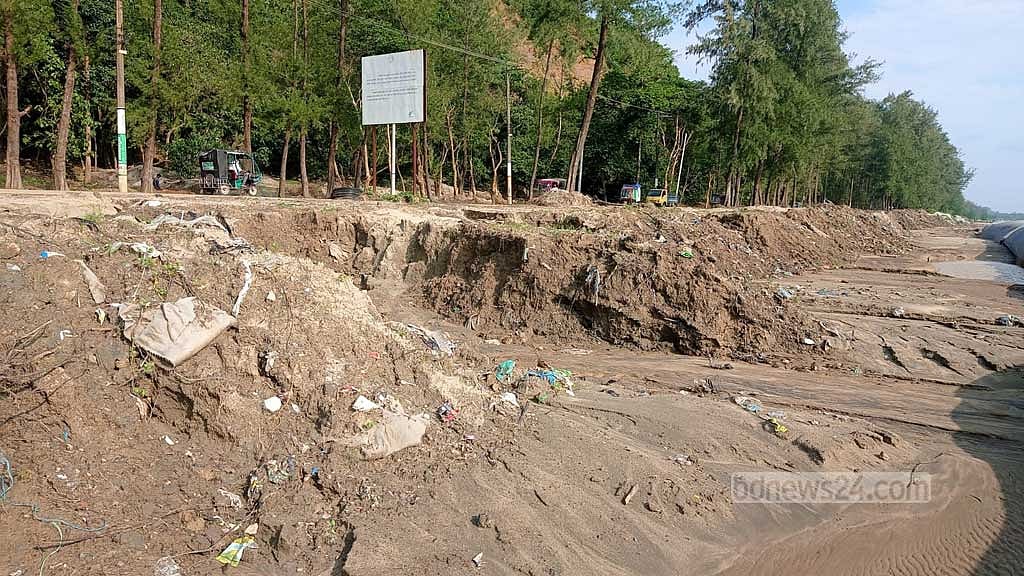
The ongoing erosion in Cox's Bazar, particularly from August 2022 onwards, has led to the beach areas being lost, roads washed away, and dams and structures damaged.
The latest phase of erosion in September 2023, after a week of heavy rainfall and flash floods, caused substantial damage to approximately five kilometres of the beach.
A team of experts from the Bangladesh Oceanographic Research Institute, or BORI, conducted an inspection and highlighted the primary causes. They provided recommendations for remedial action that could pave the way for solutions to the problem.
In August 2022, for the first time, large-scale erosion was noticed along the beach.
The following year, erosion from the tidal waves in the same month washed away two kilometres of the Marine Drive. This year, the erosion began in September after seven consecutive days of heavy rainfall and flash floods, which damaged approximately five kilometres of the beach, causing several sections to be cut off.
However, this time, a report from an expert committee has identified some of the causes of this erosion and provided recommendations for remedial action that could pave the way for solutions to the problem.
As Cox's Bazar's eastern side is surrounded by hills, flash floods and landslides caused by hill torrents are a regular occurrence during the rainy season.
However, this year's flood, which lasted longer than those of the previous ten years, caused widespread erosion along the beach, prompting an on-site investigation.
Following three consecutive years of erosion, BORI formed a six-member expert team under the Environmental Oceanography and Climate Division, or EOCD.
After inspecting erosion-prone areas, this team submitted a report highlighting the causes of the beach erosion and recommendations for mitigating the damage.
WHAT ARE THE CAUSES?
The expert team inspected the entire 80-kilometre-long Marine Drive road and the coastal area from Nazirartek to Teknaf.
They observed significant erosion at Sugandha, Laboni, Kolatoli, and President beach points, and from Dorianagar to Himchari along Marine Drive road.
In their report, the experts identified heavy rainfall and flooding caused by hill torrents as the primary reasons for this year's beach erosion.
Between Sept 13 and 15, Cox’s Bazar recorded 167.36mm, 332.76mm, and 126.25mm of rainfall, respectively. Due to this heavy rain, significant landslides occurred in the area from Himchari to Dorianagar between Sept 13 and 17.
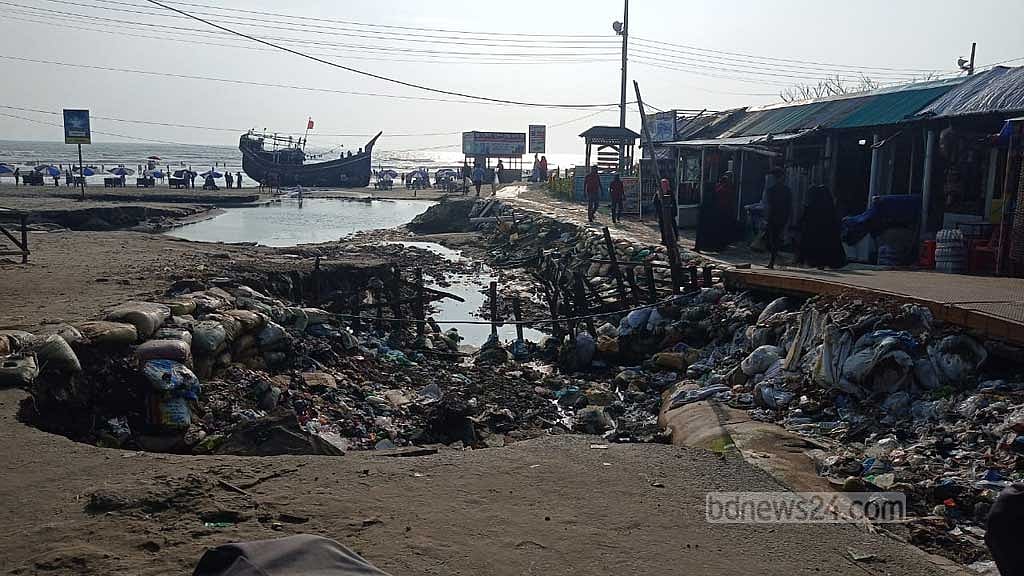
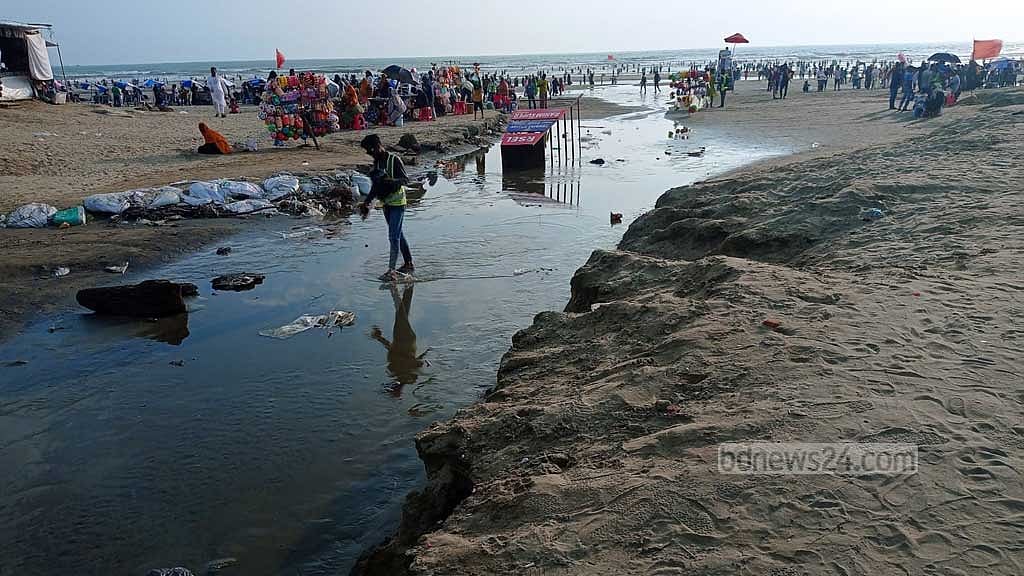
Speaking to bdnews24.com, Abu Sharif Md Mahbub E Kibria, the head of the expert team and senior scientific officer at BORI, said: “At Kolatoli beach, we found plastic, polythene, and even bricks and debris under the sand. Water from Cox's Bazar town is flowing into the sea along this beach, but there is no drainage system there.”
Their investigation revealed that the beach could not handle the water flow when it moved towards the sea through Kolatoli.
Because plastic, polythene, bricks, and debris were buried under the sand, the beach was not attached to the waterway, which caused erosion, causing the adjacent drainage to collapse.
BROKEN DRAINAGE SYSTEM AND URBAN WATERFLOW
Asif Ahmed, the executive engineer of the Cox’s Bazar Water Development Board, or WDB, said: “Previously, the town's water used to flow into the Bakkhali River through the Sugandha point, but now the drainage system is damaged. As a result, water from the town is flowing directly into the sea via Kolatoli beach, which is the main reason for last month’s flood and the beach erosion around Kolatoli and surrounding areas.”
Senior Scientific Officer Mohammad Zakaria of the BORI told bdnews24.com: “Due to the hills, Cox’s Bazar experiences heavy rainfall. Previously, some natural streams from the eastern hills would help drain the water into the sea via the beach. However, in recent years, the importance of preserving these streams during development projects has been overlooked. Most of the streams have been blocked, and those that remain have reduced capacity due to the town's waste.”
When hill torrents occur, the water now flows directly over the beach into the sea, which Zakaria believes is a significant contributor to the erosion.
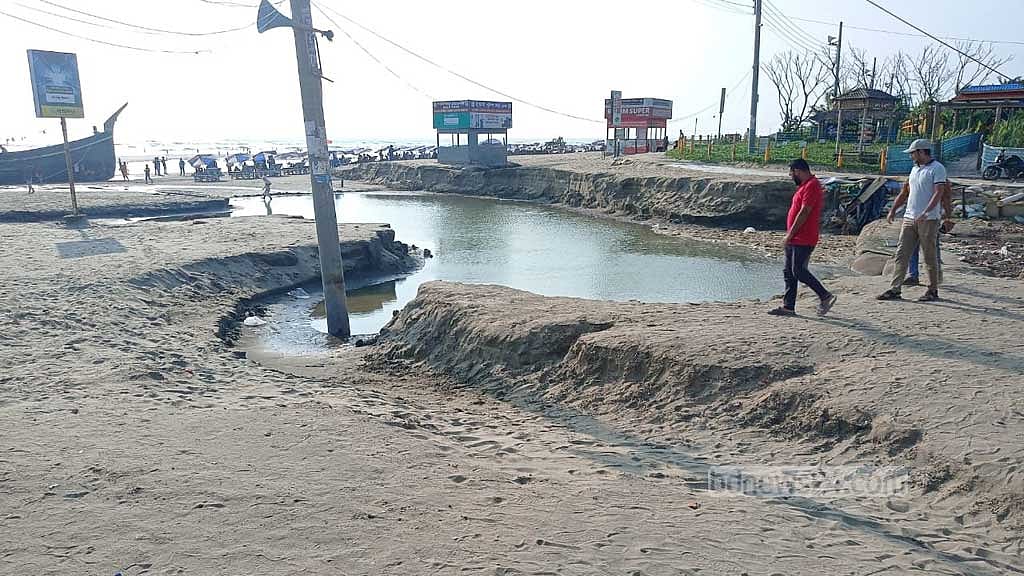
MIXED SOIL COMPOSITION OF SUGANDHA POINT
Addressing the specific case of erosion at Sugandha Point, Sharif noted: “We found a mixture of sand and clay at the beach. There is a drainage system near the concrete road next to the beach, but the wall of that system has collapsed due to the pressure of the water.”
From Dorianagar to Himchari, the soil is soft, and during continuous rain, large trees often fall from the hills, causing landslides in this area.
“The soil here has a low binding capacity, causing landslides. And since the beach in this part is relatively low, hill torrents flow into the sea here, triggering further erosion,” he added.
DESTRUCTION OF SAND DUNES WORSENING DAMAGE
Mohammad Zakaria, a senior scientific officer at BORI, believes the inability to protect the coastal dunes is another major reason for beach erosion.
He said, “The natural defence system, such as the plants on the beach, has been destroyed in various ways. Sea creeper usually grows in the first stage of the beach. However, planting casuarina trees there does not help but rather causes damage.”
In this regard, Sharif said: “The fibrous roots of casuarina trees cause them to easily uproot, making it difficult for the beach to hold sand. This leads to the reduction of dunes. On the other hand, the roots of sea creepers spread like a spider’s web in the beach soil, which helps prevent erosion.”
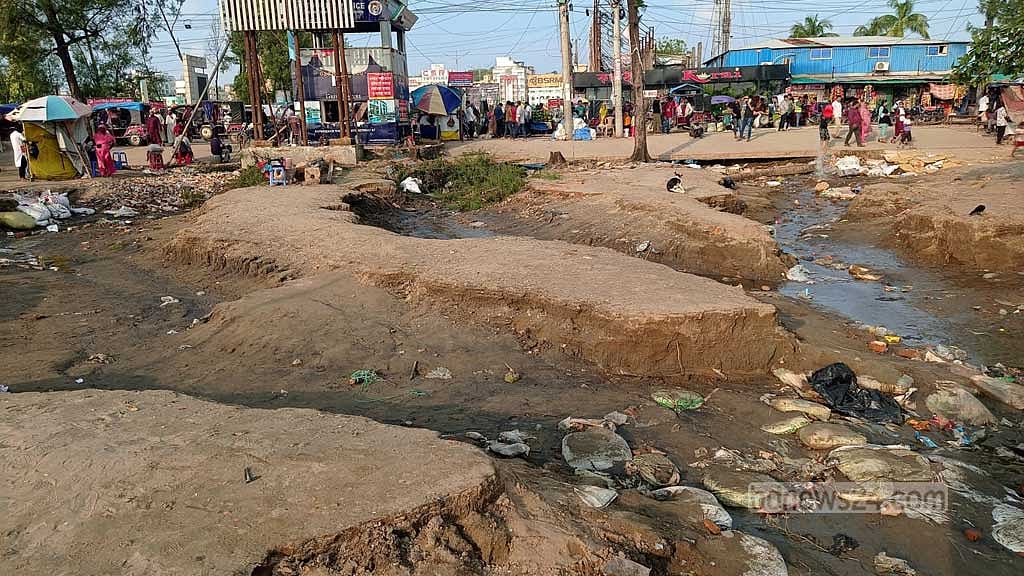
HIGHER TIDES SWALLOWING THE BEACH
On Aug 16, 2022, a low-pressure system over the sea caused tides in Cox's Bazar to rise five to six feet higher than normal.
During the full moon tide, about 300-350 feet of the beach at Kolatoli, Sugandha, Seagull, Laboni, and Shaibal points were submerged, and geo bags along the shore were washed away.
After the water receded, the eroded beach became visible in those areas.
BORI Senior Scientific Officer Zakaria said, “During the monsoon, the sea water level is already two to three metres higher than at other times. The tide rises so high that it crosses the beach and the casuarina forest, reaching the road by the shore.”
Cox's Bazar WDB’s executive engineer Asif said: “Usually, sand accumulates on the beach during the winter and gets washed away into the sea during the monsoon. Due to excessive rainfall and higher tides, more sand than usual is being washed away during the monsoon. I believe this is the main reason for beach erosion.”
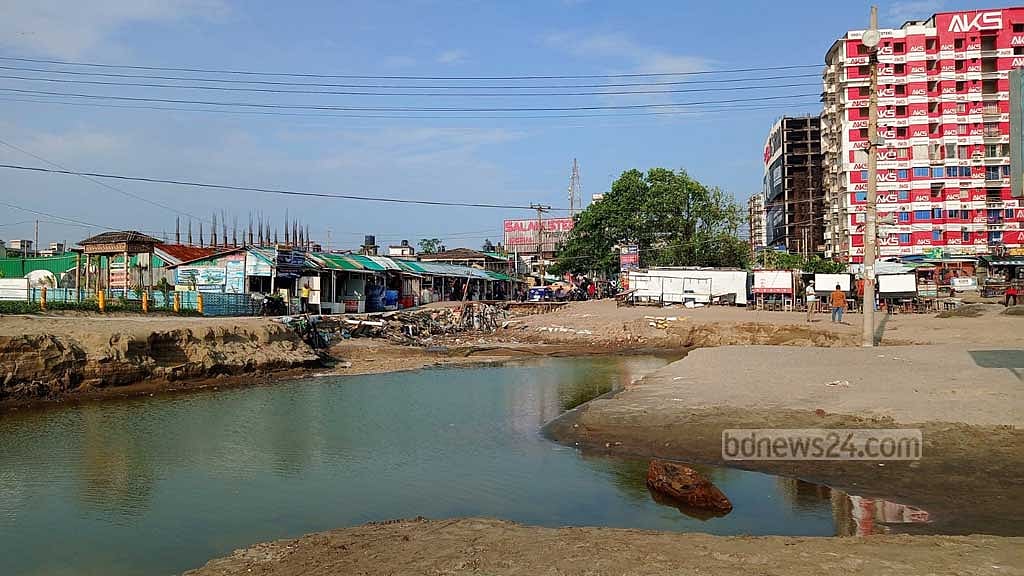
WHAT CAN BE DONE TO PROTECT THE BEACH?
Experts have recommended three types of protection measures to prevent erosion along approximately 80 kilometres of Cox's Bazar's beach. These include:
The report suggests these steps would make the area more attractive to tourists.
The BORI expert team head Sharif emphasised that the key to natural protection is the scientific development of coastal vegetation.
He explained that in the first stage of coastal vegetation, creeping plants like Sagor Lata should be grown. The second stage should include shrubs like Nishida, Keya, and Akanda, and the third stage should consist of trees like Hijol, Tamal, and Jhau or Casuarina.
He explained, “Plants like Sagor lata help build sand dunes and play an effective role in preventing erosion. However, there is a trend of planting casuarina trees in the first stage, which is ineffective. Casuarina’s roots do not spread widely in sand dunes, making it unable to hold onto the dunes. These trees are easily uprooted even by mild tidal surges.”
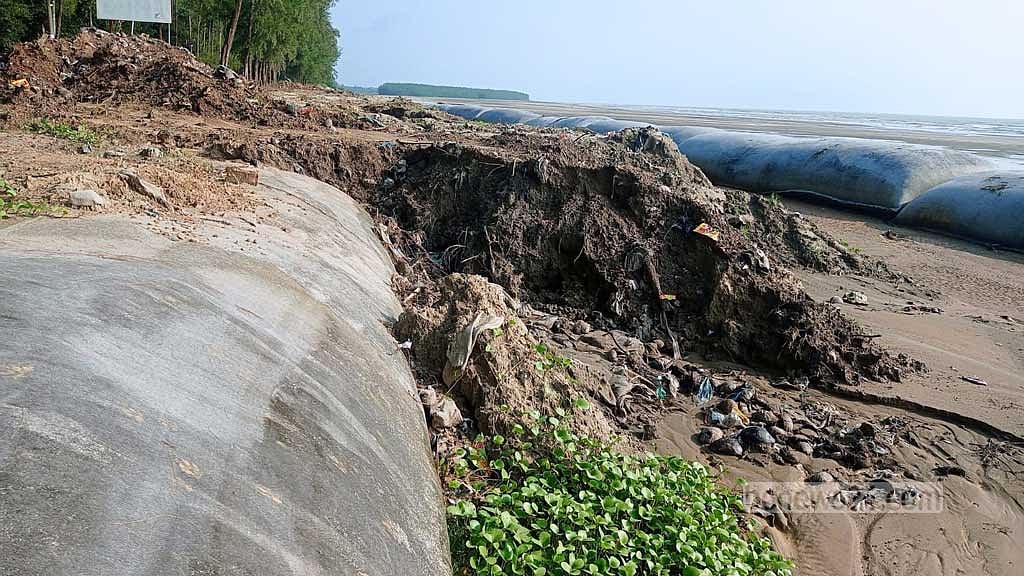
The expert report also recommends planting ulu grass as a natural protective element to prevent landslides and soil erosion.
Cox's Bazar WDB Executive Engineer Asif said, “We have already discussed with the forest department the need to follow scientific methods for planting vegetation to protect the beach.”
Ahmed further suggested that the initial focus should be on semi-engineering solutions rather than large infrastructure projects.
The expert committee's report also proposed protecting the drainage system and infrastructure at Kolatoli, Sugandha, and Marine Drive areas to prevent beach erosion.
The expert head Sharif said, “We need to build drainage systems at Kolatoli that do not collapse easily. It is crucial to prevent the disposal of polythene, bricks, and plastic from the municipal area into the beach and to ensure that drainage waste does not end up on the shore.”
The report recommends removing plastic from drains, especially near Sugandha, and regularly maintaining the drainage system.
It also suggests planting trees at the junction of the road and beach at Sugandha Point to naturally prevent erosion.
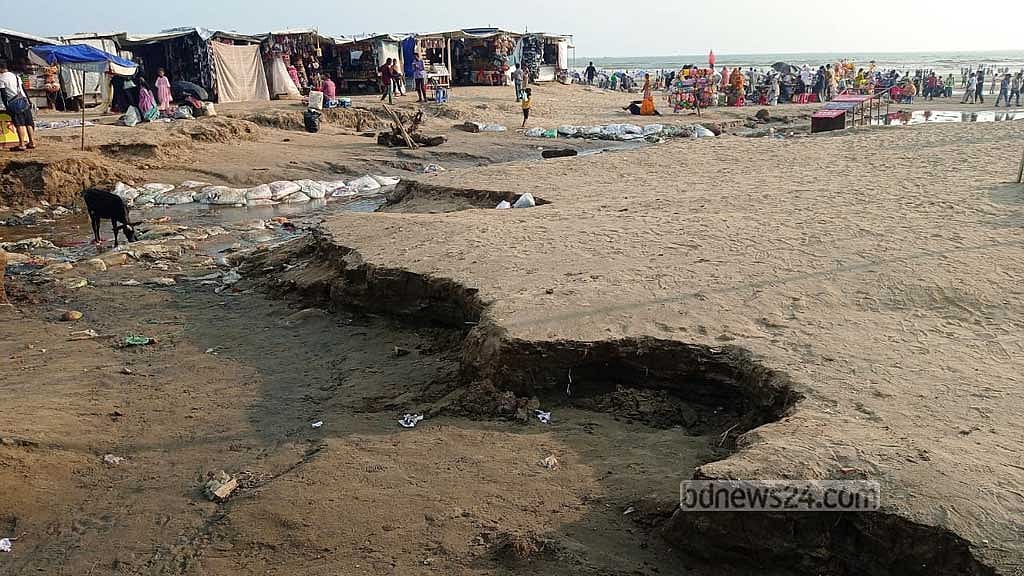
For the Marine Drive area, experts recommend creating channels to allow water to drain properly and prevent flooding.
Ahmed further said that the district administration has formed a committee to determine the necessary steps to prevent erosion, with the involvement of relevant organisations such as the Roads and Highways Department, the municipality, and the Cox’s Bazar Development Authority. The goal is to develop a coordinated drainage system to allow water to flow smoothly.
The expert report also calls for identifying landslide-prone areas in Cox’s Bazar and taking preventive measures, identifying the locations and paths of mountain streams, building protective walls, constructing culverts where necessary, using satellite and remote sensing technology to stop deforestation, and enforcing laws to prevent sand theft from the beach.
[Writing in English by Arshi Fatiha Quazi]