Published : 31 Dec 2025, 04:57 AM
Updated : 21 Aug 2026, 02:57 PM


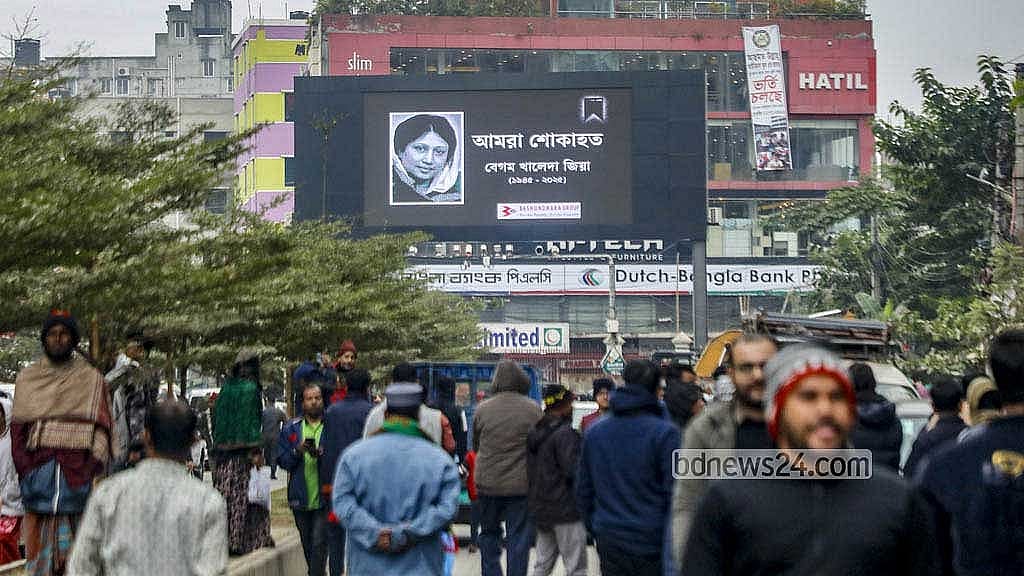
The nation has come together in grief to remember Khaleda Zia, a leader who combined political acumen with steadfast determination. From her role in ending military rule to championing democratic values, she leaves behind a legacy that resonates far beyond the BNP or parliamentary corridors.
The death of Khaleda, Bangladesh’s first female prime minister, drew an outpouring of condolences from people across society, who prayed for her departed soul and paid tribute to her role in leading post-independence Bangladesh through times of crisis and struggle.
Condolence messages from parties, organisations, and individuals recalled Khaleda’s role in shaping the BNP after taking charge of the party in the 1980s, her contribution to the movement that toppled the military ruler, her ascent to the prime minister’s office on three occasions, and her continued engagement in democratic movements.
The messages were filled with love, respect, and gratitude.
Khaleda passed away at Evercare Hospital in Dhaka, where she had been under treatment for 40 days, on Tuesday morning. She was 79.
Parties, individuals and organisations thronged the BNP chairperson’s Gulshan office on Tuesday afternoon to meet her son Tarique Rahman, who returned just five days ago from a self-imposed exile of more than 17 years in London, to convey their condolences.
Jamaat-e-Islami chief Shafiqur Rahman in a condolence message on Facebook wrote, “May Almighty Allah, [the Lord], have mercy on Bangladesh’s former prime minister and BNP chairperson Khaleda Zia, forgive her, and accept her as a guest in her beloved Paradise.”
National Citizen Party Convenor Nahid Islam in a Facebook post recalled how Khaleda led the way to democracy by spearheading the anti-autocracy movement.
“She played an extraordinary role in establishing parliamentary democracy in Bangladesh following the mass uprising of the 1990s,” he wrote in his post.
He also remembered her long political career, marked with repeated imprisonments and numerous ups and downs. Yet she remained steadfast on her political ideals and the rights of the people, he said.
Saiful Haque, general secretary of the Revolutionary Workers’ Party of Bangladesh, said: “Under Khaleda Zia’s leadership, the BNP became a political party. Despite facing various personal hardships, family tragedies, and disasters, she played an uncompromising leadership role in the anti-Ershad movement, always answering the country’s call through the party.”
Even during Sheikh Hasina’s “misrule”, he said, Khaleda was a source of inspiration for protesters.
Liberal Democratic Party President retired colonel Oli Ahmed said in a condolence message, “Khaleda Zia’s contributions to the country’s Liberation War, the struggle to establish democracy, and the anti-autocracy movement will remain ever memorable. She was uncompromising on issues of the nation’s sovereignty.”
Ganosamhati Andolan Chief Coordinator Zonayed Saki and Executive Coordinator Abul Hasan Rubel sent a joint statement condoling Khaleda’s death.
“We are overwhelmed with grief at Khaleda Zia’s death like the rest of the country. She will remain a unique example in Bangladesh’s democratic struggle and governance,” the statement said.
Bangladesh Garment Manufacturers and Exporters Association (BGMEA) President Mahmud Hasan Khan condoled the passing of Khaleda.
“The country has lost a guardian and a time-tested patriotic leader,” he said.
Expressing condolences, business and professional bodies such as the Dhaka Stock Exchange, Dhaka Reporters Unity, Economic Reporters’ Forum, and Capital Market Journalists’ Forum described the former prime minister's demise as an "irreparable loss, a void that no one can fill".
Nagorik Oikya chief Mahmudur Rahman Manna said, “The uncompromising leader of democracy, Khaleda Zia, will forever be remembered by the nation for her contributions to restoring democracy in Bangladesh and leading the anti-autocracy movement.”
Ganatantrik Jukto Front leaders urged all to transform the “grief into strength and continue the struggle to realise the spirit of the Liberation War and the aspirations of the 1990 mass uprising”.
AB Party Chairman Mojibur Rahman Monju remembered Khaleda as a “guardian of the nation”.
Nationalist Democratic Movement Chairman Bobby Hajjaj, Jatiya Party (Kazi Zafar faction) Chairman Mostafa Jamal Haider, and Jatiya Party Chairman GM Quader in their condolence messages described the life of Khaleda as an important chapter in Bangladesh’s political history.
Condolence messages were also sent by Islami Andolan Bangladesh, Jatiya Samajtantrik Dal, Bangladesh Labour Party, Democratic Lawyers Association of Bangladesh, Jatiya Press Club, Federation of Bangladesh Chambers of Commerce and Industry, Dhaka Chamber of Commerce and Industry, Bangladesh Jeweler’s Association, Real Estate & Housing Association of Bangladesh, and Anti-discrimination Creative Publishers' Association.