Published : 22 Jul 2025, 08:10 AM
Updated : 21 Aug 2026, 01:33 PM


Having completed all phases of his Bangladesh Air Force training, Flight Lieutenant Towkir Islam was flying solo over Dhaka skies in an F-7BGI fighter jet.
But his final mission ended in one of the deadliest air disasters in the country’s history -- a fiery crash into a school building that killed at least 20 people, most of them schoolchildren.
The jet went down Monday afternoon near Shahjalal International Airport, slamming into the campus of Milestone School and College in Diabari, Uttara. The Inter-Services Public Relations Directorate (ISPR) said the crash was caused by mechanical failure.
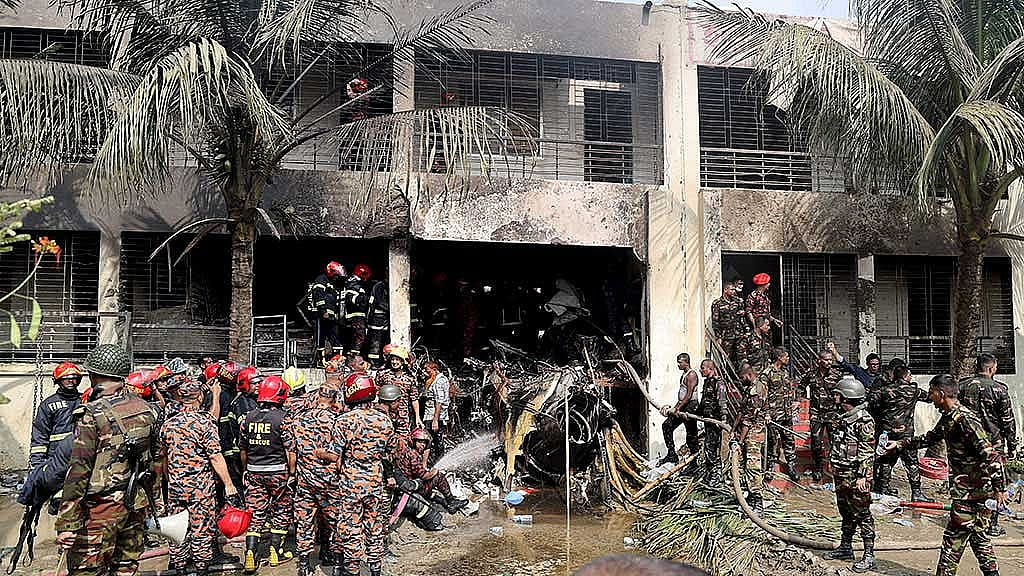
Witnesses described a harrowing scene as the jet scraped across the school grounds before smashing into a two-storey academic building and exploding into a fireball. Flames engulfed the structure in seconds.
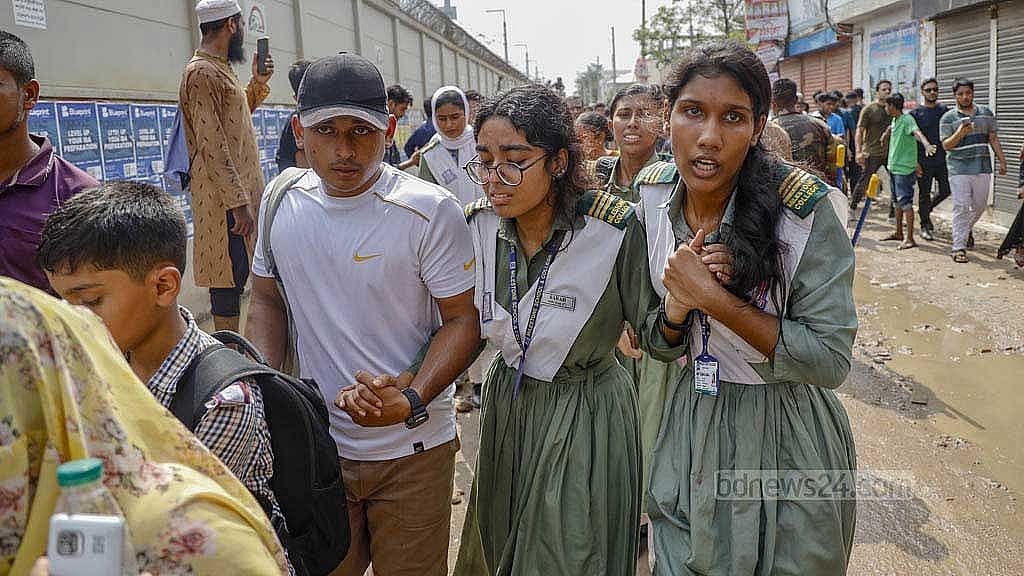
It was school closing time. Many parents were waiting near the building to pick up their children. When the jet hit, panic swept through the area, but the building’s exits were quickly blocked by debris and fire, trapping dozens inside.
Emergency crews rescued 171 people from the building over the next several hours. Most suffered serious burns. The majority of the injured were children, according to hospital officials.
Dr Shawon Bin Rahman, a resident surgeon at the National Institute of Burn and Plastic Surgery, told bdnews24.com: “Most of the burn victims are students. Many of them are in critical condition.”
The pilot, Towkir, did not survive the crash.
The government has declared Tuesday a national day of mourning. The national flag will be flown at half-mast on all government, semi-government and autonomous institutions, including schools and universities. All Bangladeshi missions abroad have also been instructed to observe mourning.
Special prayers are to be held at all religious institutions across the country for the deceased and the injured.
President Mohammed Shahabuddin, in a condolence message, expressed deep sorrow and prayed for the departed souls. He offered his sympathies to the grieving families.
Chief Advisor Muhammad Yunus also issued a statement calling the incident “an irreparable loss” to the nation.
“The loss suffered by the Air Force officer, Milestone School and College students, parents, teachers and staff, and others in this accident is irreparable. It is a moment of profound grief for the nation,” he said.
Yunus assured that the government would take all necessary measures to investigate the cause of the crash and ensure comprehensive support for the victims and their families.
WHAT HAPPENED?
The Inter-Services Public Relations (ISPR) said an F-7 BGI fighter jet of the Bangladesh Air Force crashed 12 minutes after takeoff at 1:06pm.
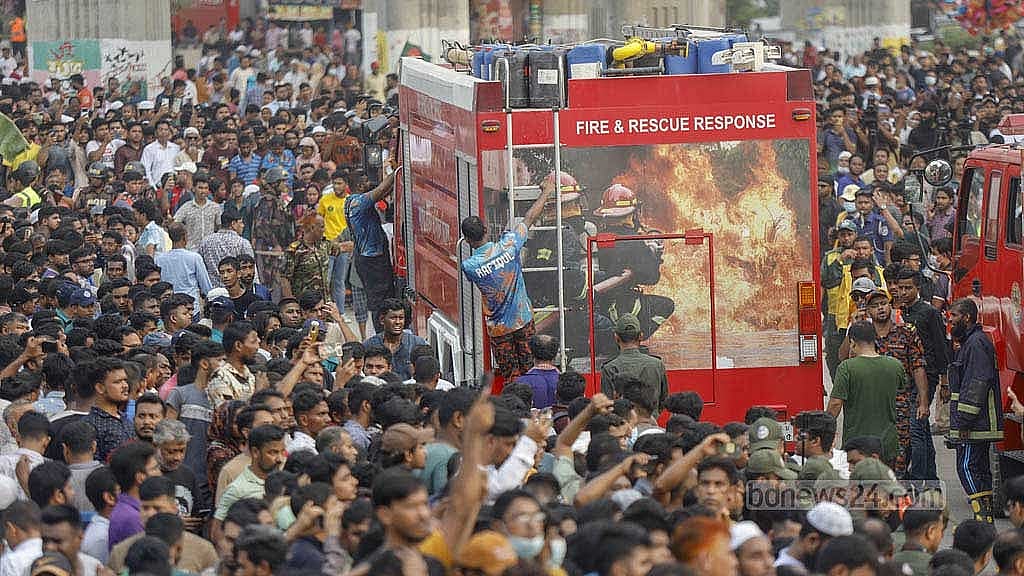
Immediately after the crash, the aircraft caught fire, as plumes of smoke rose into the air, visible from a great distance. Nine Fire Service units rushed to the scene to extinguish the blaze, later joined by members of the Border Guard Bangladesh (BGB).
Shah Bulbul, public relations officer of the institution, told bdnews24.com: “Classes were ongoing in that building. No one could escape the fire, and many were burnt inside.”
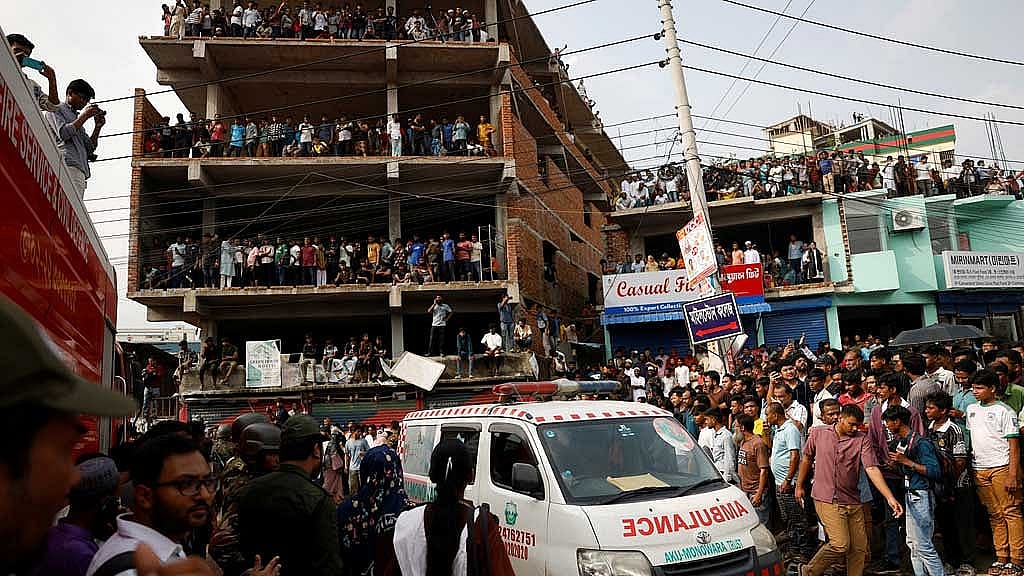
Injured and burn victims were seen being evacuated from the site by rickshaws, handcarts, and other vehicles. More than a dozen ambulances then transported them to hospitals.
Some victims were initially taken to Dhaka Combined Military Hospital (CMH), Crescent Hospital in Uttara, Uttara Modern Hospital, Kurmitola Medical College Hospital, Kuwait Maitree Hospital, and Lubna General Hospital and Cardiac Centre. Most burn victims were later transferred to the National Burn and Plastic Surgery Institute.
Brigadier General Muhammad Zahed Kamal, chief of Fire Service and Civil Defence, said at the scene around 4:30pm that his teams had recovered 19 bodies from the wreckage.
ISPR later confirmed that a total of 20 people died in the crash, including the pilot of the training aircraft.
Of the dead, 12 bodies are at the CMH, two at the Burn Institute, two at Kurmitola General Hospital, two at Lubna General Hospital and Cardiac Centre in Uttara, one at Dhaka Medical College, and one at Uttara Modern Hospital. Their identities have not yet been confirmed.
Chief Advisor’s Special Assistant Md Sayedur Rahman of the health ministry said seven of the dead could not be identified due to being completely charred.
At a press conference at the Burn Institute in the evening, he reported the deaths of 17 children. He explained the slight discrepancy in numbers was due to time needed for coordination.
Sayedur Rahman said, “Seven bodies remain unidentified. These are entirely remains of bodies. DNA samples are being taken.”
“Of these, six are at CMH and one is at Uttara Modern Hospital. Their identities will be determined from the remains.”
‘UNFORTUNATE’
According to ISPR, the pilot of the fighter jet caught in the accident made “every effort” to avoid greater damage.
ISPR said soon after take-off in the routine exercise, the aircraft developed a mechanical fault.
It said, to minimise casualties and damage, Towkir tried to steer the fighter jet away from densely populated areas toward a sparsely inhabited zone.
It added that “unfortunately” the aircraft crashed into a two-storey building of Milestone School and College in Diabari, Dhaka.
Rescue operations continued throughout the day in the area, and were declared complete by evening. At night, members of the armed forces were seen removing the wreckage of the crashed fighter jet using several pickup vans and covered trucks.
BYSTANDERS RECOUNT HORROR
Witnesses said they saw someone descending by parachute after the crash, while those inside the burning building were unreachable.
An eleventh-grade student who gave a single name, Kawsar, said the fighter jet crashed into the junior campus, home to Classes 5 through 8.
“Our younger brothers were all there. Everyone burned. We entered but couldn’t pull anyone out. The situation was terrible.”
Twelfth-grader Sadman Tanvir recalled hearing a loud explosion during class. “Everyone panicked. We rushed out to see flames engulfing Building 1. It looked like a part of the jet exploded in front of it,” he said.
“Thanks to the nearby fire station and Army camp, response was quick. But many people were still inside, especially small children.”
Latifa Begum, who lives near the school, said her niece in Grade 6 had just returned home, but others were still waiting outside for coaching classes when the jet crashed.
Mohammad Jaimat Ali, who runs a nearby excavator repair garage, said he and his colleague Apon Ahmed were stunned to see a jet flying abnormally low. Moments later, a deafening boom rang out. They ran toward the metro rail depot but saw smoke and flames billowing from the school.
“We saw someone landing with a parachute. Children and their parents were on fire. We tried to help, but the heat was unbearable,” Jaimat said.
“There was no way to get inside. We don’t know what happened to those trapped.”
Excavator operator Apon said they saw 10 to 15 children lying motionless.
“We couldn’t save them. Even the ones pulled out were severely burned -- everything from their clothes to schoolbags.”
The Army and Fire Service teams arrived soon after.
ANGUISHED CRIES
The two-storey building where the jet crashed was named Hyder Ali Building. At the time, the fourth and fifth grades of the English medium section were holding classes there. According to a ninth-grade student who only gave his first name, Shanto, about 150 students were attending coaching classes in that part of the institution.
The building housed a total of 16 classrooms spread across two floors, along with four teachers’ rooms, Shanto added.
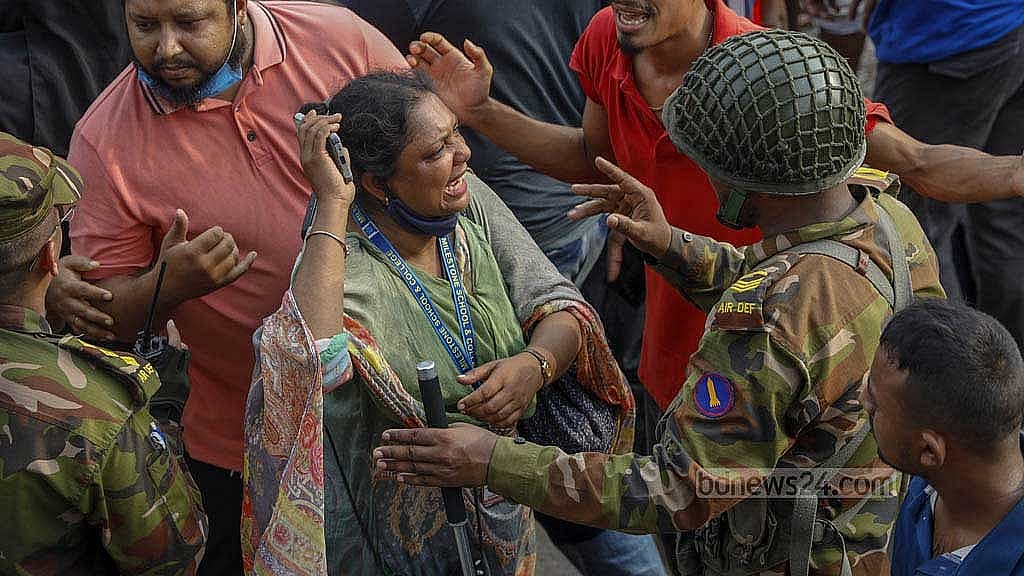
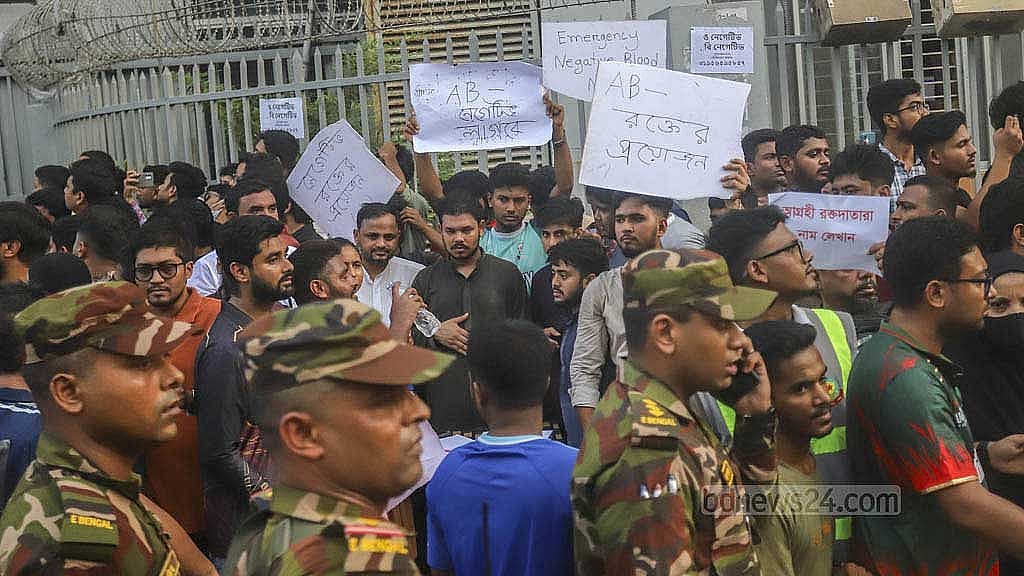
After the accident, some rushed to find their children, while others desperately sought news of dear friends. Members of the Rapid Action Battalion (RAB), Army, police, APBN, and Air Force struggled to control the chaotic crowd at the site.
Another fifth grader, known only as Arifa, was being searched for by her friend Hridoy Islam, but as of 5pm, there was still no trace.
He said, “I first heard about her from her mother. I want her back. Even if injured, at least if she comes back, it will be enough. So far, everyone rescued from inside has severe burns.”
Tania Ahmed was frantically searching for her daughter Raisa Ahmed, who remained missing. She repeatedly pleaded with security forces to allow her inside.
One ambulance after another sped away with sirens blaring, escorted by Army vehicles. Soldiers tried to manage the swelling crowd by blowing whistles.
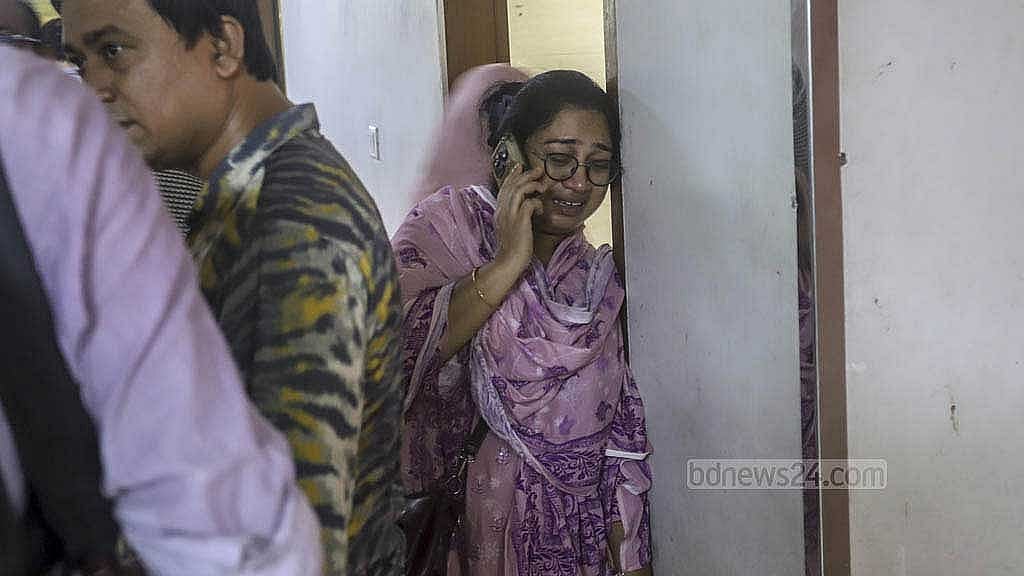
A woman was crying hysterically while talking on the phone, repeatedly asking the person on the other end, through tears: “Miss, where is my child?”
As she sobbed loudly, locals gathered at the school gate asked her the name and class of her child. She said her son’s name was Sajjad Saadi, a tenth-grade student.
Someone present tried to comfort her, saying: “Sister, please don’t worry at all. Nothing happened to the Class 10 students. We went inside. It’s mainly the fourth and fifth graders who were affected by the crash.”
That parent told bdnews24.com, “My son’s pretest exams are under way. He doesn’t have a phone; so much time has passed, but I haven’t heard anything from him. I came here somehow. I called his class teacher; she knows nothing. Other teachers couldn’t give any news either.”
Behind the building where the jet crashed, Fire Service personnel collected the aircraft’s wreckage. There, scorched remains of chairs, tables, and school bags were seen.
Ishraq Islam Imon, an eleventh-grade student of the institution, told bdnews24.com: “We were attending classes at another campus. After our class teacher informed us, we rushed here. When we arrived, we saw the fire burning.”
Even hours after the incident, the smell of burning remained. The scent of charred bodies and fuel spread some distance around the area.
Nixon, involved in the rescue operation, told bdnews24.com: “The jet fell in such a way that everything inside the building was burnt. We couldn’t even find the ceiling fan in the room. We recovered a bag, but it was reduced to charred coal.”
Meanwhile, after the crash, parents of students at Milestone School and College were thrown into panic. They began evacuating residential students from four hostels. Those whose families do not live in Dhaka have also gone to relatives’ homes.
WOUNDED CHILDREN
The National Burn and Plastic Surgery Institute has released a list of 39 people injured by burns in the crash. Most of the burn victims are aged between 10 and 13 years. 11 of them remain under intensive care.
Erickson and Mehrin suffered burns over their entire bodies. Two others -- 13-year-olds Nazia and Mahtab -- each have 80 percent burns.
Fifteen-year-old Makin has 62 percent burns, while 14-year-old Ayan and Masuma each have 60 percent burns.
Others include Tasnia with 35 percent burns, 11-year-old Arian with 55 percent, Ashraful Islam with 15 percent, Rohan 50 percent, Shreya 5 percent, Kabya 20 percent, Yusha 6 percent, and Rupi Boroa 6 percent burns.
Alongside them, Tasmiya has 5 percent, Zayana 8 percent, Saiba 8 percent, Payel 10 percent, Abir 20 percent, Kafi Ahmed 10 percent, Muntaha 5 percent, Albina 5 percent, and Nilo’s body bears 18 percent burns.
Parents waited anxiously outside the emergency department of the burn institute, their anguished cries filling the air.
Monica Akter Anki, mother of Arian, broke down in tears outside the emergency ward, pleading: “Allah, please bring my child back to me.”
“He went to school just before 8am. School was supposed to finish at 1:30pm, followed by coaching from 1:30 to 3:30pm. I gave him food in the morning, and then this happened.”
Their home is close to the school. Upon hearing the news, she rushed to the school to find her son, whom she later found severely burned.
Arian was first taken to Bangladesh Medical College Hospital and later referred to the burn institute for advanced treatment.
A resident of Sector 10, Uttara, Rubina Akter, aunt of seventh grader Shayan, said: “This morning, a healthy boy left home, and now he’s in hospital.”
Junaid’s mother, Jhorna Akter, was also crying outside the emergency unit. The Naya Nagar resident said her son was moved to the ICU.
“He would have gone home as soon as school finished, but now my son is in ICU,” she said.
Eleventh-grade student Saiyum Khan described the chaos during the incident.
“The junior shift starts in the morning. I was in class when suddenly there was a loud noise, then fire. The situation worsened quickly. Within moments, Army personnel arrived to start rescue operations, followed by the Fire Service.”
“An auntie said, ‘Please hold my daughter; both her hands are burnt.’ We then rushed her to the hospital.”
THREE CRASHES BEFORE
The F-7 BGI is a multi-role fighter jet based on the Chinese-built Chengdu J-7 series, which itself is a modernised version of the Soviet-era MiG-21. The aircraft is manufactured by Chengdu Aircraft Corporation.
The Bangladesh Air Force currently operates a fleet of 36 F-7 fighter jets. The majority of them are F-7 BGIs, along with variants such as the FT-7MB and F-7BG.
The I in BGI stands for “improved”, indicating an upgraded version of the earlier F-7BG model. It is based on the J-7G platform and was custom-built for Bangladesh.
In 2011, Bangladesh signed a deal with China to procure 16 of these jets, and they were formally inducted into the Air Force in 2013. That same year, Chengdu Aircraft Corporation ceased production of the model.
Compared to the F-7BG, the BGI version features several distinct upgrades. These include three multi-functional displays and a more powerful fire-control radar.
The single-engine aircraft can fly at a maximum speed of Mach 2.2 -- over twice the speed of sound. It is capable of carrying air-to-air missiles, laser-guided bombs, GPS-guided bombs, and additional fuel tanks, with a maximum payload capacity of 1,500kg.
The aircraft is operated by a single pilot. It uses a KLJ-6E radar and can fly at altitudes of up to 17,500m, or 57,420ft.
Monday’s crash was the third accident involving this model in Bangladesh.
In November 2018, an F-7BG trainer aircraft of the Air Force crashed during an exercise at the firing range in Rasulpur, Madhupur in Tangail. Wing Commander Arif Ahmed Dipu was killed in the incident.
Then in November 2021, an F-7MB crashed into the Bay of Bengal shortly after taking off from the Zahurul Haque Air Base in Chattogram. Flight Lieutenant Tahmid was killed in that crash.
Over the past three and a half decades, the Air Force has experienced 32 aircraft crashes. However, none of those incidents caused as many casualties as Monday’s.
The deadliest air crash on Bangladeshi soil remains the accident on August 5, 1984, when a Biman Bangladesh Airlines Fokker F27-600 crashed into a wetland near Dhaka airport amid poor weather. That crash claimed 49 lives.
Monday’s crash is now the second deadliest aviation disaster in Bangladesh’s history.
The ISPR has yet to confirm the exact cause of the accident.
A high-level probe committee has been formed by the Air Force to investigate the crash. ISPR said details will be made public once the investigation is complete.