Published : 07 Oct 2025, 08:54 AM
Updated : 21 Aug 2026, 02:33 PM


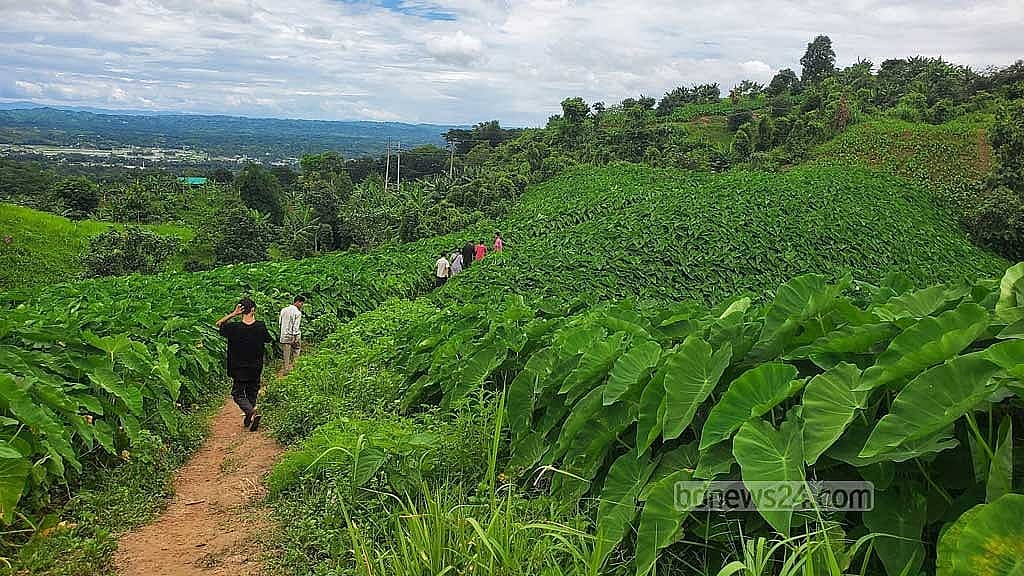
Despite knowing the risks of erosion, taro -- a high-yielding root crop suited for plains -- is increasingly being cultivated on the slopes of Khagrachhari. The practice, experts warn, is stripping away the “topsoil”, silting streams and hill channels, and reducing water retention in the region.
Environmentalists say clearing hillsides for taro threatens the fragile ecosystem. When the slopes are tilled and vegetation removed, wildlife lose habitat and biodiversity declines.
“Taro is not a crop for the hills. It should be grown on flat land. The hills should have fruit, timber, and medicinal trees,” said Md Farid Miah, divisional forest officer of Khagrachhari. “Taro belongs to the plains, but we are forcing cultivation onto the hills.”
The terrace farming method, considered a sustainable alternative, has not caught on. Farmers remain unaware of the soil erosion caused by taro, focusing instead on its short growing cycle and strong market price.
Khagrachhari’s Matiranga Upazila leads to hill taro cultivation. In the Gomti area, farmer Shamsuddin Miah planted taro on three acres this season.
“It gave good yields and prices are high,” he said. “Had I harvested earlier, the profit would have been even better.”
Shamsuddin admitted he did not know taro cultivation harmed the environment, but observed that “some soil washes away during the rains”.
A study by the Soil Resources Development Institute (SRDI) in Bandarban found that on 26 percent slopes, a single hectare of cultivated land loses 58 tonnes of soil annually. These eroded sediments flow into streams and rivers, filling them up.
In many taro fields, slopes are even steeper, between 40 percent and 60 percent, making erosion far more severe. Yet most farmers remain unaware, and the issue rarely comes up in public discussions.
Around Khagrachhari’s Alutila tourist area, taro has replaced lush forests once home to diverse wildlife. The slopes, which teemed with vines, shrubs, and animal life until last year, have been cleared bare for commercial taro plantations.
Unplanned cultivation is now blamed for a string of environmental changes: frequent flash floods, reduced streamflow in dry seasons, and a noticeable decline in wildlife populations.
THE 'TOPSOIL' EFFECT
According to Dr Md Mahbubul Islam, chief scientific officer at SRDI Bandarban, hill cultivation should never involve deep digging.
“Hill farming should disturb the soil as little as possible,” he said. “Crops like taro, ginger or turmeric must not be grown on steep slopes. Only gentle or mild slopes are suitable.”
Instead of cutting up entire hillsides, farmers should only dig small pockets for seed placement, he added. “But they usually plough the whole slope into channels, so the rain washes it all away.”
Topsoil -- the thin upper layer rich in nutrients -- is vital for plant growth. Beneath it lies rock and gravel. “When the topsoil washes away, the fertility disappears,” said Mahbubul. “It may take 10 to 15 years, but eventually the land becomes uncultivable.”
He explained that once eroded, soil from the slopes fills nearby Jhiri, or streams, blocking natural drainage. “Where water should flow, it’s now silt. That’s why floods occur even after 100mm of rain.”
It takes 300 years for one inch of topsoil to form naturally, Mahbubul added. “Humans can’t create it, but they’re destroying it within years.”
His research found that at 26 percent slopes, one hectare loses 58 tonnes of soil annually. In Khagrachhari alone, where 810 hectares of taro were planted in FY 2025-26, up 55 hectares from last year, this equates to 47,000 tonnes of soil erosion this season.
Forest Officer Farid Miah said, “Topsoil is the most valuable layer. Plants grow on it. When hills are stripped, the bare ground heats up under direct sunlight, radiating heat and damaging the microclimate.”
He added that before planting taro or other tuber crops, farmers often burn vegetation. “This wipes out biodiversity. Earthworms and microorganisms die from tilling and heat. Biodiversity is being destroyed.”
Deputy Director Md Bashirul Alam at the Department of Agricultural Extension said they are not banning taro but discouraging hill cultivation.
“We advise farmers to grow it on flat land,” he said. “Fruits like mango and guava should be grown on slopes, their roots help hold soil. The top six inches contain most nutrients, and when taro is harvested, all that soil gets washed away.”
Sathowai Marma of the Save the Biodiversity Conservation Society said he visited a hill in Ramgarh where taro farming had recently begun.
“The stream below is full of mud,” he said. “You can see it clearly -- the topsoil has been washed down. Taro farming may bring farmers profit, but it’s bringing disaster for biodiversity and nature.”
THE CASE FOR TERRACE FARMING
Terrace or step cultivation -- common in China, Vietnam, and Nepal -- cuts sloping land into a series of flat steps that hold both soil and water.
“Terracing helps preserve soil moisture and prevents erosion,” said Sabuj Chakma, founder of the volunteer group Plantation for Nature, which has spent five years reforesting Khagrachhari’s hills.
“Taro and vegetables can be grown on terraces. Rainwater suffices during the monsoon season when taro is grown. If we use this method, soil erosion will drop drastically.”
Sabuj urged the government to pilot terrace farming projects. “If they succeed, the model could be scaled up among farmers. The agriculture department should test this.”
Dr Mahbubul Islam of SRDI agreed. “We need government-led initiatives for terrace farming. In India, community-based terrace agriculture is common. Though costly, donor support could help farmers adopt it.”
THE EXTENT OF TARO CULTIVATION
This year, the highest cultivation was recorded in Matiranga, with 228 hectares under taro. Other Upazilas include Ramgarh (141 ha), Sadar (85), Guimara (35), Manikchhari (78), Mahalchhari (85), Dighinala (25), Panchhari (48) and Laxmichhari (85).
Some farmers are reconsidering.
Md Kashem, a grower from Taitong in Matiranga, said after attending a training on agroecology, he learned about the erosion problem.
“I didn’t know before,” he admitted. “Now I see how much soil is lost. I won’t plant taro next season.”