Published : 28 Jul 2026, 06:27 AM
Updated : 08 Sep 2026, 09:28 AM


One LNG Outage, a Nation Strained
Imported gas nearly halves: RLNG supply falls 49 percent after one FSRU shuts down, widening the daily gas deficit to 1.65 billion cubic feet
Grid pushed to the brink: The power sector bore the brunt, causing peak load shedding to climb to 962MW as unserved power surged
Generation costs surge 12 percent: Relying on expensive furnace oil and coal to bridge the energy shortfall drove generation costs up
Kitchen stoves fall silent: Depleted gas pressure left urban residents unable to cook, forcing costly shifts to electricity.
The breakdown of a single floating liquefied natural gas terminal has exposed the fragility of Bangladesh's energy system, sending shockwaves from power stations to household kitchens.
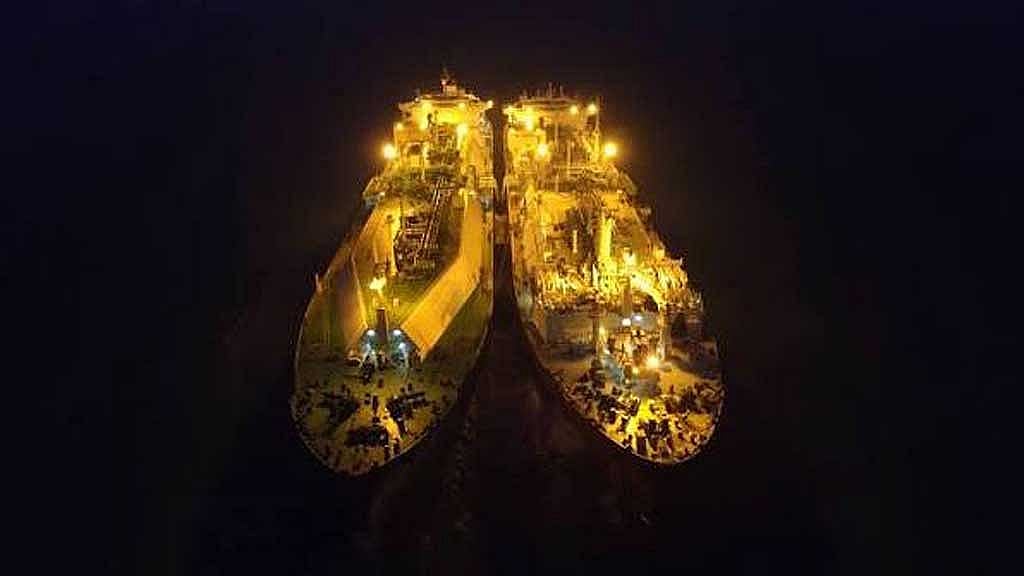
Within five days, the shutdown of one floating storage and regasification unit (FSRU) off Moheshkhali almost halved imported LNG supplies to the national grid.
Gas-fired electricity generation slumped, load shedding climbed to its highest level in days, and the cost of producing electricity rose as authorities leaned more heavily on coal and expensive liquid fuels to keep the lights on.
Official data from Petrobangla and Power Grid Bangladesh PLC's National Load Dispatch Centre (NLDC) show that imported re-gasified LNG (RLNG) supplies fell by about 492.4 million cubic feet a day. Overall gas supply shrank by nearly 490 million cubic feet daily.
The power sector absorbed the biggest blow.
Daily gas deliveries to power plants dropped by about 228 million cubic feet, while electricity generated from gas-fired stations fell by roughly 25 percent over the same period.
Authorities increased production from coal-fired and furnace oil-fired plants to cushion the impact. Even so, supply failed to keep pace with rising demand.
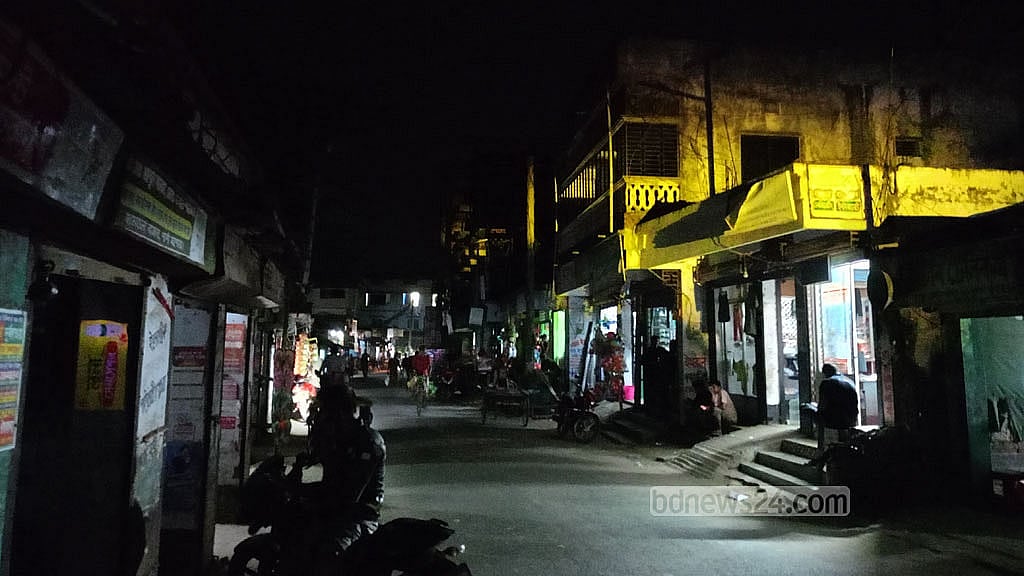
Load shedding peaked at 962MW at 11pm on Jul 25, leaving more than 13.7 million units of electricity undelivered to consumers.
The gas shortage has also rippled through households, factories and compressed natural gas (CNG) filling stations. Across many parts of Dhaka, gas pressure remains too weak for cooking during much of the day, forcing families to switch to electric cookers despite the higher electricity bills.
Imported Gas Dries Up
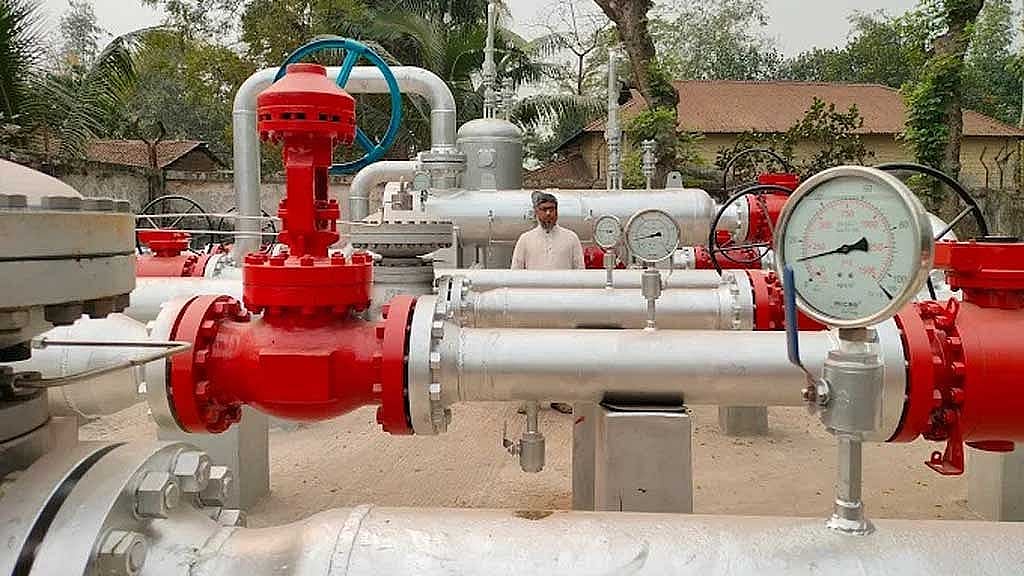
Petrobangla figures show RLNG supply stood at 993.5 million cubic feet a day during the 24-hour period beginning at 8am on Jul 20.
By the corresponding period ending on Jul 26, it had fallen to 501.1 million cubic feet a day -- almost half.
Domestic production, meanwhile, remained largely stable at about 1.65 billion cubic feet daily.
The collapse in LNG imports reduced Bangladesh's total daily gas supply from 2.64 billion cubic feet to 2.15 billion cubic feet.
That is well short of the country's official daily demand of around 3.8 billion cubic feet, leaving a supply gap of roughly 1.65 billion cubic feet.
Bangladesh imports LNG by sea before converting it back into gas at floating storage and regasification units and feeding it into the national pipeline network.
The country has two such floating terminals at Moheshkhali. With one out of service, imported gas supplies have effectively been cut in half.
Power Plants Run Short
Power Grid Bangladesh data show gas supplied to power plants fell from 926.8 million cubic feet a day on Jul 20 to 698.9 million cubic feet on Jul 25 -- a decline of 227.9 million cubic feet, or 24.6 percent.
Electricity generated from gas-fired plants dropped from 125.6 million kilowatt-hours to 94 million kilowatt-hours, a fall of about 31.6 million units, or 25.2 percent.
Gas-fired generation's share of the country's electricity mix also slipped from 36.7 percent on Jul 20 to 27.9 percent on Jul 25.
The decline began to emerge on Jul 21, when gas deliveries to power stations fell to 858.4 million cubic feet, before sliding further over the following days.
As demand climbed, the strain on the grid became increasingly visible.
Peak evening demand rose from 15,511MW on Jul 20 to 16,693MW on Jul 25.
Electricity generation increased only marginally, from 15,332MW to 15,785MW, widening the gap between demand and supply from 179MW to 908MW.
Hourly grid data show maximum load shedding climbed from 253MW on Jul 20 to 962MW by 11pm on Jul 25.
At that moment, electricity demand stood at 16,327.74MW against generation of 15,322.74MW.
At 8pm, the heaviest regional load shedding was recorded in Mymensingh at 353MW, followed by Sylhet with 207MW, Dhaka with 161MW and Khulna with 101MW.

Keeping the Lights On Gets Pricier
Power Development Board Member (Generation) Md Zahurul Islam said generation from liquid fuel-fired power plants had been increased to compensate for reduced gas-fired output.
He said these plants generated around 3,690-3,700MW the previous day, which he believes was the highest level recorded this year.
Coal-fired stations and gas-fired plants with available fuel were also operating at full capacity.
Yet demand still outstripped supply, making power cuts unavoidable.
Zahurul said he could not predict whether outages would worsen, although he hoped the situation would gradually improve.
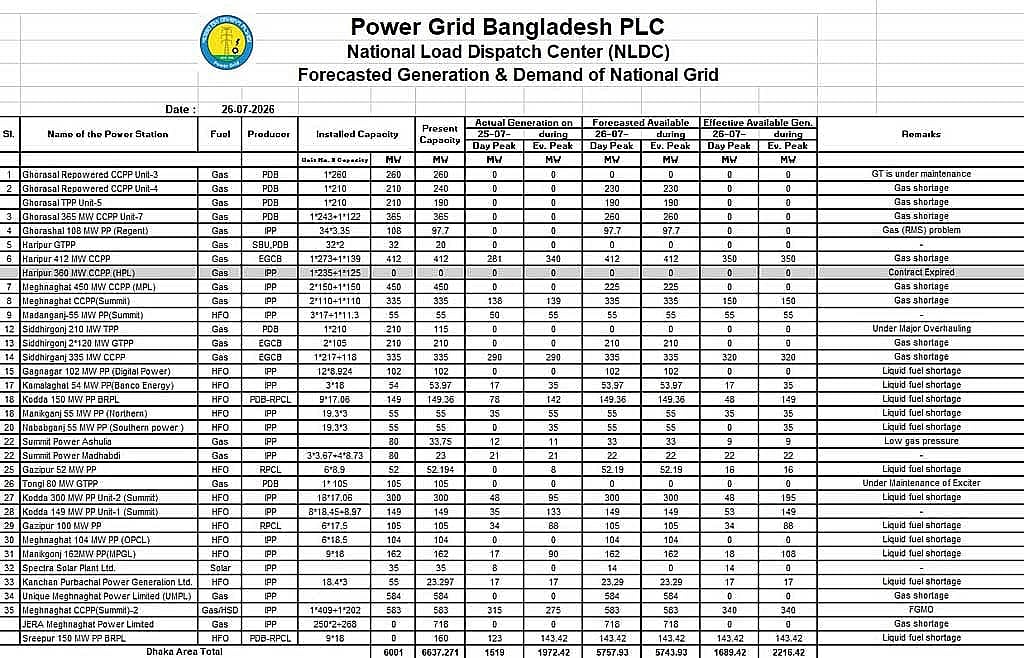
Power Grid Bangladesh classifies electricity that cannot be supplied as "energy unserved".
On Jul 20, unserved electricity stood at 2.66 million kilowatt-hours. By Jul 25, it had surged to 13.72 million kilowatt-hours -- more than five times higher.
Total electricity demand on Jul 25 reached 350.7 million kilowatt-hours, while generation and imports together supplied only 336.99 million kilowatt-hours.
Coal-fired generation increased from about 122.9 million units on Jul 20 to 138.6 million units on Jul 25, a rise of around 13 percent.
Generation from furnace oil-fired plants climbed from roughly 27 million units to 38.7 million units, an increase of about 44 percent.
Coal's share of total generation rose from 35.9 percent to 41.1 percent, while furnace oil increased from 7.9 percent to 11.5 percent.
Electricity imports, however, declined from approximately 58.8 million units to 54.6 million units over the same period.
The average cost of electricity generation also increased from Tk 6.31 per unit to Tk 7.09 -- up 12.4 percent. The Power Grid report did not specify why costs had risen.
Officials say the worsening load shedding is not solely the result of gas shortages. Constraints on liquid fuel supplies, scheduled maintenance and mechanical faults have also left numerous power plants either idle or operating below capacity.
Power Grid Bangladesh's generation forecast for Jul 26 identified 25 power plants or generating units affected by gas shortages, with a combined generation gap of about 4,134MW.
They include several units at Ghorashal, Haripur, Meghnaghat 450MW, Summit Meghnaghat, two 120MW Siddhirganj units, Unique Meghnaghat, JERA Meghnaghat and several Ashuganj plants.
The same forecast identified another 33 plants or units affected by shortages of liquid fuel, with a combined generation gap of about 1,840MW. Others remain offline because of maintenance, mechanical failures, expired contracts and technical problems.
Shortage Reaches the Kitchen
The impact has spread beyond the power grid to Titas Gas Transmission and Distribution, which supplies Dhaka, Gazipur and Narayanganj.
Titas distributed 1.48 billion cubic feet of gas during the 24-hour period beginning on Jul 20. By Jul 25, that had fallen to 1.21 billion cubic feet -- down by 270.7 million cubic feet, or more than 18 percent.
The utility's daily demand is about 2 billion cubic feet, and it had already been operating around 500 million cubic feet short before the FSRU outage.
The additional reduction has left many neighbourhoods across the capital without enough gas pressure for cooking during the day. Ageing pipelines and rainwater entering parts of the network have further compounded the problem.
For many residents, patience has run out.
Writing in the Facebook group Amra Mohammadpurbashi, resident Ishtiaq Khan Tanzim said large parts of Mohammadpur, including Shekhertek and Nobodoy Housing, had gone four consecutive days without gas.
He criticised public representatives for failing to respond, saying thousands of residents were enduring severe hardship.
Another resident Tania Masud said households continued paying gas bills despite receiving little or no service, adding that the situation had become embarrassing when entertaining guests.
In Uttara, resident Atika Roma said she had resorted to cooking enough food for two or three days at a time during the early hours of the morning or late at night, when gas briefly became available.
She said she had also turned to electric cookers, pushing up her electricity bills while continuing to pay regular gas bills for two homes.
"We want a real solution, not empty promises," she wrote.
As engineers race to restore the damaged LNG terminal, the crisis continues to unfold far beyond Moheshkhali's waters. It now plays out in darkened neighbourhoods, silent factory floors, long queues at CNG stations and kitchens where families wait for gas that rarely comes.