Published : 04 Sep 2025, 10:13 PM
Updated : 28 Aug 2026, 01:26 AM


Bangladesh saw an estimated $16 billion stolen and siphoned abroad each year during the Awami League’s 15 years in power, fuelling the “global economy of corruption”, according to François Valérian, chair of the Berlin-based anti-graft watchdog Transparancy International.
Valérian said the scale of illicit financial flows under the ousted regime showed how “positions of power were turned into opportunities for extraction” rather than public service.
“According to estimates, under the authoritarian regime, $16 billion a year were stolen over 15 years,” Valérian told a press conference at the Transparency International Bangladesh (TIB) office in Dhaka on Thursday.
“Why is that extremely important? Because when public money is stolen, it is diverted from education, health, infrastructure and climate policy. Instead of serving the people, it fuels what we call the global economy of corruption.”
Explaining how the funds were moved abroad, he said: “The money first stops in offshore centres or cryptocurrency hubs like Dubai, Singapore, Hong Kong. Then it lands in a few countries like the UK, France, the US, Germany and Switzerland. And corrupt leaders are not investing it in cancer drugs or technological startups. They are buying real estate and luxury cars, but most of it inflates capital markets. This is a value-destroying economy, turning useful public money into useless private money.”
On the way forward, he said: “The first thing is we need to know where the money is. That requires beneficial ownership transparency. At that level of plundering, people hide behind legal entities. We need to know the individuals behind them. I know there is a draft bill in Bangladesh to ensure this transparency, and it is very important to enact it.”
“International cooperation is also crucial. Recently, £185 million worth of real estate was seized by British authorities after a joint call by TI Bangladesh, TI UK and Spotlight on Corruption. But restitution is essential. That money has to be returned to the people of Bangladesh under civil society oversight.”
Asked about specific allegations of corruption during the Awami League era, Valérian said he would not comment on particular cases.
“I never do that in the countries I visit because we are a coalition of autonomous chapters,” he said. “It is up to TI Bangladesh to comment or not comment on allegations or investigations. What I am simply saying as a general principle is that in every country worldwide we need investigations, we need corruption cases prosecuted, and we need a judiciary system that is independent from the executive branch, properly resourced, and with integrity at every level.”
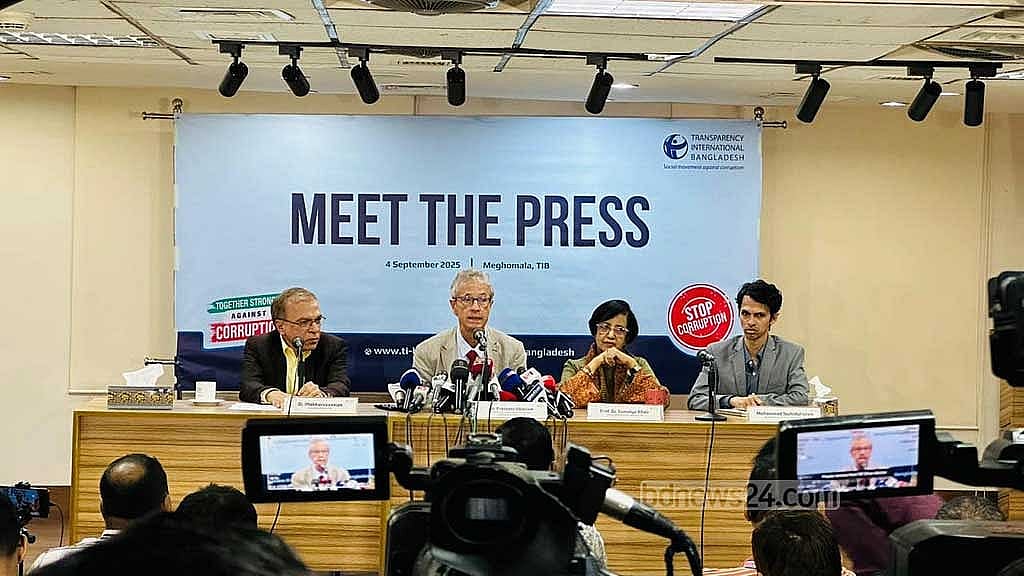
‘TIB MORE RELEVANT THAN EVER'
Valérian dismissed suggestions that the organisation might have lost its relevance following the July Uprising that ended the Awami League’s 15-year rule.
“Well, not at all. And I would say unfortunately not at all because I think there are still corruption problems in Bangladesh, like in every country worldwide,” he said.
“Every time there will be power somewhere, there will be the temptation to abuse this power. Therefore, it is always very, very important that we have civil society — people without political or economic power — to control what is being done in their name, so that we keep fighting against abuse of power.”
Valérian stressed the need for citizens to constantly engage in efforts to curb the abuse of power and corruption.
“You can’t say that you have solved the corruption problem. It is a constant effort by citizens to control power. And it is the duty of power to be accountable to the citizens. Public officers have duties. Citizens have rights. And it is not the other way around. Therefore, TI Bangladesh is more indispensable than ever in this critical period for Bangladesh, which is also an important period for the world.”
Valérian, who was elected chair of TI in 2023, arrived in Bangladesh on Monday for a three-day visit -- his first since taking the role.
TIB said the purpose of the trip was to exchange views on preventing corruption and promoting good governance, to review TIB’s activities, and to share global and national experiences of challenges and opportunities.
On Wednesday, Valérian met Chief Advisor Muhammad Yunus. He also held talks with the chief justice and top Anti-Corruption Commission officials.
“Yesterday with Dr Iftekharuzzaman [TIB chief], we had three meetings with important bodies or persons in charge of the transition efforts,” he said. “In every one of those meetings I felt a strong commitment to succeed in this transition towards the new Bangladesh.
“Yes, the challenges are high, the stakes are high, and the world is observing — and more than the world, the citizens of Bangladesh are observing. Because all the sacrifices, all the human sacrifices of last year, they can’t have been in vain. Something is owed to them, not only by Bangladesh but also by the world. I feel extremely grateful to these heroic people. The international community and global civil society must also help.”
He explained that the Bangladesh stop was part of a wider regional tour of South Asia covering the Maldives, Sri Lanka and Bangladesh. “I came here to show the full support and solidarity of the global anti-corruption movement.”