Published : 25 Aug 2025, 05:20 AM
Updated : 21 Aug 2026, 01:42 PM


Bangladesh must amend its existing law to ensure universal birth and death registration by 2030, speakers have said at a workshop in Dhaka.
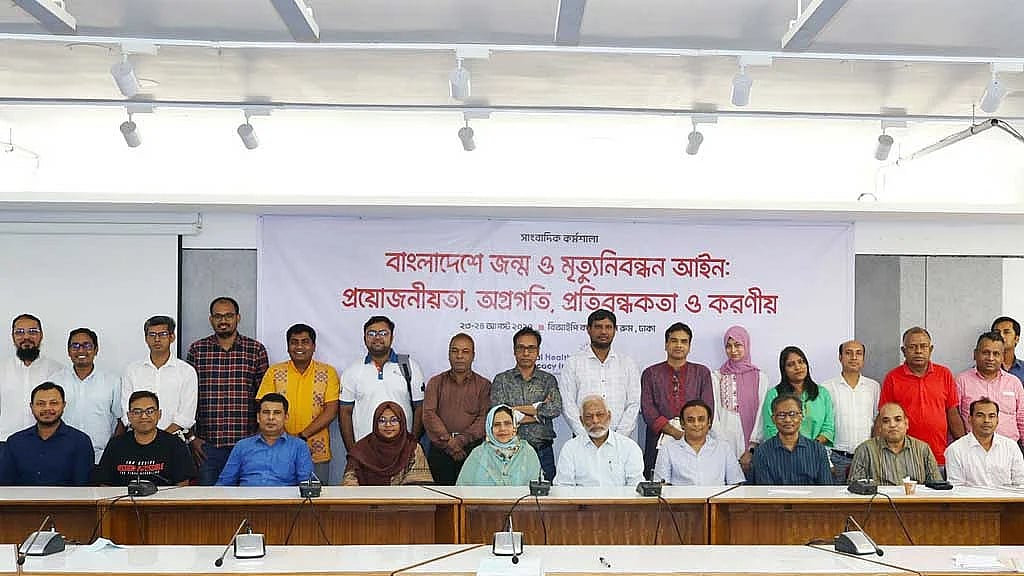
The two-day workshop on “Birth and Death Registration in Bangladesh: Progress, Challenges and Way Forward” was held on Aug 23-24 at the Bangladesh Institute of Planners.
It was organised by PROGGA (Knowledge for Progress) with support from the Global Health Advocacy Incubator (GHAI).
Currently, only 50 percent of births and 47 percent of deaths in the country are registered, far below the global averages of 77 and 74 percent, according to UNICEF.
In South Asia, birth registration stands at 76 percent.
At the individual level, birth and death registration secures access to basic rights, including citizenship, education, healthcare, inheritance and voting.
Nationally, accurate data on population and health is essential for planning, budgeting, public health and governance.
Although 67 percent of children in Bangladesh are born in healthcare facilities, hospitals are not legally mandated to register births and deaths. The current law places the responsibility on families, while the health sector’s role remains optional.
Speakers at the workshop pointed out that in many Asia-Pacific countries, assigning this responsibility to hospitals has enabled them to achieve near-universal coverage.
They argued that Bangladesh could also make significant progress if hospitals, clinics and healthcare facilities were legally bound to register births and deaths.
They also identified a lack of public awareness, procedural complexities, technical issues and weak coordination with the healthcare sector as key obstacles.
Muhammad Ruhul Quddus, Bangladesh Country Lead of GHAI, said: “Assigning the responsibility of birth and death registration to health facilities through law amendment will enable Bangladesh to achieve universal (100%) birth and death registration by 2030.”