Published : 09 May 2026, 06:43 AM
Updated : 28 Aug 2026, 01:34 AM


Farmers in Sunamganj are finding themselves unable to benefit from the government’s Boro rice procurement drive, as untimely rains and flash floods have either washed away their crops or left the remaining harvest too damp to meet official quality standards.
The government’s procurement policy requires paddy to maintain a maximum moisture level -- typically around 14 percent -- and be free of rot or sprouts.
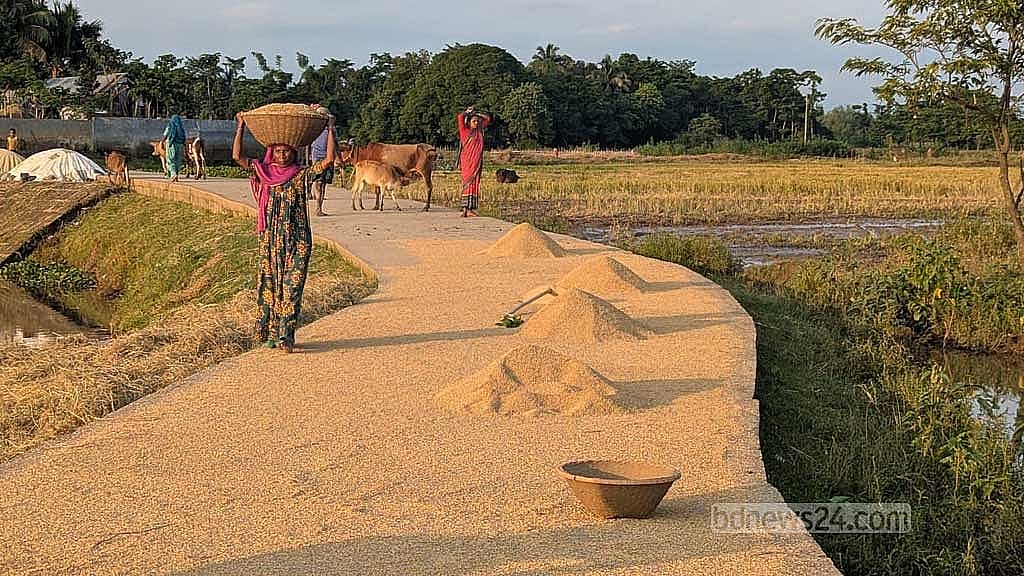
After weeks of torrential rain and waterlogging that began in March and peaked in late April, farmers have been unable to dry their grain, with many reporting that their hard-earned harvest is already beginning to germinate or give off a foul smell.
For Rais Mia, a farmer in Dekhar Haor, the season has turned into a "nightmare".
He watched in despair as the floodwaters swallowed almost his entire field of over two hectares between Apr 26 and 30.
"My luck is bad," Rais said.
"The rain started in Falgun (Early March). How much water can the Haors take? They are already silted up."
Rais managed to reap only 0.36 hectares of paddy, but even that portion is rotting because the lack of sunshine has made drying impossible.
Having spent Tk 130,000 on cultivation, he now faces a bleak year with a family of eight to support.
"If I could have gathered the crop, I would have had at least 150 maunds. I could have sold it to the government at a fair price," he added.
The Department of Agricultural Extension (DAE) reported that while the target for Sunamganj’s 193 Haors was 1.4 million tonnes of paddy -- valued at roughly Tk 50 billion -- the target is now under threat.

The food department’s collection drive, which offers Tk 36 per kg, has seen a dismal start.
In some areas, collection figures remain strikingly low.
In Shalla and Bishwambharpur, only one tonne of paddy has been collected in each Upazila.
In Sunamganj Sadar, the collection stands at eight tonnes, while in Jagannathpur, it is four tonnes.
Overall, the total district collection has reached only 95.6 tonnes as of May 7, against a target of 21,349 tonnes.
"The moisture content is too high due to the lack of sun," said Md Mushfique Ur Rahman, acting district food controller.
"We are advising farmers to dry their paddy, but the weather is not helping."
The crisis is also hitting millers, who rely on purchasing paddy from farmers to produce parboiled and atap rice for government silos.
With the crop quality compromised, many farmers like Rasel Mia of Muktikhala village have given up on the idea of selling to the state.
"My hybrid paddy started sprouting because it didn't get any sun after cutting," Russell said.
"The warehouse won't take damaged grain, so I've stopped thinking about giving it to the government."
For Swapan Roy of Udgal Haor, the loss is even more personal.
He spent Tk 20,000 per 0.12 hectare using hired labour because he and his wife were ill.
Now, with half his land submerged and the rest damp, he is worried about his daughters' education.
"One is taking her SSC exams, the other is in class seven. I can't even collect our own food for the year, let alone sell to the government," he said.
Obaidullah Haque Milan, general secretary of the Sunamganj Haor and River Protection Movement, warned that more than half the region's paddy has been submerged.
"The remaining portion is rotting. This will lead to a major shortfall in the government's procurement goals this year," he said.