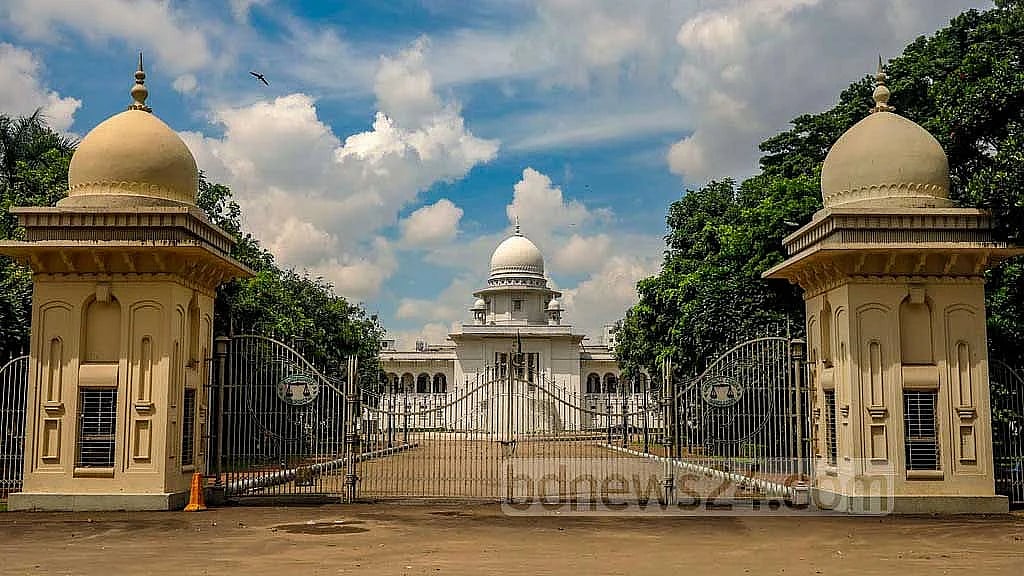
Published : 16 Mar 2026, 09:30 PM
Updated : 21 Aug 2026, 03:28 PM


The Supreme Court has said the idea of a caretaker government emerged from broad public demand for a neutral electoral process.
The observation came in the Appellate Division's ruling on the appeal and review petitions over the judgment that had scrapped the 13th Amendment to the Constitution, which introduced the caretaker government system.
The full text of the judgment, in which the review was allowed, was published by the Supreme Court on Mar 12.
In its observations, the court said the non-party caretaker government system had not damaged the Constitution’s basic structure. Rather, the system had strengthened it by safeguarding the “sanctity” of Article 7.
The top court has restored the non-party caretaker government system for election periods, declaring illegal the decision taken during the Awami League government to abolish the 13th Amendment.
The verdict was delivered on Nov 20, 2025, by a full seven-member bench of the Appellate Division led by then chief justice Syed Refaat Ahmed.
The ruling means the caretaker government system has automatically returned to the Constitution, although the court said it will take effect from the 14th parliamentary election.
Bangladesh introduced the non-partisan caretaker government system in 1996 through the 13th Amendment during the BNP government.
In 2011, during the Awami League government, the Appellate Division struck down that amendment, leading to the abolition of the caretaker system. The chief justice at the time was ABM Khairul Haque.
After the fall of the Awami League government in August 2024, and during the tenure of the subsequent interim administration, a petition was filed seeking reconsideration of the 2011 judgment. The Supreme Court then decided to hear the matter afresh. The Appellate Division unanimously allowed the appeal and review.
The judgment said the earlier ruling led by Khairul Haque had “impaired the judiciary’s legislative wisdom and corrective authority” in relation to the post of chief advisor to the caretaker government.
It said a chief justice could, in theory, be influenced by the prospect of later becoming chief advisor, but added that striking down a law on the basis of such speculative concern undermined the judiciary’s legislative wisdom and corrective authority.
The Appellate Division said the 13th Amendment had been “a profound reinforcement of democratic spirit” and itself formed part of the Constitution’s inviolable basic structure.
It said the historical context of the amendment showed that it had been designed to assist the Election Commission in holding free, fair and neutral general elections.
From this perspective, the amendment was not identified as a path of departure from democracy, but rather as an indispensable instrument for ensuring the integrity of the democratic process, the court said.
The court noted that the idea of a caretaker government had been conceived as a neutral interim administration to oversee the routine affairs of the state during the transition from one elected government to another.
Its main purpose was to ensure that an incumbent government could not use the machinery of the state to influence election results, thereby protecting a free and fair electoral process.
The Appellate Division said the caretaker government system in Bangladesh had evolved into a “fundamental political institution”, born out of “a deep crisis of confidence” in the electoral system.
The observations said the majority ruling delivered in 2011 had declared the 13th Amendment void for allegedly damaging the Constitution’s basic structure, while at the same time allowing the 9th and 10th parliamentary elections to be held under that same caretaker framework.
“This dual position reveals that even the majority, while invalidating the system, acknowledged its temporary necessity and democratic value,” the judgment said.
The court also pointed to what it described as a major procedural inconsistency in the “controversial” 2011 ruling.
It said the short order issued on May 12, 2011, had allowed the next two general elections to be held under the caretaker system, but that operative part was omitted or changed in the full judgment published more than a year and a half later.
The court said the author of the majority opinion in the 2011 judgment, then chief justice Khairul Haque, had tried to base his reasoning on an expansive and “somewhat personalised” reading of the basic structure doctrine, confining the caretaker system within “a narrow conception” of democracy and the rule of law.
The court said the 13th Amendment would be recognised as a significant constitutional achievement designed to uphold the sovereign will of the people to exercise their voting rights freely, fairly and impartially.
Article 7 of Bangladesh’s Constitution guarantees the supremacy of the Constitution and the sovereignty of the people. It declares the people to be the ultimate source of state power and the Constitution to be the supreme law of the land, rendering void any law inconsistent with it.
In the ruling, the Supreme Court said it was clearly apparent that the Appellate Division judgment delivered 14 years ago had been “vitiated by multiple errors”.
That ruling was set aside in its entirety.
The Appellate Division said the provisions relating to the non-party government in Part IV, Chapter II(A) of the Constitution, inserted through Section 3 of the 13th Amendment Act, were revived and brought back into force by this judgment.
However, the court said the caretaker government provisions would apply only prospectively.