Published : 03 Jul 2025, 08:34 PM
Updated : 21 Aug 2026, 01:28 PM


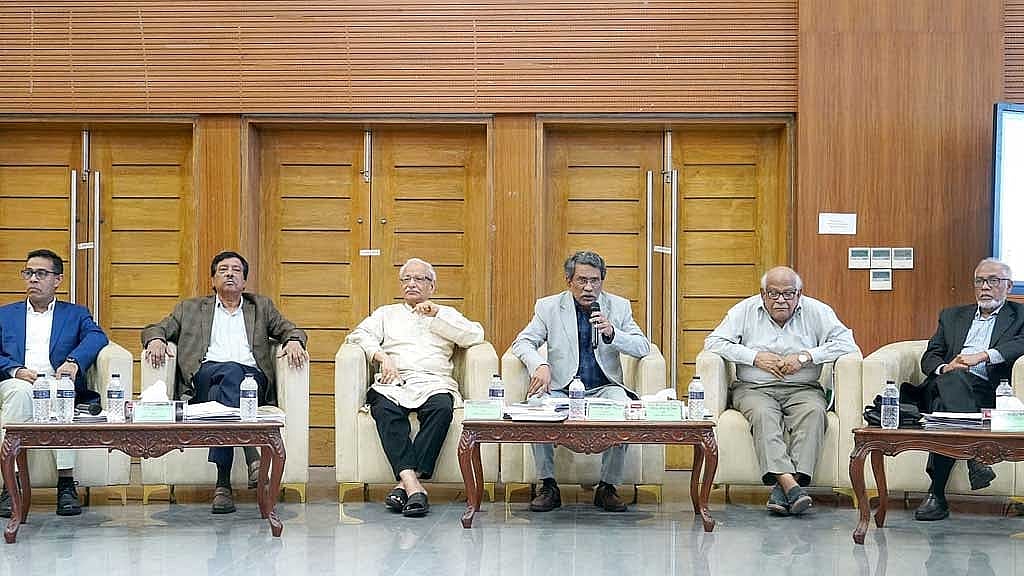
Political parties are having informal discussions among themselves on reform proposals, which has inspired the National Consensus Commission, says the body’s Vice Chairman Ali Riaz.
He made the remarks in his introductory speech on the ninth day of the second phase of the dialogue with political parties at the Foreign Service Academy on Thursday.
"Not only here, we know that you are also having discussions among yourselves as political parties, and as coalitions, which is positive. This is because we cannot decide everything by sitting here and talking," Riaz said.
“We requested all the parties to talk to like-minded parties, organisations, and coalitions. We are getting some informal news which has inspired us."
He said, "There has been no opportunity to discuss reforms over the last 53 years. We have reached this point of opportunity through great hurdles, many adversities, struggle, and sacrifice. There is a positive aspect to these discussion in terms of knowing and understanding each other."
The second phase of the dialogue began on Jun 17 regarding those issues where parties had failed to reach consensus in the first round.
Riaz said that there were differences of opinion on some fundamental issues in the first phase of the dialogue.
"In addition, according to our calculations, there are about 20 issues that we need to talk about and make decisions on. We consider those issues to be very important. To be precise, we consider those as fundamental issues."
Regarding the discussions in the second phase of the dialogue, Ali Riaz said: "We are presenting the initial discussion points on various issues every day. That is why you may wonder why we are not resuming yesterday's incomplete discussion today. One of the reasons is that in the initial process, we can understand the positions our political parties hold. We can understand the perspectives and each other’s logic.”
“We want to keep that opportunity so that you can talk to your fellow party members and in the coalitions regarding that reasoning. It will lead us to a common place in the next stage, where we can easily move towards consensus. That is why we are now discussing all the issues that remained unresolved.”
Ali Riaz said the political parties were changing their stances through discussions. “We are also taking that into consideration. We believe that your position will be stronger through the discussions. You will be able to present arguments about your position. We are following that process.”
Thursday’s meeting agenda includes the issues of presidential clemency, judiciary decentralisation, and declaration of states of emergency, the commission’s vice chairman said.
He said, “Today, we can discuss three issues. If the political leaders agree, then we can decide on one issue. If we can come to a decision, that will be the biggest positive aspect.”
“At the end of the day, we hope to have a fruitful discussion and use its success outside these talks as well. We’ll try to achieve that.”
Ali Riaz said, “Leaders of political parties - the way your activists paved the way for us to reach this position through their struggle - we remember them every day. We are here because of the consequences of the struggle they endured by putting their lives at risk.
“We must always remember that and let that be our guiding principle, our direction.”
He said, “We have reached this point of opportunity at the cost of many lives, after facing many atrocities. This opportunity never existed in the past. We can’t let this opportunity go. We must play our role as individuals, parties, alliances, and as citizens to tap this opportunity.”