Published : 26 Dec 2025, 03:42 PM
Updated : 28 Aug 2026, 01:31 AM


The Election Commission (EC) has issued guidelines on how people held in prisons or in legal custody will be able to vote in the upcoming 13th national election and referendum through the postal voting system.
Registration for in-country postal voting (ICPV) through the "Postal Voting BD" app is currently under way and will continue until Dec 31.
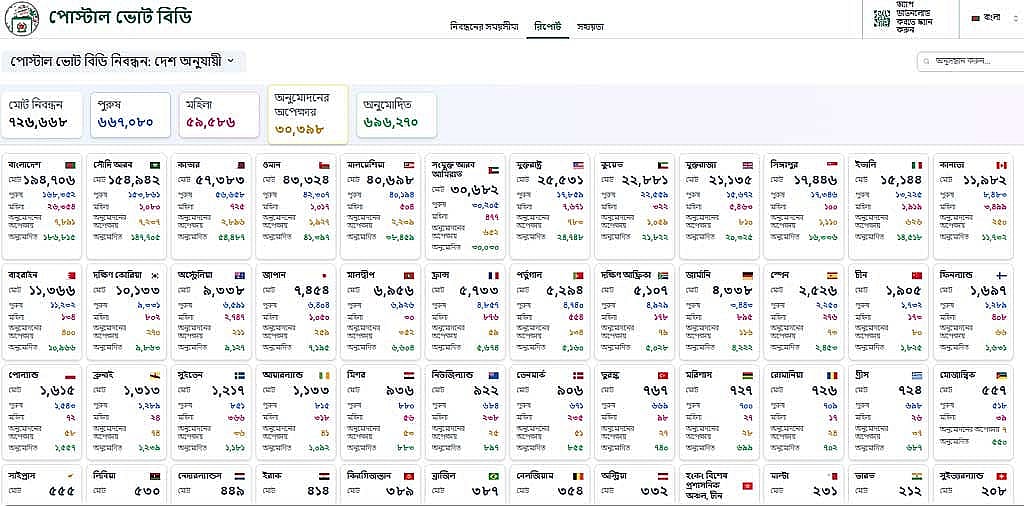
As of Thursday, more than 725,000 people had registered for postal voting. Of them, around 525,000 are expatriates, while roughly 200,000 are based inside Bangladesh.
This election marks the first time the EC has introduced postal voting for multiple categories of voters, including expatriates (out-of-country voting), government employees, election officials on duty, and individuals held in legal custody.
The EC said it had sent detailed instructions to the inspector general of prisons on Wednesday, outlining how the process will be managed inside prisons and detention facilities.
HOW THE PROCESS WILL WORK
Under the guidelines, people held in prisons or in legal custody will be able to vote after registering under the ICPV system. Their registration will be verified and approved through the relevant authorities.
A dedicated digital platform, prisoner.ocv.gov.bd, will be used for registering eligible voters in custody. Prison and detention authorities will nominate two representatives each to oversee and complete the registration process.

Once registration is completed, the authorities will send a printed list of registered voters, signed and sealed, to the EC. Voter details will also be uploaded to the designated online portal.
Registered voters will receive postal ballot envelopes through the prison or detention authorities. Special voting rooms or booths will be set up to ensure privacy during voting.
Postal ballots will not include candidates’ names. Instead, voters will see only the allocated symbols, with a blank space beside each. Authorities will therefore provide voters with a final list of candidates and their symbols for the relevant constituency.
Voters will mark their choice with a tick or cross next to the symbol in the parliamentary election ballot, and next to “Yes” or “No” in the referendum ballot. The completed ballot papers will be sealed in small envelopes, along with a signed declaration form, and placed inside a larger yellow envelope addressed to the returning officer.
Once voting is completed, prison authorities will send the envelopes to the nearest post office, from where they will be forwarded to the respective returning officers.
REGISTRATION DEADLINE EXTENDED
The Assistant Inspector General of Prisons (Development) Md Jannatul Forhad said registration for people in legal custody had initially been scheduled from Dec 21-25, but the deadline had now been extended to Dec 31.
“Registration has already begun. Work is under way according to the Election Commission’s instructions, and consolidated nationwide data will be available later,” he said.
There are currently around 80,000 inmates across Bangladesh’s 75 prisons, although the number fluctuates due to regular admissions and releases. Authorities say those interested in voting are being brought under the registration process.
NO IN-PERSON VOTING AFTER POSTAL REGISTRATION
The EC has clarified that anyone who registers for postal voting while in prison will not be allowed to vote in person at a polling station, even if they are released on bail or freed before election day.
According to the election schedule, nomination papers must be submitted by Dec 29. After scrutiny and the resolution of objections, candidates will be allowed to withdraw until Jan 20, with symbols allocated the following day.
Postal voting is expected to begin after Jan 21.
Election Commissioner Md Anwarul Islam Sarker said the rule would also apply to expatriate voters.
“Anyone who registers for postal voting while abroad will not be able to vote after returning to the country,” he said. “Their name will already be marked as a postal voter. The same applies to prisoners. Once registered, they must vote through the postal ballot system. They cannot later vote at a polling centre.”