Published : 01 Aug 2026, 03:38 AM
Updated : 08 Sep 2026, 09:29 AM


European football has reached for its most powerful weapon.
UEFA’s 55 member associations have unanimously threatened to boycott the World Cup and every other FIFA competition if Gianni Infantino presses ahead with plans to sell minority stakes in the governing body’s commercial operations to private investors.
It is an extraordinary escalation. A World Cup without England, France, Spain, Germany, Italy, the Netherlands, Portugal and the rest of Europe would cease to be a credible World Cup in anything but name.
UEFA knows this. FIFA knows it too.
That is why the confrontation has quickly become about something much bigger than one proposed investment deal. It is a struggle over who owns world football, who governs it and whether its greatest competitions should be treated as sporting institutions or financial assets.
On the substance of the dispute, UEFA has a compelling case.
FIFA does not appear to need emergency capital. The World Cup is among the most valuable properties in sport, generating billions through broadcasting, sponsorship, hospitality and ticketing. FIFA’s latest financial cycle was already expected to bring in more than $13 billion.
Yet Infantino wants to create a commercial subsidiary, FIFA Forward Enterprise, through which outside investors would be able to acquire minority, supposedly non-controlling stakes in FIFA’s competitions and commercial rights.
The subsidiary has reportedly been valued at around $20 billion, with an American venture-capital firm expected to lead the proposed investor group.
If the project were simply about raising funds, FIFA would need to explain why an organisation with vast revenues and reserves must surrender a share of its future income to investors expecting substantial returns.
That explanation has not been convincingly offered.
Instead, FIFA has presented its 211 national associations with an offer that is difficult for many of them to refuse: an initial payment of $20 million, potentially rising to $40 million, if they support the proposal.
South American football expert Tim Vickery described the tactic as “stuffing 211 mouths with gold”.
The phrase is deliberately provocative, but it captures the political structure behind the plan. The money is not merely an investment in football development. It is also an investment in votes.
Commercial Deal Built on Political Incentives
Every FIFA member has one vote.
England has one. Brazil has one. Haiti, Bhutan, Fiji and the Cayman Islands each have one.
That democratic structure is one of FIFA’s greatest strengths. It prevents wealthy European associations from simply claiming ownership of the global game.
But when a president controls the distribution of enormous sums to associations that may depend on FIFA funding, equality at the ballot box can become something more complicated.
The proposed payments give each association an immediate financial interest in approving a deal whose long-term risks may fall mainly on supporters, players, clubs and future administrators.
FIFA describes the proposal as an offer rather than an obligation. But attaching millions of dollars to acceptance—and imposing a deadline for associations to qualify for the first payment—makes the distinction less convincing.
UEFA has called this coercive. That may sound theatrical, but the process described by European officials raises serious governance questions.
Even senior FIFA office-holders were reportedly unaware of the negotiations. There was no broad consultation with confederations, leagues, clubs, players’ representatives or supporters before the proposal was presented.
A decision that could permanently alter the ownership structure surrounding the World Cup appears to have been developed in private and then placed before national associations alongside an unprecedented financial incentive.
That is not how the stewardship of the world’s most important sporting competition should work.
Private Equity Never Enters Merely to Observe
FIFA insists investors would hold only minority, non-controlling interests.
That sounds reassuring until one considers why private capital invests in the first place.
Investors are not patrons. They do not enter sport to preserve tradition, protect exhausted players, or make tickets affordable for families. Their responsibility is to generate returns.
Once private capital is allowed inside FIFA’s commercial structure, pressure to increase revenue would be constant.
The most obvious route would be more football: more competitions, larger tournaments, additional broadcasting windows, new commercial events, and a further expansion of an already overcrowded calendar.
The enlarged Club World Cup offers a glimpse of the direction of travel. FIFA presents expansion as global development, but clubs, leagues and players increasingly see it as another demand on a schedule already stretched beyond reason.
Private investors would have no commercial interest in reducing the number of matches. A competition played less frequently, involving fewer teams or charging lower ticket prices would leave potential income unrealised.
Even without formal control, investors would possess influence. They would expect FIFA’s commercial decisions to justify the valuation placed on the new company.
Ticket prices could rise. Broadcasting could become more fragmented. Tournaments could be altered to create additional inventory. Matches could be staged according to the needs of global television audiences rather than supporters attending them.
FIFA would continue to speak of acting for the “good of the game”. But that familiar phrase often conceals the question of whose good is actually being served.
Development funding matters. Smaller football nations require infrastructure, coaching programmes, pitches and administrative support.
But a funding model that permanently transfers part of football’s future commercial value to private investors may prove an extraordinarily expensive way of financing those needs.
UEFA’s Threat Is Powerful—But Dangerous
UEFA’s boycott threat may be the only action strong enough to halt the proposal.
Europe accounts for only 55 of FIFA’s 211 members, but it provides much of the World Cup’s sporting quality, commercial appeal, and broadcasting value.
European countries have won 13 of the 23 men’s World Cups. Six of the eight quarter-finalists at the latest tournament were European. The continent supplies most of the world’s richest leagues, clubs, and star players.
A World Cup without Europe would struggle to attract the investment upon which FIFA’s plan depends.
UEFA therefore has leverage. But leverage should be used to force negotiation, not to destroy the institution itself.
A permanent European withdrawal would not produce one stronger, cleaner football system. It would probably create two weaker ones.
Europe could organise its own international competitions, drawing on its wealth, infrastructure and elite players. Yet a European-only game would lose the global reach that gives the World Cup its unique emotional power.
There would be no Brazil against Germany, Argentina against England, France against Senegal or Spain against Morocco. Football’s greatest stage would be replaced by rival tournaments claiming separate forms of legitimacy.
FIFA, meanwhile, would retain Africa, Asia, South America, North and Central America, the Caribbean and Oceania, but without many of the teams and players responsible for the competition’s commercial value.
Both sides would survive. Neither would be whole.
FIFA Authority Rests on Collective Consent
FIFA’s control over world football can appear absolute. In reality, it exists because national associations and continental confederations collectively agree to recognise it.
Its authority is institutional, contractual and political—not an unchangeable law of nature.
If UEFA withdrew, FIFA could not physically compel European nations to participate. Equally, Europe could not simply declare that its own competitions represented the whole world.
That mutual dependence is what makes the current confrontation so dangerous.
A schism would expose the fragility of football’s governing system. It might also invite further battles over player eligibility, club participation, transfer regulations, disciplinary authority and access to international competitions.
The uncertainty would not end with national teams. Clubs and players could be forced to choose between rival governing structures.
The consequences would extend through the entire football pyramid.
Europe Has Lost This Argument Before
The conflict also revives an older struggle between Europe and the wider football world.
FIFA was once dominated by European administrators. Stanley Rous, the English president of FIFA from 1961 to 1974, represented an age when Britain and Western Europe largely assumed their right to lead the international game.
That era ended when João Havelange defeated Rous in the 1974 FIFA presidential election.
The Brazilian built his campaign around associations in Africa, Asia, the Caribbean and other parts of the developing world. He promised greater representation, more development funding and an expanded World Cup.
He understood the power of one nation, one vote.
Successive FIFA presidents have worked from the same political map. Infantino’s financial offer may be unprecedented in scale, but the strategy is familiar - build a coalition among the many associations outside Europe and neutralise resistance from the wealthiest confederation.
Europe has repeatedly complained that it generates most of football’s money while possessing only a quarter of FIFA’s votes.
But that complaint does not carry much moral force outside Europe.
Many associations remember when European officials resisted decolonisation, protected old power structures and were slow to grant meaningful influence to Africa, Asia and the Caribbean.
They do not automatically view UEFA as the democratic guardian of football. Nor are they likely to accept instructions from Europe to reject development money without being offered a credible alternative.
UEFA Must Win Votes, Not Abandon Them
This is where Europe’s strategy has traditionally failed.
UEFA often behaves as if its financial contribution and sporting strength should give it a natural right to direct world football. When the wider FIFA electorate refuses to accept that claim, Europe threatens withdrawal or retreats into its own institutions.
That approach leaves the field open to Infantino.
The better response is harder and less dramatic: remain inside FIFA, build alliances and persuade associations beyond Europe that the private-equity plan is not in their long-term interests.
UEFA must make the case that transparent governance, affordable access, calendar restraint and public ownership of major competitions benefit every football nation—not only the richest leagues.
It must also offer a serious development alternative.
It is not enough to tell a small association to reject $20 million in the name of principle. Europe must demonstrate how infrastructure, coaching and grassroots programmes can be funded without transferring part of the World Cup to private investors.
That would require UEFA to abandon any lingering belief in European primacy. It would need to approach Africa, Asia, South America, Concacaf and Oceania as partners rather than voting blocs to be instructed.
The aim should be to defeat the proposal within FIFA’s democratic structure, not to destroy that structure when the vote becomes inconvenient.
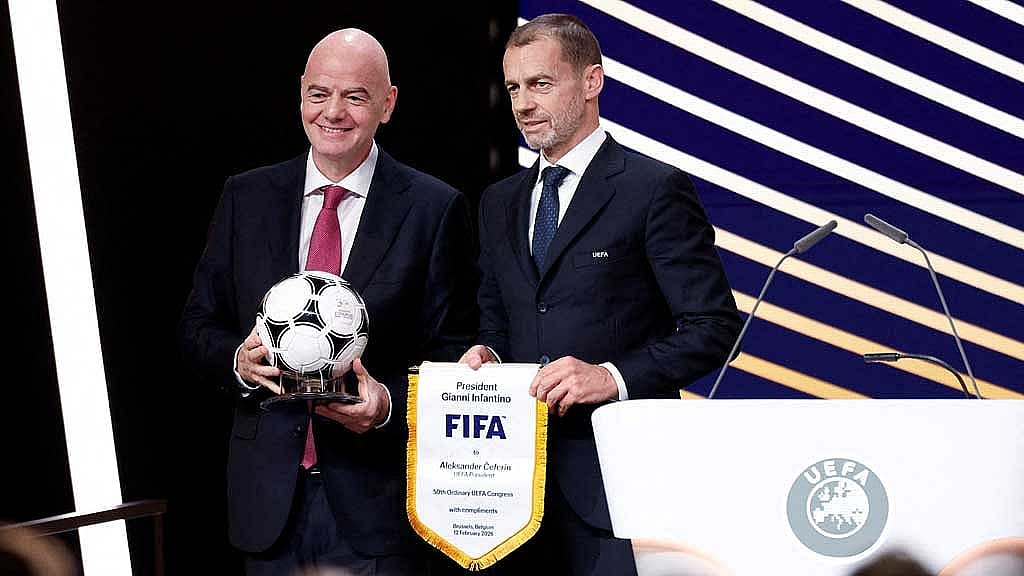
Infantino Should Retreat, but Europe Must Not Leave
The scale of UEFA’s opposition may force Infantino to reconsider. Without European participation, the commercial assumptions behind FIFA Forward Enterprise could collapse.
Backing down would be damaging for the FIFA president, particularly after presenting the deal directly to all 211 members. But the alternative could be a rupture from which world football might never fully recover.
UEFA is right that the World Cup should not be treated as an investment product.
It was built by generations of players, supporters and national teams. FIFA administers it, but FIFA did not create its meaning and does not possess an unlimited moral right to sell claims on its future income.
Yet Europe must also recognise that the World Cup does not belong to UEFA.
It belongs just as much to Africa, Asia, South America, the Caribbean, North and Central America and Oceania.
The challenge is therefore to defend the competition without attempting to reclaim control of it.
A boycott may be necessary as a threat. A permanent walkout would be an admission of political failure.
Europe’s task is not to leave the global game and establish a richer but smaller version of it. It is to remain, contest the electorate and build a coalition capable of preventing football’s greatest competitions from becoming another asset class.
Otherwise, both FIFA and UEFA may win control of their respective territories, and world football will lose the one thing neither can recreate alone: a game that still belongs to everyone.
[Biswadip Das is a senior editor at bdnews24.com]