Published : 24 Jul 2025, 07:32 AM
Updated : 21 Aug 2026, 01:33 PM


Leaders of several political parties have accused the interim government of bias and mismanagement following a high-profile meeting with Chief Advisor Muhammad Yunus, saying they were granted little time to voice concerns while “favouritism” towards certain groups undermines democratic parity.
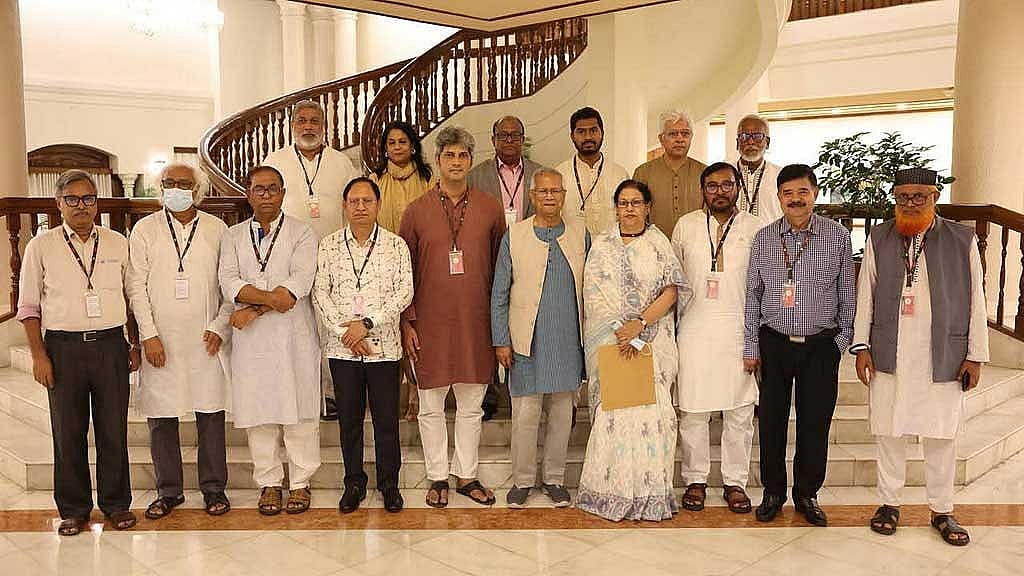
On Wednesday, Yunus met with representatives from 12 political parties and one alliance, just a day after holding talks with four others, including the Bangladesh Nationalist Party, the Jamaat-e-Islami, the Islami Andolan, and the National Citizen Party (NCP).
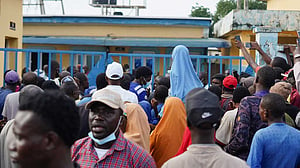
The back-to-back dialogues come amid heightened tensions following the Air Force jet crash at Milestone School and College, which sparked mass protests.
Wednesday’s attendees included leaders from Ganosamhati Andolon, Rashtro Songskar Andolon, Nagorik Oikya, AB Party, Gono Odhikar Parishad, Liberal Democratic Party, Khelafat Majlis, CPB, BaSaD, Gono Forum, JaSaD, Biplobi Workers Party, and the 12-party alliance.
The division of meetings into two separate rounds triggered discontent, with some leaders questioning why an unregistered party like the NCP was grouped with the BNP in the earlier session.
During the meeting, parties raised alarm over the government’s “weak posture,” accusing it of calling them only when facing crises. They criticised the slow pace of judicial and electoral reform and cited recent violent episodes in Gopalganj and Diabari as signs of systemic failure.
The participants demanded a clear electoral roadmap, regular consultations with all political parties, recognition of those killed and injured in the July Uprising, and decisive action against corruption and misgovernance.
AB Party Chairman Mojibur Rahman Bhuiyan Monju blamed the interim administration for deepening divisions among the parties after the fall of the Awami League government.
“Instead of building the national unity we needed after Hasina’s fall, we’ve seen a rift emerging, some treating this as a privilege while others feel isolated,” he said.
Monju argued that the government could have bridged this divide early on. “Yunus admitted this himself,” he said. “He has promised to hold more frequent meetings with parties ahead of the election.”
He warned against symbolic engagement, saying: “We’re only called when there’s trouble. And even then, in these large-format meetings, we get just a couple of minutes to speak.”
Monju cited widespread doubts over reform and electoral credibility. “Many parties criticised the government’s step-motherly treatment. Some are receiving protocol, others are being ignored. This isn’t how you build trust.”
LDP Secretary General Shahadat Hossain Salim, part of the 12-party alliance, echoed the frustration.
“We had very little time to speak,” he said. “We reiterated our call to reform the Advisory Council by appointing competent individuals. And we warned against the government being swayed by partiality.”
He cautioned that certain parties are using state protocol to attack others politically, fuelling division. “This is not healthy for the political environment.”
Revolutionary Workers Party General Secretary Saiful Haque was blunt.
“These meetings should have started the moment Yunus returned from London. The government’s delay in reaching out has created an unwanted situation,” he said.
He added that the government failed to inspire confidence through dialogue. “Despite being the most publicly supported government in history, the perception is that this interim authority is the weakest ever. As a result, a semi-anarchic state is unfolding.”
Gono Forum’s Mizanur Rahman painted a grim picture of institutional decay.
“After the Uprising, the country’s key institutions, civil administration, police, and judiciary, were in disarray. Despite promises, the interim government has failed to restore discipline in the last 11 months.”
Khelafat Majlis Secretary General Ahmad Abdul Quader accused the government of double standards.
“You called the first four parties and declared them ‘major’. Only after criticism did you invite us. Even today, not all parties were invited. This clearly shows inequality.”
Gono Odhikar Parishad President Nurul Haque Nur said all parties present in Wednesday’s meeting strongly protested against what they called “discriminatory behaviour and government bias.”
He questioned how the government determined which parties were “major”, noting that the NCP was grouped with the BNP.
“This raised serious objections, which many supported,” Nur said. “The government appears to be favouring the NCP.”
He warned that even a popular, post-Uprising government would lose public support if it appeared to lean in any direction. “Favouritism erodes credibility,” he said.