Published : 28 Jun 2026, 09:21 AM
Updated : 08 Sep 2026, 09:19 AM


A sudden wave of flags bearing the Kalema Tayyiba has spread across Bangladesh over the past two weeks, stirring debate over whether the display is an expression of faith or a political symbol with wider consequences.
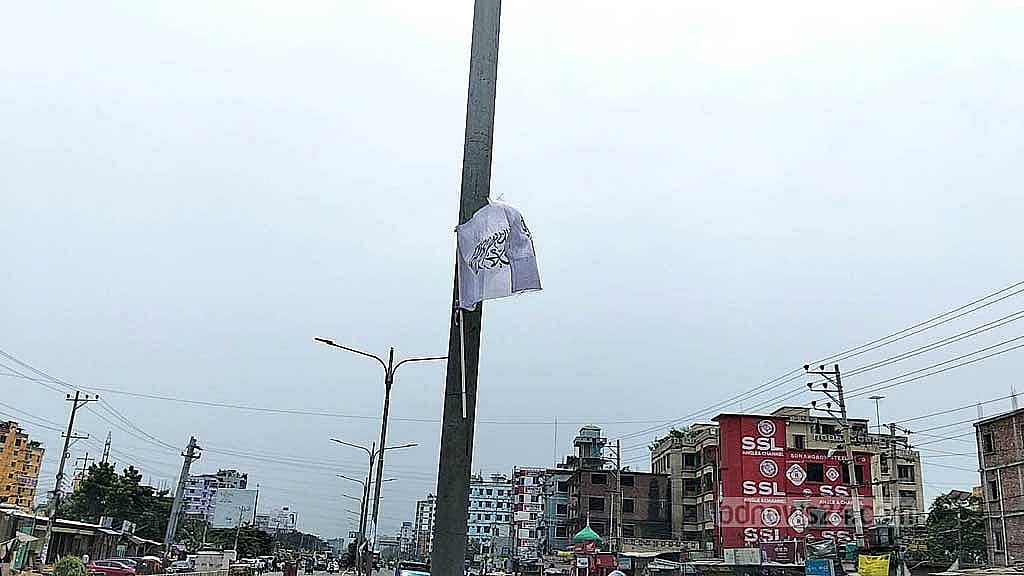
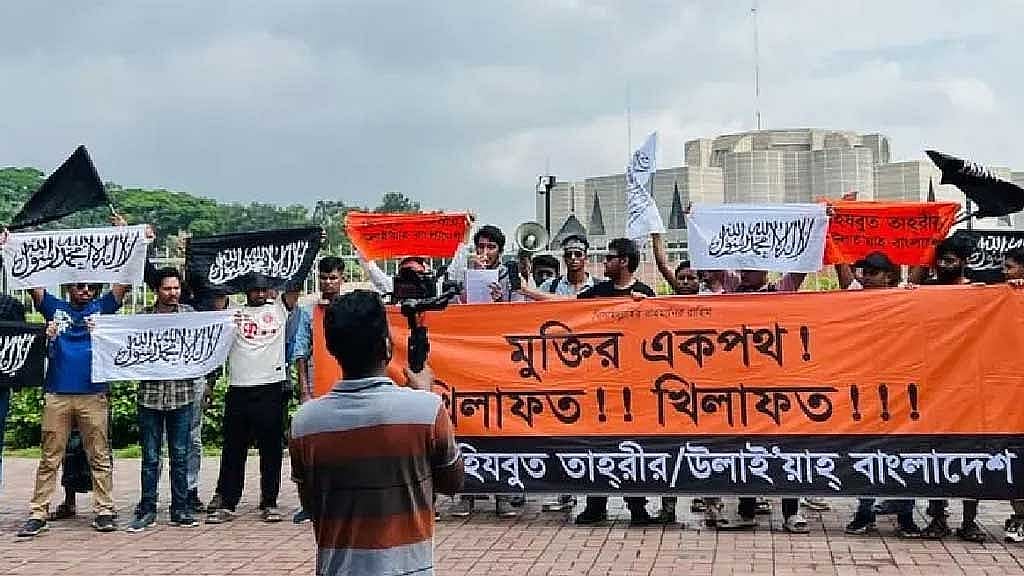
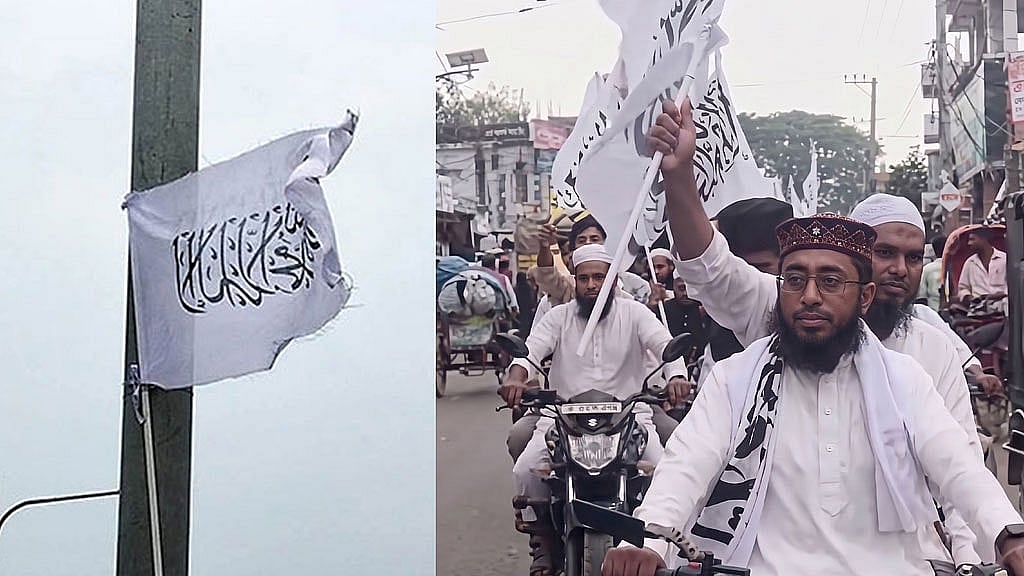
The flags, usually printed in white Arabic script on black or white cloth, have appeared on roads, bridges, and flyovers, while groups carrying them have marched in several districts and staged motorcycle processions.
Those promoting the flags argue that if Bangladeshis can fly the flags of Brazil or Argentina during football tournaments, there should be no objection to a flag bearing the Kalema. They frame the issue as a question of double standards: if foreign football flags can fill streets, rooftops, and flyovers without controversy, why should a religious declaration on a flag be treated differently?
But others, including security analysts and rights activists, say the issue is more complicated. They warn that similar imagery has been used by extremist groups in other parts of the world and could be exploited to portray Bangladesh as vulnerable to militancy.
Some have urged law-enforcing agencies to look into who is organising the campaign and why it has grown so rapidly.
From Scattered Appearances to Wider Campaign
Flags bearing the Kalema were seen in some protests, marches, and rallies after the fall of the Awami League government in the July Uprising on Aug 5, 2024. At the time, a few media outlets reported on the issue.
But the latest spread began in Dhaka and has since moved to other regions of Bangladesh. Roads, bridges and flyovers have been decorated with the flags, while processions have been held in several places.
In recent days, people have been seen carrying the flags in Dhaka, Narayanganj, Faridpur, Gopalganj and Bogura. In some places, the marchers identified themselves as “Tawhidi Janata”, or a loosely organised Islamist group that rallies under the banner of Islamic monotheism to defend what they perceive as religious values.
On Friday, a group marched in Sherpur of Bogura under the banner of “Tawhidi Janata” to protest against what they described as the “removal and insult” of Kalema flags from Jatrabari flyover in Dhaka.
Bangladesh’s red and green national flag and the Palestinian flag were also seen in the procession.
Last year, groups using the name “Tawhidi Janata” were accused of attacks on shrines, Sufi establishments and Baul gathering places. It could not be confirmed whether those groups and the recent marchers using the same label are connected.
A Sacred Phrase, A Contested Symbol
The Kalema Tayyiba is central to Islamic faith. It declares: “There is no god but Allah, and Muhammad is the Messenger of Allah.”
But in recent decades, extremist groups including al-Qaeda, Islamic State and Boko Haram have used the Kalema in their visual branding. Black flags bearing white Arabic script have become associated in parts of the world, particularly in the United States and Europe, with militant movements.
That association is one reason some observers in Bangladesh are concerned.
They say the phrase itself is not in question, but the design, context, and organised public use of the flag could create risks at a time when Bangladesh is dealing with economic pressure and trying to protect trade, diplomacy, and the interests of Bangladeshis abroad.
At a time of economic strain, they warn, any attempt to cast Bangladesh as a country sliding towards extremism could hurt trade and diplomatic ties, while Bangladeshis living overseas could also face difficulties if the country is branded negatively.
Flags on Sale Online
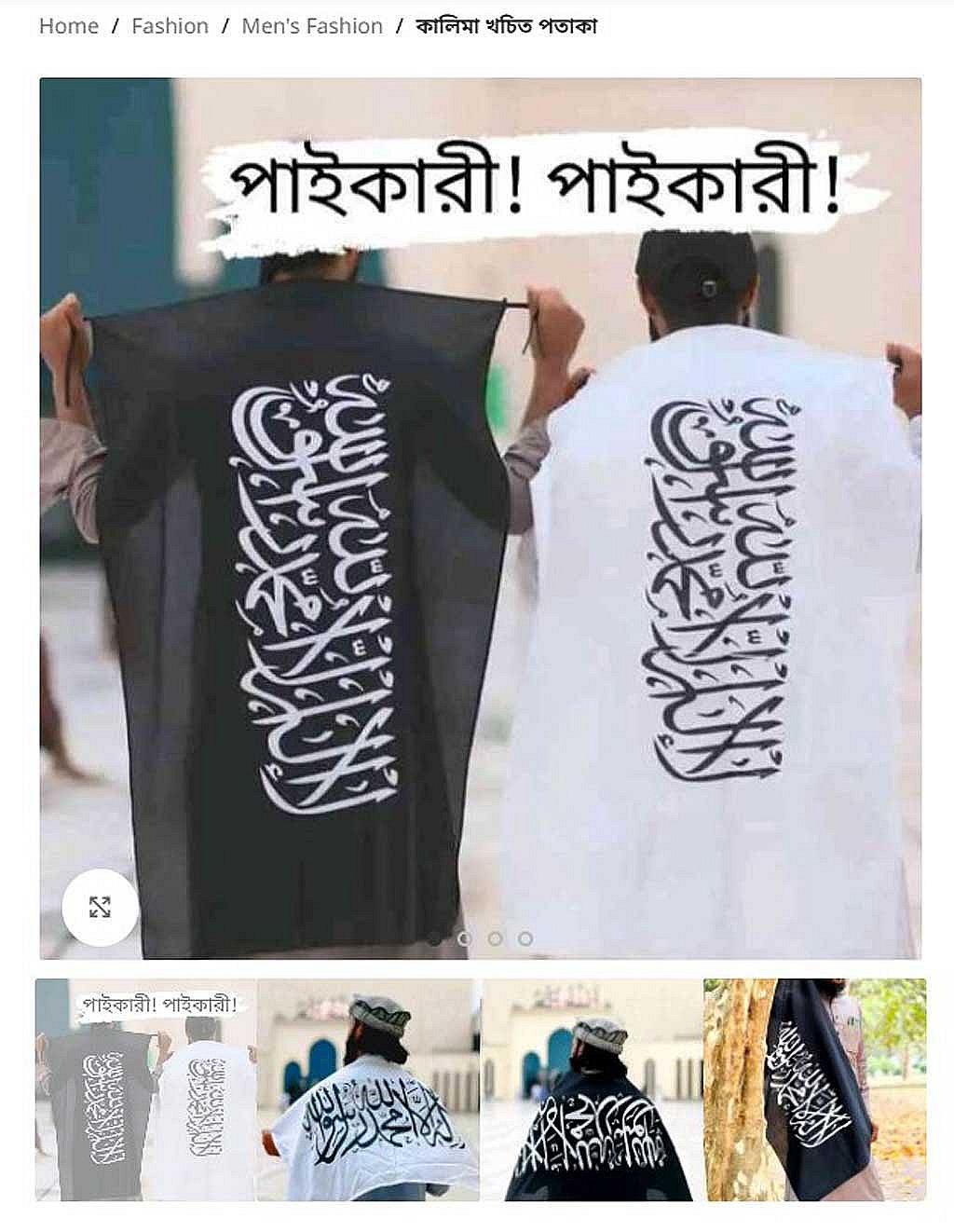
Flags bearing the Kalema are also being sold on Facebook pages and online marketplaces, with prices ranging from Tk 110 to Tk 330, depending on size.
Several religion-based pages on Facebook have promoted the flags, saying Hifazat-e Islam leader Mufti Harun Bin Izhar is in support of flying them.
Photocards claiming that Harun had encouraged people to spread the flags have circulated widely online. He could not be reached for comment by phone.
In a video circulated by a Facebook channel named Masuk Media, Mufti Harun Izhar is heard saying young people had begun putting up Kalema flags and that these should be placed everywhere.
He argued that if such flags were treated as militancy, then the flags of Argentina and Brazil should also have to come down. “If this is militancy, then the Argentina and Brazil flags must also be taken down,” he said in the video. “If those flags remain, our Kalema flags will remain too.”
In another video of a sermon delivered at a Chattogram mosque and shared on his own Facebook page, Mufti Harun said people needed to understand the matter strategically.
He asked whether every Kalema flag automatically meant Islamic State or the Taliban, and said some young people may be using designs familiar from online images of the Taliban and other groups.
Mufti Harun Izhar also said people could make more colourful versions of such flags, and dismissed some of the anxiety around the issue as "unnecessary". He described fears over the flags as excessive, arguing that people were turning a religious symbol into a source of alarm.
Writers Urge Cautio
Islamic writer Faruk Ferdous wrote on Facebook that the question was not about the Kalema itself.
He said the Bangladesh Army also uses flags containing the Kalema or Quranic verses. The concern, he wrote, was about specific designs that resemble the flags of certain foreign groups and could be used for dangerous propaganda.
Another Islamic writer, Manzurul Haque, wrote that people should not panic merely at the sight of a flag bearing the Kalema.
He pointed out that the Saudi flag also contains the Kalema, while Iran’s flag contains the word “Allah”.
In Manzurul's view, the “Kalema flag” is primarily a political symbol, and its use has more to do with promoting the political ideology of the bearers than establishing Islam.
Manzurul also argued that there is no strong narration proving that the Prophet’s flag carried the written Kalema. He said historical references suggest the practice of writing Islamic messages or the Kalema on flags began during the Abbasid era.
“As far as I know, there is no strong narration that the Prophet’s flag had the Kalema written on it,” Manzurul wrote. “The narration found in Al-Tabarani is considered weak by Imam Ibn Hajar.”
He said historical accounts suggest that the practice of writing Islamic messages or the Kalema on flags began during the Abbasid period, rather than in the earliest period of Islam.
Citing an early Islamic precedent, he wrote that even true words can be used for questionable purposes if the motive behind them is political.
Manzurul referred to the Kharijites, who raised the Quran on the tips of spears and declared, “La hukma illa lillah” -- meaning that judgment belongs only to Allah. He recalled that Ali (RA) responded with the famous saying: “Kalimatun haqqin urida biha al-batil” -- words of truth being used for a false purpose.
His point was that a sacred phrase can be used sincerely by believers, but it can also be turned into a political instrument depending on who carries it, how it is displayed and what purpose it serves.
What Lies Behind The Campaign?
Some observers fear that if the widespread display of these flags is interpreted by Western countries as a sign of rising extremism, Bangladesh’s trade relations and the position of Bangladeshis living abroad could be affected.
They say the concern is sharper because Bangladesh is already under economic pressure, and a negative international label could carry real costs for exports, investment, diplomacy and migrant workers.
A Dhaka Metropolitan Police counterterrorism official, speaking on condition of anonymity, said the unit had not yet been instructed to work on the issue.
“We are watching it,” the official told bdnews24.com.
“It seems a group is trying to bring some behaviour or culture of foreign extremist groups into the mainstream. It appears they are very carefully trying to gain the moral support of ordinary religious people in the name of the Kalema.”
Rights activist Nur Khan, who was a member of the commission formed during the interim government to investigate enforced disappearances, said the main question was how the flag was being used.
“If ordinary Muslims fly this flag, there is nothing to say,” Nur said. “But there are enough reasons to fear that a group has entered into a symbolic battle to consume society with an extremist political idea.”
He warned that if the flag was used as a symbol to spread extremist ideology, it could damage Bangladesh’s international relations, including trade.
Such a perception, he suggested, could also expose Bangladeshis abroad to suspicion or difficulty if the country’s image is deliberately recast through this symbolism.
Security analyst M Sakhawat Hossain, a former advisor to the interim government, said security agencies should examine who is behind the campaign.
He said the argument comparing these flags with Argentina or Brazil flags did not fully apply, because this flag is seen internationally as symbolic of certain groups and has been used by several organisations known under different names. Unlike football flags, he said, this particular design carries an international security context that cannot be ignored.
Sakhawat also referred to recent allegations by an Israeli diplomat posted in India about Hamas activity in Bangladesh.
“At this time, this kind of activity involving the flag needs to be looked into,” he said. “Whether someone is trying to portray Bangladesh again as a disorderly state, or create that kind of identity for it, I cannot say. But I think this should be examined.”
Law-enforcing agencies have so far remained publicly silent on the issue. Officials declined to comment formally.